How to Utilize a Professional Contract Review Service for USA Commercial Property Purchase Agreements in 2026

Acquiring commercial real estate is often one of the largest capital outlays a growing business will ever make. Whether you are purchasing an office building, a retail storefront, or industrial warehouse space, entering into a purchase and sale agreement without an independent legal assessment exposes your company to severe operational and financial liabilities. Utilizing a dedicated contract review service before waiving contingencies ensures that critical deal terms, title commitments, and inspection rights work in your favor rather than locking you into costly pitfalls.
The commercial real estate market in the United States continues to see significant capital movement. Full-year 2025 U.S. commercial real estate transaction volume reached $560.2 billion, up 14.4% year over year, with 176,445 properties transacted. With higher transaction values and tighter underwriting conditions across US lending institutions, buyers cannot afford ambiguous contract language that jeopardizes their earnest money deposits or clouds property ownership.
A professional legal review goes far beyond spotting typos. It evaluates every clause through the lens of deal risk, state-specific property law, and financial protection. Understanding how a contract review service operates empowers founders and small-business owners to negotiate from strength, safeguard their capital, and close on schedule.
Table of Contents
- Quick Summary
- What a Commercial Property Contract Review Service Actually Covers
- Why Generic Proofreading Fails in Commercial Real Estate
- Step-by-Step: How to Prepare for and Navigate a Contract Review
- State-Specific Nuances and Real Estate Jurisdiction in the USA
- Common Traps Buyers Overlook in Commercial Property Contracts
- Secure Your Next Commercial Acquisition with Confidence
- Frequently Asked Questions
- Recommended
Quick Summary
| Takeaway | Explanation |
|---|---|
| Risk Mitigation | A legal review identifies hidden liabilities, title defects, and restrictive zoning before earnest money becomes non-refundable. |
| Custom Negotiation | Real estate attorneys translate complex boilerplate into redlined edits and actionable negotiation leverage. |
| Financial Protection | Clear financing, appraisal, and inspection contingencies protect your deposit if property conditions fall short. |
| Jurisdictional Compliance | Review ensures terms conform with state-specific conveyance laws, disclosure rules, and local closing customs. |
| Turnaround Speed | Modern flat-fee legal platforms typically deliver comprehensive redlines and feedback within 2 to 3 business days. |
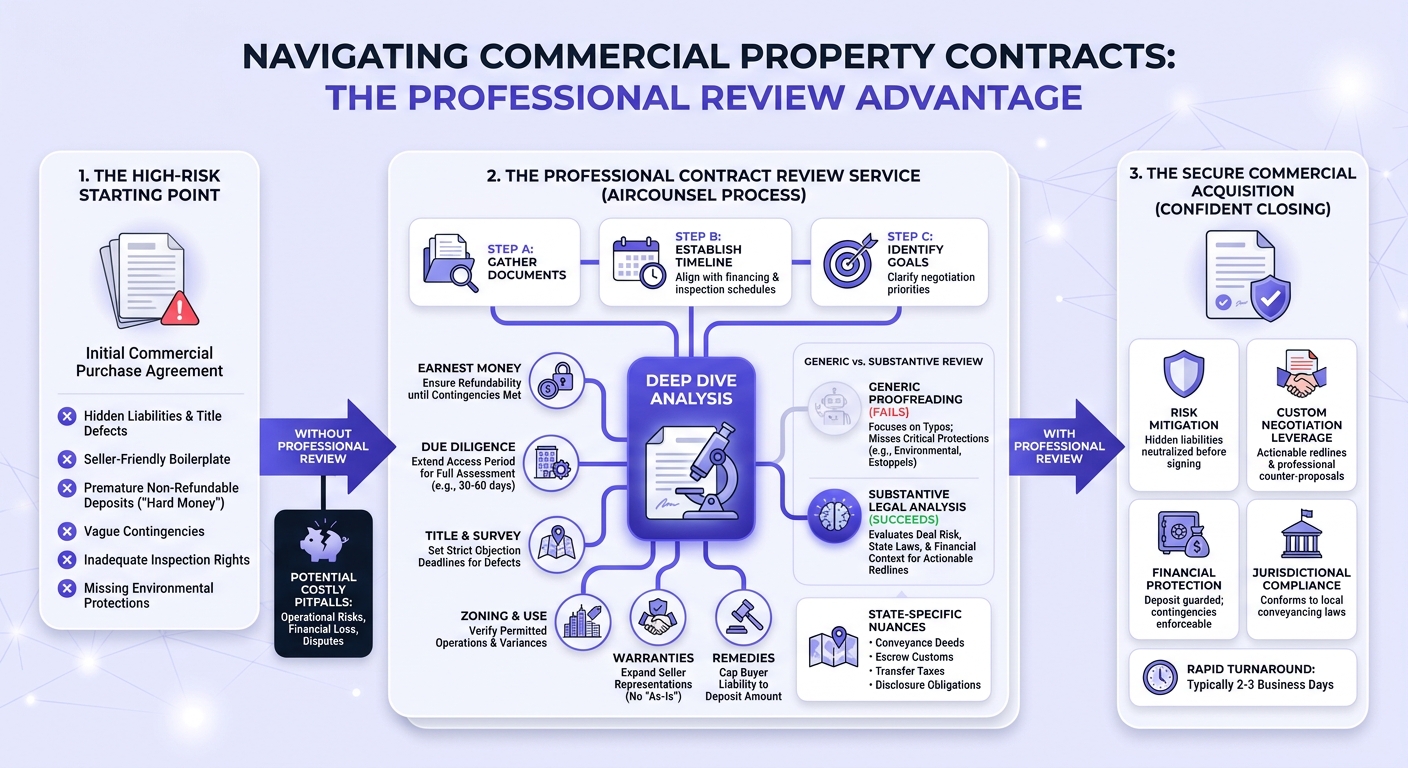
What a Commercial Property Contract Review Service Actually Covers
A commercial property purchase agreement is a legally binding contract defining how real estate, physical improvements, and associated rights transfer between parties. Unlike residential transactions, which frequently rely on standardized state board forms with statutory consumer protections, commercial purchase agreements are heavily negotiated and usually drafted to favor whichever party prepared them.
Engaging a contract review service provides an exhaustive analysis of the agreement's terms, ensuring that representations, warranties, and closing mechanics align with your business goals.
Key Contract Clauses Under the Microscope
A thorough legal review examines both the primary transaction terms and the ancillary obligations tucked away in standard boilerplate language:
- Purchase Price and Earnest Money: Defines deposit amounts, escrow holder instructions, release conditions, and whether deposits become non-refundable ("hard money") before all contingencies are satisfied.
- Due Diligence and Feasibility Periods: Establishes your explicit right to inspect physical structures, review financial operating records, perform environmental studies, and terminate the deal at your sole discretion without forfeiture.
- Title and Survey Contingencies: Sets strict deadlines for objecting to easements, liens, encroachments, and municipal land-use restrictions revealed in title commitments.
- Zoning and Permitted Use: Confirms whether the property's municipal zoning designation permits your intended business operations without requiring special variances or conditional use permits.
- Representations and Warranties: Analyzes the seller's explicit statements regarding structural defects, hazardous materials, pending litigation, lease statuses, and tax assessments.
- Default and Remedies: Limits seller remedies in the event of buyer default to the earnest money deposit, eliminating the threat of specific performance lawsuits or excess monetary damages.
- Indemnification and Post-Closing Liabilities: Restricts post-closing liability survival periods and places financial caps on indemnity claims between buyer and seller.
| Contract Clause | Standard Seller-Friendly Draft | Buyer-Protective Target Language |
|---|---|---|
| Due Diligence Period | 15 days; buyer pays non-refundable fee; limited property access. | 30–60 days; full access for engineering, Phase I environmental, and lease audit; right to terminate for any reason. |
| Earnest Money | Becomes non-refundable immediately upon contract execution. | Remains fully refundable in escrow until the end of the due diligence period. |
| Seller Warranties | Property sold entirely "as-is" with zero express representations. | Seller warrants no unrecorded liens, no hazardous substances, and no pending code violations. |
| Default Remedies | Seller can sue for specific performance and consequential damages. | Liquidated damages strictly capped at the existing earnest money deposit. |
| Closing Conditions | Buyer must close regardless of tenant defaults or minor damage. | Closing contingent on clear title, clean estoppels, and property maintained in existing condition. |
Why Generic Proofreading Fails in Commercial Real Estate
Founders and operators sometimes assume that reading a contract carefully or using basic automated grammar checkers is sufficient. However, commercial contracts require substantive legal analysis, not simple proofreading.
Generic review tools cannot detect missing protections, such as the absence of a Phase I Environmental Site Assessment contingency or the omission of an estoppel certificate requirement for existing commercial tenants. Under the guidelines of programs like the U.S. Small Business Administration 504 and 7(a) real estate loan programs, lenders demand rigorous due diligence, environmental clearances, and clear title before disbursing acquisition funds. A missing clause in your purchase agreement can stall financing and trigger a default under tight contractual timelines.
When you work with an experienced real estate attorney, they evaluate the entire transaction context: your debt financing schedule, your entity structure, and your local operating environment.
Step-by-Step: How to Prepare for and Navigate a Contract Review
To maximize value and speed up the review process, approach your contract review methodically.

Step 1: Gather Core Deal Documents
Assemble all relevant documents before submitting them to your legal team. These include the primary purchase and sale agreement, draft escrow instructions, existing leases, preliminary title commitments, property surveys, and any letters of intent (LOIs) signed during preliminary talks.
Step 2: Establish Your Due Diligence Timeline
Mark key milestones against your internal financing and inspection schedules. If your lender needs 45 days to complete commercial appraisal and underwriting, an agreement granting only a 21-day finance contingency must be modified immediately.
Step 3: Identify High-Risk Deal Terms and Negotiation Goals
Clarify your deal priorities. Are you planning structural renovations that require immediate municipal permit verifications? Do you need seller rent concessions during transitions? Documenting these objectives helps your legal counsel craft targeted redlines rather than theoretical edits. For broader operational contracts, you can also explore our guide on using a contract review service for high-stakes supplier agreements.
Step 4: Redline, Negotiate, and Finalize
Your attorney will deliver an annotated version of the contract with redline adjustments and a summary memorandum explaining risks in plain English. Use these redlines to present a clean, professional counter-proposal to the seller or broker, maintaining leverage while keeping the closing timeline on track.
State-Specific Nuances and Real Estate Jurisdiction in the USA
Commercial real estate is predominantly governed by state statutory frameworks and local municipal codes. While general principles of contract law apply across the country, local rules create significant variations in how contracts must be structured.
- Conveyance Deeds: States differ on the standard deed types used to convey commercial property. Some jurisdictions default to Special Warranty Deeds (or Limited Warranty Deeds), while others utilize General Warranty Deeds or Bargain and Sale Deeds with covenants.
- Escrow and Closing Customs: In western US states, transactions generally close through independent escrow and title companies. In northeastern and southern states, closing attorneys often manage settlements and issue title policies directly.
- Transfer Taxes and Recording Fees: State and municipal transfer taxes can range from negligible fees to several percentage points of the total purchase price. Your purchase agreement must clearly specify which party pays these costs.
- Disclosure Obligations: Commercial sellers rarely have the statutory disclosure mandates required in residential real estate. Caveat emptor ("let the buyer beware") often applies, making robust contractual representations and warranties essential.
Common Traps Buyers Overlook in Commercial Property Contracts
Without a trained legal assessment, small-business buyers routinely fall into contractual traps that result in lost deposits or expensive disputes:
- Inadequate Casualty and Condemnation Provisions: Failing to specify who bears the risk if the building suffers fire damage or eminent domain taking prior to closing.
- Vague Estoppel Requirements: Neglecting to require signed tenant estoppel certificates, leaving you vulnerable to unrecorded lease disputes or rent withholding after taking ownership.
- Automatic Deposit Releases: Agreeing to clauses that automatically wire earnest money to the seller before title objections are resolved.
- Short Survival Clauses: Accepting seller warranty survival windows of 30 or 60 days, leaving no recourse if structural defects or undisclosed environmental issues emerge six months later.
- Missing Assignment Rights: Lacking the flexibility to assign the purchase agreement to a newly formed holding company, such as a single-purpose LLC, before closing.
Secure Your Next Commercial Acquisition with Confidence
Entering into a commercial real estate purchase without dedicated legal representation exposes your business to unnecessary operational risk and capital loss. A professional contract review gives you clear visibility into every clause, ensuring your earnest money is protected, contingencies are enforceable, and potential liabilities are neutralized before you sign.
AirCounsel delivers rapid, fixed-fee legal support from licensed US attorneys who understand commercial property transactions. Protect your acquisition timeline, secure transparent pricing, and avoid surprise liabilities by having our experienced attorneys review your purchase agreement.
- Get started with our Real Estate Contract Review to safeguard your property purchase.
- Need a broader legal assessment? Choose our general Review of your Contract or Legal Document.
- Enhance your transaction leverage with professional attorney-led Negotiation Support.
Frequently Asked Questions
What does a contract review service check in a commercial property purchase agreement?
A contract review service evaluates critical legal and business terms, including earnest money refundability, due diligence inspection rights, title and survey objection procedures, financing contingencies, zoning compliance, environmental representations, indemnities, and default remedies.
Do I need a lawyer to review a commercial real estate purchase agreement in the USA?
While real estate brokers can facilitate negotiations and provide standard forms, they cannot provide legal advice or draft custom protective clauses. A licensed real estate attorney ensures the contract protects your specific financial assets and aligns with state property laws.
What are the biggest risks buyers miss in commercial property contracts?
The most frequent blind spots include short inspection windows, hard earnest money deposits released prematurely, lack of tenant estoppel requirements, restrictive assignment clauses, and clauses that waive seller liability for environmental or structural defects.
How long does a professional contract review usually take before closing?
With modern legal platforms like AirCounsel, a standard commercial property contract review is typically completed within 2 business days, with express same-day options available for time-sensitive contract deadlines.
Recommended
Need Legal Assistance?
Our expert legal team is ready to help you navigate complex legal matters with confidence.