The 2026 Guide to Using a Contract Review Service for High-Stakes Supplier Agreements

Signing a vendor or supplier contract without professional oversight is one of the fastest ways for a growing company to compromise cash flow and operational stability. When managing high-stakes supply chains, unexpected price increases, vague delivery schedules, and one-sided indemnities can quickly erode profit margins. Utilizing a specialized contract review service ensures that founders and operators uncover hidden legal exposures before binding their business to restrictive terms.
According to data from the U.S. Bureau of Labor Statistics, intermediate supply-chain price swings have fluctuated by over 11% in volatile procurement categories, creating significant cost uncertainty for commercial buyers who lack robust price-adjustment caps.
Modern businesses no longer need to accept traditional legal bottlenecks or open-ended hourly fees to protect their operations. On-demand, flat-fee contract review delivers attorney-backed redlines, prioritized risk assessments, and practical commercial fallbacks within hours, allowing operators to sign supplier deals with total confidence.
Table of Contents
- Understanding What a Contract Review Service Delivers
- Core Risks in High-Stakes Supplier Agreements
- Key Components of an Actionable Contract Review
- When to Escalate to an Attorney Review
- US Contract Law Factors in Supplier Deals
- Comparing Review Methods: Costs and Timelines
- Protect Your Operations Before You Sign
- Frequently Asked Questions
- Recommended
Quick Summary
| Takeaway | Explanation |
|---|---|
| Pre-Signature Risk Screening | Identifies ambiguous liability caps, unilateral termination clauses, and hidden cost drivers. |
| Actionable Redlines | Delivers precise contract language and fallback positions ready to send back to the vendor. |
| Cost and Timeline Predictability | Fixed fees starting at $250 with turnaround times between 4 hours and 2 business days. |
| Plain-English Guidance | Eliminates dense legal jargon so founders understand exact operational and financial exposures. |
| Enforceability Protection | Ensures compliance with state-level commercial laws and Uniform Commercial Code (UCC) defaults. |
Understanding What a Contract Review Service Delivers
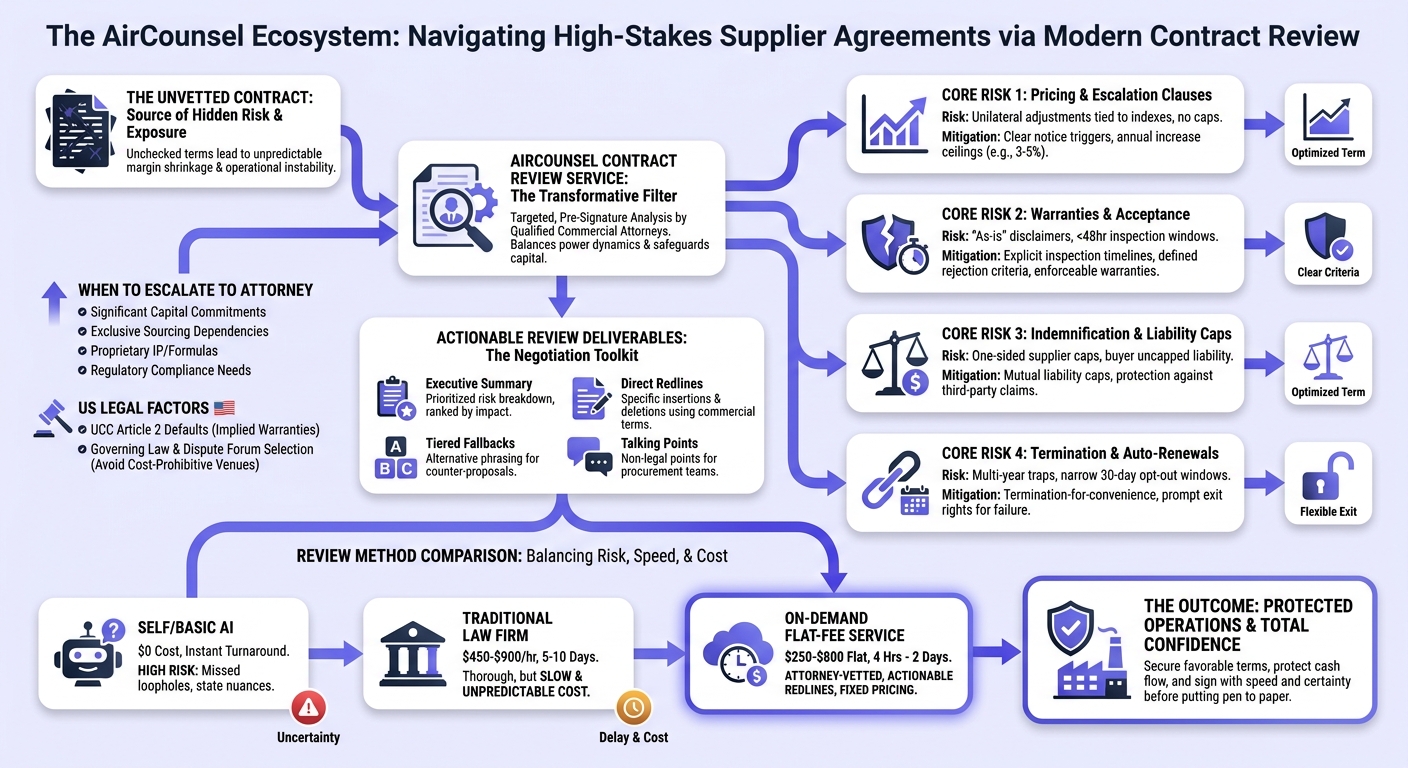
A commercial contract review service provides targeted, pre-signature analysis of legal agreements to identify commercial risks, clarify vague terminology, and propose balanced contract revisions. Rather than relying on rigid templates or generic legal opinions, an on-demand review service focuses on the specific commercial context of your transaction.
When you submit a supplier or vendor agreement for review, a qualified commercial attorney screens the document from start to finish. The primary objective is to balance power dynamics that typically favor the drafting vendor, safeguarding your operating capital and customer fulfillment obligations.

Core Risks in High-Stakes Supplier Agreements
Vendor-drafted agreements are almost always structured to protect the supplier while placing performance, delay, and financial burdens onto the buyer. A thorough review targets four high-risk operational areas.
Pricing and Price Escalation Clauses
Suppliers frequently insert clauses permitting unilateral price adjustments tied to raw material indexes, shipping surcharges, or inflation. Without clear advance-notice triggers and price increase ceilings (such as capping annual adjustments at 3% to 5%), buyers risk unpredictable margin shrinkage.
Warranties and Acceptance Criteria
Standard vendor contracts often include aggressive "as-is" disclaimers or limit inspection windows to 48 hours or less. A proper review ensures your agreement defines explicit inspection timelines, clear criteria for rejecting defective goods, and enforceable repair-or-replace warranties.
Indemnification and Liability Caps
Suppliers routinely cap their own liability at the total amount paid over the preceding 30 days while leaving the buyer's liability uncapped. Legal review aligns these provisions, ensuring mutual liability caps and protecting your business against third-party intellectual property or product liability claims.
Termination Rights and Auto-Renewals
Hidden auto-renewal clauses can trap your business in multi-year agreements with narrow 30-day opt-out windows. Reviewing attorneys ensure you retain termination-for-convenience options and prompt exit rights if the supplier fails to meet core service levels.
Key Components of an Actionable Contract Review
A professional review deliverable goes beyond highlighting problematic sentences; it provides a comprehensive toolkit for negotiation.
- Plain-English Executive Summary: A prioritized breakdown of critical legal risks, ranked by business impact and probability.
- Direct Document Redlines: Specific tracked-change insertions and deletions using standard commercial terminology.
- Tiered Fallback Positions: Alternative phrasing to propose if the supplier rejects your initial redline edits.
- Negotiation Talking Points: Non-legal talking points your procurement or operations team can use during vendor discussions.
When to Escalate to an Attorney Review
While low-cost, off-the-shelf software subscriptions may carry minimal downside, complex commercial contracts demand legal scrutiny. You should engage an attorney whenever a contract involves significant capital commitments, exclusive sourcing dependencies, proprietary product formulas, or regulatory compliance requirements.
To evaluate broader vendor vulnerabilities across your operations, read our guide on the small business supplier risk checklist to determine when external legal intervention is essential.
US Contract Law Factors in Supplier Deals
In the United States, commercial sales of goods are primarily governed by Article 2 of the Uniform Commercial Code, which sets default rules for implied warranties, risk of loss, and standard remedies unless explicitly modified by written contract terms.
Additionally, governing law and dispute forum selection clauses determine where and how legal conflicts must be resolved. A contract designating distant state courts or mandatory arbitration can make routine dispute enforcement cost-prohibitive for small businesses. Aligning terms with guidance from the Small Business Administration contracting resources ensures federal and state commercial standards are respected.
Comparing Review Methods: Costs and Timelines
Choosing the right contract review workflow depends on balancing legal risk, speed, and budget constraints.
| Review Method | Typical Cost | Turnaround Time | Risk Assessment Quality |
|---|---|---|---|
| Self-Review or Basic AI | $0 | Instant | High risk of missed legal loopholes and state nuances |
| Traditional Law Firm | $450–$900/hr | 5–10 business days | Thorough, but unpredictable total cost and slow execution |
| On-Demand Flat-Fee Service | $250–$800 flat | 4 hours–2 business days | Attorney-vetted, actionable redlines with fixed pricing |
Protect Your Operations Before You Sign
Securing reliable supplier terms should not require weeks of administrative back-and-forth or opaque legal bills. With fast turnaround times and upfront pricing, you can protect your cash flow and secure favorable commercial terms before putting pen to paper.
Ensure your agreements are fully vetted by ordering a Review of your Contract or Legal Document today, or secure experienced counsel to interface directly with counterparties through our Negotiation Support package.
Frequently Asked Questions
What does a contract review service typically check in a supplier agreement?
A contract review evaluates payment terms, price increase mechanics, delivery obligations, warranties, acceptance and rejection procedures, liability limitations, indemnities, intellectual property protections, termination conditions, and dispute resolution venues.
When should a small business use an attorney instead of self-review or AI-only review?
A small business should engage an attorney when a contract carries high financial liability, impacts core revenue generation, involves custom intellectual property, or includes complex indemnification obligations that automated tools frequently misunderstand.
How fast can an on-demand contract review turn around a supplier agreement?
Standard on-demand contract reviews are typically completed within 2 business days, with express review options delivering attorney redlines and actionable feedback in as little as 4 business hours.
What are the most common red flags in vendor or supplier contracts for SMBs?
The most frequent red flags include unilateral price escalation clauses, strict limitations on vendor liability, short windows for defect reporting, broad non-solicitation restrictions, and automatic renewal traps with narrow cancellation windows.
Recommended
Need Legal Assistance?
Our expert legal team is ready to help you navigate complex legal matters with confidence.