The US Founder’s Guide to Custom Contract Drafting for Delaware C-Corp Seed Rounds

Raising a seed round is a defining milestone for early-stage ventures. Yet, moving from an agreed term sheet to cleared wire transfers requires rigorous legal architecture. Relying on generic, unvetted templates often creates capitalization table errors, unassigned intellectual property disputes, and costly regulatory friction during institutional due diligence.
Professional custom contract drafting ensures your Delaware C-Corporation satisfies sophisticated investor expectations while preserving founder control and long-term equity value. According to the U.S. Securities and Exchange Commission, over 90% of early-stage private capital raises rely on Regulation D exemptions, which require strict investor representation terms, board authorizations, and timely federal filings.
Whether you are issuing Simple Agreements for Future Equity (SAFEs), convertible promissory notes, or priced Series Seed preferred stock, tailored legal drafting aligns your corporate governance with your exact commercial strategy.
Table of Contents
- Pre-Seed Foundation: Delaware Formation Readiness
- Core Seed Financing Instruments: SAFE vs Convertible Note vs Priced Equity
- Key Negotiation Variables Founders Must Navigate
- Federal Securities Law and Delaware Governance Compliance
- Step-by-Step Custom Contract Drafting Workflow
- Common Pitfalls in DIY Startup Agreements
- Streamline Your Seed Financing with AirCounsel
- Frequently Asked Questions
- Recommended
Quick Summary
| Takeaway | Explanation |
|---|---|
| Clean Governance First | Ensure authorized shares, bylaws, and initial board consents comply with the Delaware General Corporation Law before accepting investor capital. |
| Secure Core IP | Execute comprehensive proprietary information and invention assignment agreements for all founders, employees, and contractors prior to closing. |
| Choose the Right Instrument | Select between SAFEs, convertible notes, or priced preferred equity based on dilution impact, execution speed, and investor profile. |
| Securities Compliance | Structure offerings under Regulation D Rule 506(b) or 506(c) and file SEC Form D within 15 calendar days of the first sale. |
| Custom Drafting Prevents Traps | Tailored terms prevent conflicting side letters, uncontrolled board expansion, and problematic liquidation stacking. |
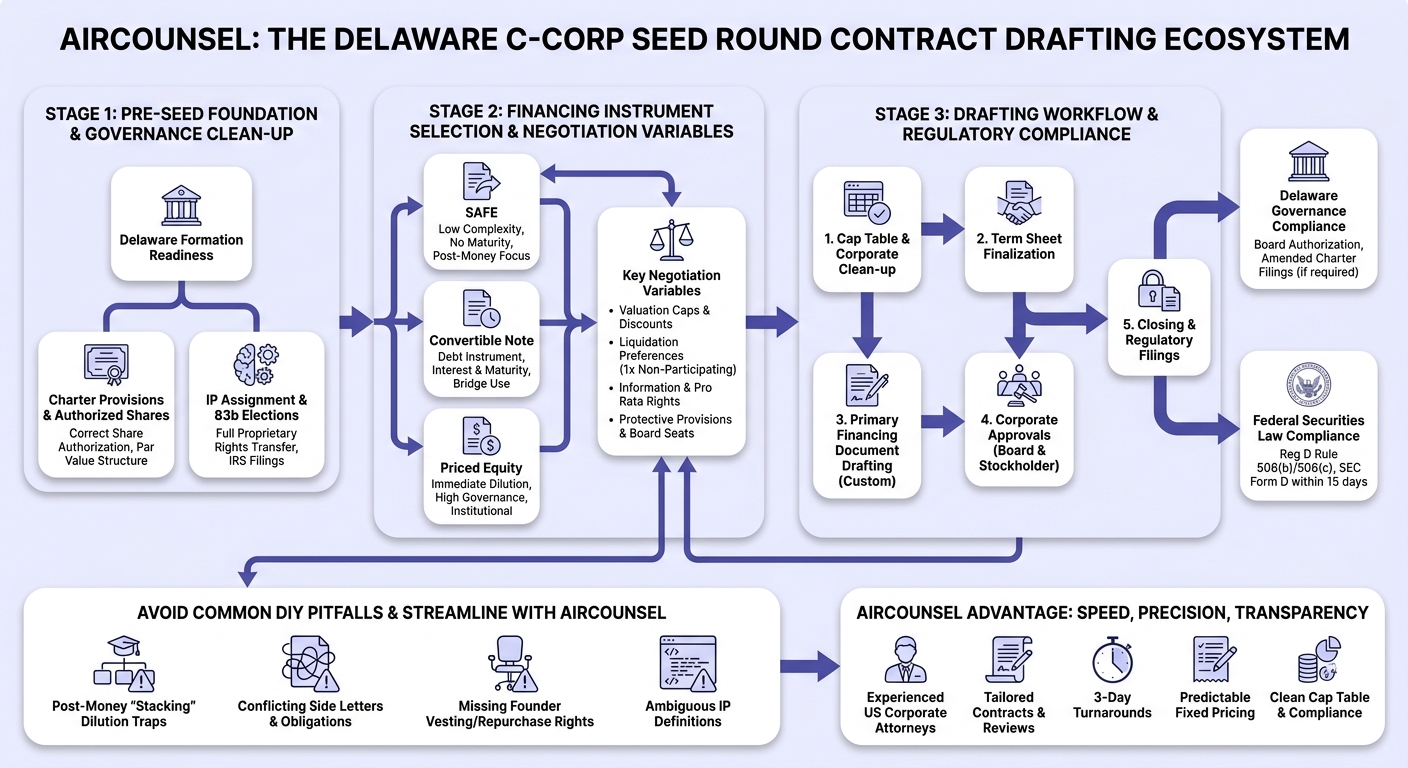
Pre-Seed Foundation: Delaware Formation Readiness
Before drafting investor-facing financing contracts, founders must ensure the corporation's underlying legal foundation is fully organized and compliant. Institutional angel groups and venture funds conduct due diligence on your initial corporate records before executing transaction documents.
Charter Provisions and Authorized Shares
Under Delaware law, a corporation can only issue shares that have been explicitly authorized in its Certificate of Incorporation. If your initial charter only authorized 1,000 common shares with no par value, you cannot issue millions of shares to founders, set up an equity incentive pool, or reserve shares for future convertible instrument conversions without filing an amended charter.
A standard venture-ready setup typically includes 10,000,000 authorized shares of common stock with a par value of $0.0001 per share. This par value structure also helps minimize the annual Delaware franchise tax calculated under the Assumed Par Value Capital Method.
IP Assignment and 83b Elections
All code, designs, business plans, and domain names created prior to incorporation must be formally assigned to the corporate entity. A complete Custom IP Assignment Agreement ensures that the company—not individual founders—owns the core assets.
Additionally, when founders receive restricted stock subject to vesting schedules, each founder must file a Section 83(b) election with the IRS within 30 days of stock receipt. Missing this statutory deadline can trigger massive income tax liabilities as the company's valuation rises over time.
Core Seed Financing Instruments: SAFE vs Convertible Note vs Priced Equity
Choosing the right transaction structure depends on your fundraising target, deal timeline, and cap table complexity. Each mechanism carries distinct legal mechanics that require precise custom contract drafting.
| Instrument Type | Dilution Timing | Governance Complexity | Documentation Required | Best Use Case |
|---|---|---|---|---|
| Post-Money SAFE | Converts at next priced round | Low (no board seat or debt maturity) | SAFE Agreement, Board Consent | Fast, early angel checks under $2,000,000 |
| Convertible Promissory Note | Converts at qualified financing or maturity | Medium (interest accrual and maturity date) | Note Purchase Agreement, Promissory Note, Board Consent | Bridge rounds or debt-oriented angel syndicates |
| Priced Preferred Seed Round | Immediate equity dilution | High (voting agreements, board rights) | Stock Purchase Agreement, Amended Charter, Investor Rights Agreement | Institutional seed raises of $3,000,000 or more |
Key Negotiation Variables Founders Must Navigate
Every seed financing negotiation revolves around balance-of-power terms that dictate economic outcomes and operational control:
- Valuation Caps and Discounts: A valuation cap sets the maximum effective valuation at which an investor's convertible instrument converts into equity. Tailored drafting ensures whether the cap operates on a pre-money or post-money basis, directly impacting founder dilution.
- Liquidation Preferences: Standard seed equity carries a 1x non-participating liquidation preference, meaning investors receive their initial investment back before common stockholders or participate pro-rata in proceeds. Avoid multi-tiered or participating preferences that heavily penalize founders in modest exit scenarios.
- Information and Pro Rata Rights: Major investors often request rights to participate in future fundraising rounds to prevent dilution, alongside quarterly financial reporting rights. Custom drafting can restrict these rights to investors contributing above a designated dollar threshold (e.g., $100,000 or more).
- Protective Provisions and Board Seats: Ensure that minority investors do not secure veto power over ordinary corporate actions, such as standard vendor agreements, employee hiring, or future debt facilities within reasonable operating limits.
Federal Securities Law and Delaware Governance Compliance
Issuing securities to investors is heavily regulated under both federal statutes and state corporate law. Failing to observe statutory formalities can render stock issuances void and trigger personal liability for directors.

Under Section 152 of the Delaware General Corporation Law, stock and convertible securities must be formally authorized by the Board of Directors, determining that the consideration received is adequate.
From a federal regulatory perspective, early-stage offerings must qualify for an exemption under Regulation D of the Securities Act of 1933. Founders typically rely on:
- Rule 506(b): Allows raising unlimited capital from accredited investors without general solicitation, permitting standard private pitch meetings.
- Rule 506(c): Permits general solicitation and public fundraising announcements, but requires reasonable verification steps to confirm that all purchasers are accredited investors.
Following the first sale of securities, companies must file an electronic Form D notice with the SEC within 15 calendar days and satisfy applicable state "Blue Sky" notice filings.
Step-by-Step Custom Contract Drafting Workflow
Executing a clean, investor-ready seed round follows an established legal sequence:
- Step 1: Cap Table and Corporate Clean-up: Verify that all founder stock purchase agreements, vesting schedules, and IP assignments are fully executed and recorded in your corporate ledger.
- Step 2: Term Sheet Finalization: Agree on primary commercial terms, including investment amounts, instrument type, valuation cap, and investor rights.
- Step 3: Primary Financing Document Drafting: Prepare tailored transaction agreements—such as SAFEs, Note Purchase Agreements, or Series Seed Stock Purchase Agreements—incorporating accurate representations and warranties.
- Step 4: Corporate Approvals: Adopt unanimous written consents of the Board of Directors and stockholders authorizing the financing and share reservations.
- Step 5: Closing and Regulatory Filings: Collect signature packets, confirm receipt of funds, issue electronic securities certificates, and submit the SEC Form D filing.
Common Pitfalls in DIY Startup Agreements
Founders attempting to close seed financing using unedited online templates often encounter severe structural pitfalls:
- Post-Money SAFE "Cap Table Stacking": Issuing multiple post-money SAFEs with different valuation caps without tracking cumulative dilution can leave founders with far less equity than anticipated when equity converts.
- Conflicting Side Letters: Granting bespoke rights (such as most-favored-nation clauses or special board observer rights) across separate email side letters creates conflicting obligations that complicate future venture rounds.
- Missing Founder Vesting and Repurchase Rights: Omitting reverse vesting provisions leaves the company unprotected if a co-founder departs early with a substantial equity block.
- Ambiguous IP Definitions: Utilizing broad employment agreements that lack explicit proprietary invention assignment language can cloud company ownership of proprietary software.
Streamline Your Seed Financing with AirCounsel
Closing a seed round demands speed, precision, and transparent costs. AirCounsel connects founders with experienced US corporate attorneys who deliver tailored financing contracts, governance documents, and compliance reviews with quick 3-day turnarounds and predictable fixed pricing.
Protect your cap table and accelerate your closing process with our Custom Contract Drafter or obtain a comprehensive Review of your Contract or Legal Document. For structured share issuances, leverage our Custom Sale of Stock Agreement to ensure clean execution and complete statutory compliance from day one.
This article provides general information and is not legal advice.
Frequently Asked Questions
What contracts should a Delaware C-Corp have ready before a seed round?
A Delaware C-Corp should have a filed Certificate of Incorporation, adopted Bylaws, Initial Board Consents, Founder Stock Purchase Agreements with vesting schedules, Proprietary Information and Inventions Assignment Agreements (PIIAs), and an up-to-date capitalization table before presenting documents to investors.
Do seed round documents need to be customized for each investor?
While the core financing instrument (such as a standard SAFE or convertible note) remains uniform across a single financing round, specific variables like investment amounts, valuation caps, discount rates, and individual accredited investor representations must be tailored for each participating investor.
What is the difference between a SAFE, convertible note, and priced equity round?
A SAFE is a contractual right to receive equity in a future priced financing round without maturity dates or interest rates. A convertible note is a debt instrument that accrues interest and has a fixed maturity date when repayment or conversion is required. A priced equity round involves issuing actual preferred stock with immediate voting, liquidation, and governance rights at a negotiated fixed per-share price.
What Delaware and federal filings come after closing a seed round?
At the federal level, companies must file an electronic Form D notice with the SEC within 15 days of the first security sale. In Delaware, if the financing involved amending the Certificate of Incorporation to authorize new share classes, the amended charter must be filed with the Delaware Secretary of State. State Blue Sky notice filings may also be required depending on investor locations.
Recommended
Need Legal Assistance?
Our expert legal team is ready to help you navigate complex legal matters with confidence.