Why Custom Contracts by an Attorney Prevent Class-Action Risks on Your Website

As a small business owner, getting your website off the ground is an exciting milestone. Many founders copy-paste generic terms of service from a competitor or use automated legal builders to save money, unaware of the immense compliance risks. However, if your business serves users in high-scrutiny states like California, these shortcuts can easily trigger devastating class-action litigation or regulatory fines.
According to data from the SBA's Small Business Research, 99.9% of U.S. businesses are small businesses, and they are the prime targets for predatory lawsuits hidden in terms-of-service loopholes. Securing custom contracts by an attorney ensures your enterprise has tailored protections mapping to your unique billing flow, data collection, and dispute resolution mechanisms.
In this guide, we will look at why standard website templates consistently fail online businesses and how customized contract drafting keeps your business secure, compliant, and legally defensible.
Table of Contents
- Quick Summary
- The Failure of Generic Website Terms
- California Compliance and Class-Action Risks
- The Dangerous Legal Gaps in DIY Templates
- Template vs. Custom Contract: When Do You Custom-Draft?
- Practical Checklist for Auditing Your Website Terms
- Get Your Website Protected Today
- Frequently Asked Questions
- Recommended
Quick Summary
| Takeaway | Explanation |
|---|---|
| High Class-Action Risks | Generic terms often contain unenforceable class-action waivers, making them highly vulnerable in California courts. |
| Auto-Renewal Strictness | Strict state and federal laws govern recurring subscriptions, requiring specific, clear checkout disclosures. |
| Data Privacy Violations | Standard templates fail to match actual tracking tools, leading to expensive privacy claims under the CCPA. |
| Tailored Liability Shields | Custom contracts define precise dollar limits on damages based on your unique business model and transaction volume. |
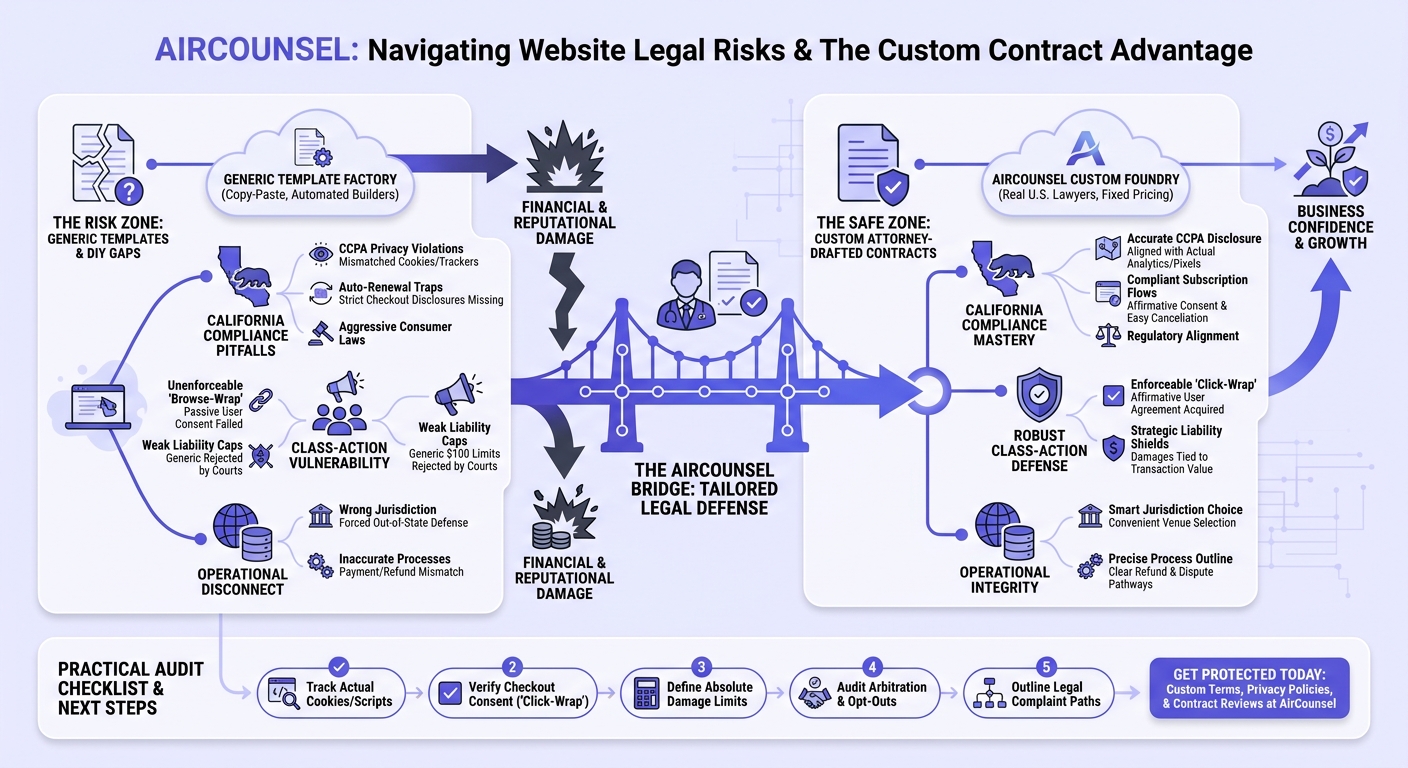
The Failure of Generic Website Terms
When you copy website Terms of Service (ToS) or use a basic online template, you represent your business through a legal framework that was likely built for someone else. Copy-pasting terms from a massive enterprise platform to your niche software or e-commerce shop does not protect you. In fact, it often does the exact opposite.
Generic terms frequently refer to features you do not have, mention states where you do not operate, or outline dispute processes that are entirely impractical for your budget. If your terms claim that you handle payments in a certain way, but your live payment gateway operates differently, a plaintiff's attorney can use that inconsistency as grounds for a misleading business practice lawsuit.
Furthermore, courts are increasingly striking down generic "browse-wrap" agreements—agreements that claim a user consents to terms simply by browsing a site. Without proper, attorney-drafted "click-wrap" mechanisms that prompt active, affirmative agreement from the user, your entire liability shield could be ruled completely unenforceable.
California Compliance and Class-Action Risks
Among U.S. jurisdictions, California has some of the most aggressive consumer-protection laws in the nation. It serves as the primary epicenter for digital class-action lawsuits. If your website can be accessed by California residents, you fall under its legal scanner regardless of where your company is geographically headquartered.
The CCPA and Consumer Privacy Pitfalls
The California Consumer Privacy Act (CCPA) regulates how companies collect, share, and process the personal information of California consumers. A generic privacy policy bought online rarely catalogs the actual cookies, trackers, and data-sharing plugins active on your actual platform.
Under California's legal standard, a failure to match your real-world data practices with your public disclosures constitutes a direct violation. Class-action firms use automated web scanners to identify sites with misaligned policies, issuing high-dollar demand letters to small businesses that cannot afford to litigate.
Auto-Renewal and Subscription Traps
If your business utilizes a subscription billing model or offers free-trial signups, California's Auto-Renewal Law (ARL) imposes incredibly strict checkout disclosure rules. The FTC's Negative Option Rule guidance also mirrors these strict consumer disclosure requirements at a federal level.
To comply, your checkouts must feature:
- Clear, prominent disclosures of recurring pricing placed immediately adjacent to the submit button.
- Affirmative user consent to the auto-renewal terms prior to charging.
- An easy, fully digital mechanism for cancellation (such as a one-click button in the account dashboard).
Templates almost never configure these exact processes within their generic phrasing, leaving businesses open to lawsuits where the court can order the restitution of all membership fees collected during the period of non-compliance.
The Dangerous Legal Gaps in DIY Templates
When analyzing standard online templates versus those tailored by experienced legal professionals, specific operational gaps emerge.
- Indemnity Clauses: A template often shifts heavy liability back onto the business operator instead of requiring third-party vendors or partners to protect you from platform disruptions.
- Limitation of Liability: A standard limitation clause might simply state a generic "$100 liability cap," which judges regularly throw out for being unconscionable. Successful limitation language must be tailored strategically to represent the value of services provided.
- Operating Jurisdiction: Templates frequently default to Delaware or New York venue choices that force a founder in Texas or Florida to fly out of state to defend a basic customer contract claim.
- Refunds and Chargebacks: If your terms do not explicitly outline your card refund timeline or chargeback policies, banks will default to the buyer's preference in standard payment disputes.
Template vs. Custom Contract: When Do You Custom-Draft?
Templates are occasionally acceptable for low-risk personal blogs or non-commercial portfolio websites. However, commercial operations with payment portals, user accounts, and personal data access require dedicated attention.
| Feature / Case | Template Contract | Custom Contracts by an Attorney |
|---|---|---|
| SaaS Applications | Unsafe; lacks clear service level descriptions and uptime liability shields. | Highly recommended; secures intellectual property and structures user tiers. |
| E-commerce Stores | Conditional; leaves business open to international shipping and compliance risk. | Recommended; provides robust terms for product shipping, returns, and safety disclaimers. |
| Subscription Boxes | Unsafe; regularly triggers auto-renewal statutory violations. | Essential; drafts precise legal funnels for consent and checkout compliance. |
| Consultants & Agencies | Unsafe; boilerplate intellectual property provisions fail to protect deliverable ownership. | Highly recommended; clearly outlines milestones, client approvals, and payment cycles. |
Practical Checklist for Auditing Your Website Terms
Before running paid marketing campaigns, introducing a checkout flow, or launching your core product, complete an audit of your online legal architecture using the following five-step checklist:
- Step 1: Track actual cookie scripts. Document every piece of backend software, analytic tool, or tracking pixel executing on your domain to align with your privacy statements.
- Step 2: Check your checkout structure. Ensure user consent is acquired using an active checking box labeled "I agree to the Terms of Service and Privacy Policy" with clear hyperlinks.
- Step 3: Define absolute damage limits. Match your Limitation of Liability clauses to either a set business benchmark or the payment history of that specific user over the previous 12 months.
- Step 4: Audit your arbitration paths. Avoid class-action vulnerabilities by embedding a clear, separate, and bolded arbitration clause with a logical opt-out timeline.
- Step 5: Outline a legal process for complaints. Give your users defined pathways to settle complaints directly with your administration before seeking civil remedies.
Get Your Website Protected Today
Eliminating legal risks does not require thousands of dollars in open-ended hourly attorney billing rates. At AirCounsel, we offer transparent, fixed pricing to help entrepreneurs secure fast and legally robust website documents created by real U.S. lawyers.
Whether you need a comprehensive Custom Application, Software or Website Terms of Service or want a thorough Review of your Contract or Legal Document to sweep for hidden liabilities, our experts deliver professional drafts within 3 business days.
If you are also collecting customer data, pair your terms with a tailored Custom Application, Software or Website Privacy & Cookies Policy to survive audit requests and satisfy California compliance frameworks.

Ready to launch with confidence? Reach out to our team with a quick Online Consultation to pinpoint the exact custom contracts your startup needs today.
This article provides general information and is not legal advice.
Frequently Asked Questions
Do I need custom website terms if I already use a template?
Yes, templates are designed for mass distribution and lack the specific, operational realities of your business. If a customer files a dispute or a class-action lawyer audits your platform, generic template statements often turn out to be inaccurate, exposing your company to liability.
What parts of a terms of service are most likely to cause class-action risk?
Class-action firms target improperly structured arbitration agreements, non-compliant auto-renewal subscription funnels, and cookie policies that fail to match the real pixels and marketing software operating on your storefront.
Why is California often treated as a higher-risk state for website terms?
California has implemented aggressive consumer-focused laws like the California Consumer Privacy Act (CCPA) and the California Auto-Renewal Law. These statutes feature steep fine incentives and allow private attorneys to bring bulk claims on behalf of consumers.
When should a founder hire an attorney instead of relying on a DIY contract template?
Founders should hire an attorney whenever they process customer payments, handle private data, use user-generated content, market subscriptions, or host proprietary intellectual property they wish to protect from theft.
Recommended
- Custom Contract Drafter — Learn more about obtaining compliant business and vendor agreements directly from vetted lawyers.
- Custom Application, Software or Website Terms of Service — Protect your commercial website or mobile interface from standard regulatory and class-action risks.
- Custom Application, Software or Website Privacy & Cookies Policy — Structure an accurate disclosure document that maps perfectly to federal and CCPA data privacy frameworks.
Need Legal Assistance?
Our expert legal team is ready to help you navigate complex legal matters with confidence.