Why Delaware LLCs Must Update Their Operating Agreements for 2026

Starting a business in Delaware is a gold standard for founders. However, keeping that business compliant has recently become far more complex. With the full implementation of the Corporate Transparency Act (CTA), many business owners who used basic llc formation services are discovering that their initial governance documents are already outdated.
According to federal small business research, 99.9% of U.S. businesses are small businesses, meaning millions of business owners are currently navigating these strict new federal reporting rules. If you formed a Delaware LLC, your Operating Agreement is no longer just a private agreement between partners; it is a critical tool for managing your federal compliance obligations.
Failing to update your internal documentation to align with recent federal regulations can lead to severe penalties. Here is what you need to know to protect your business, manage your ownership records, and ensure your entity remains in good standing.
Table of Contents
- Quick Summary
- The 2026 Corporate Transparency Act Landscape
- Why Delaware LLC Operating Agreements Must Be Updated
- Key Clauses to Update in Your Operating Agreement
- Who Is Most Affected by CTA Rules?
- Practical Compliance Workflow for Your Delaware LLC
- Common Pitfalls of Outdated Operating Agreements
- Get Professional Assistance
- Get Started with AirCounsel
- Frequently Asked Questions
- Recommended
Quick Summary
| Takeaway | Explanation |
|---|---|
| Federal Mandate | The Corporate Transparency Act requires most LLCs to report Beneficial Ownership Information (BOI) to the federal government. |
| Delaware LLC Relevance | Delaware's flexible entity laws place strong emphasis on the internal Operating Agreement to define compliance responsibilities. |
| Necessary Updates | Operating Agreements must compel members to provide accurate BOI data and indemnify the LLC for non-compliance penalties. |
| Role of Formation Services | While basic online tools file initial papers, comprehensive llc formation services and legal platforms help keep internal governance current. |
The 2026 Corporate Transparency Act Landscape
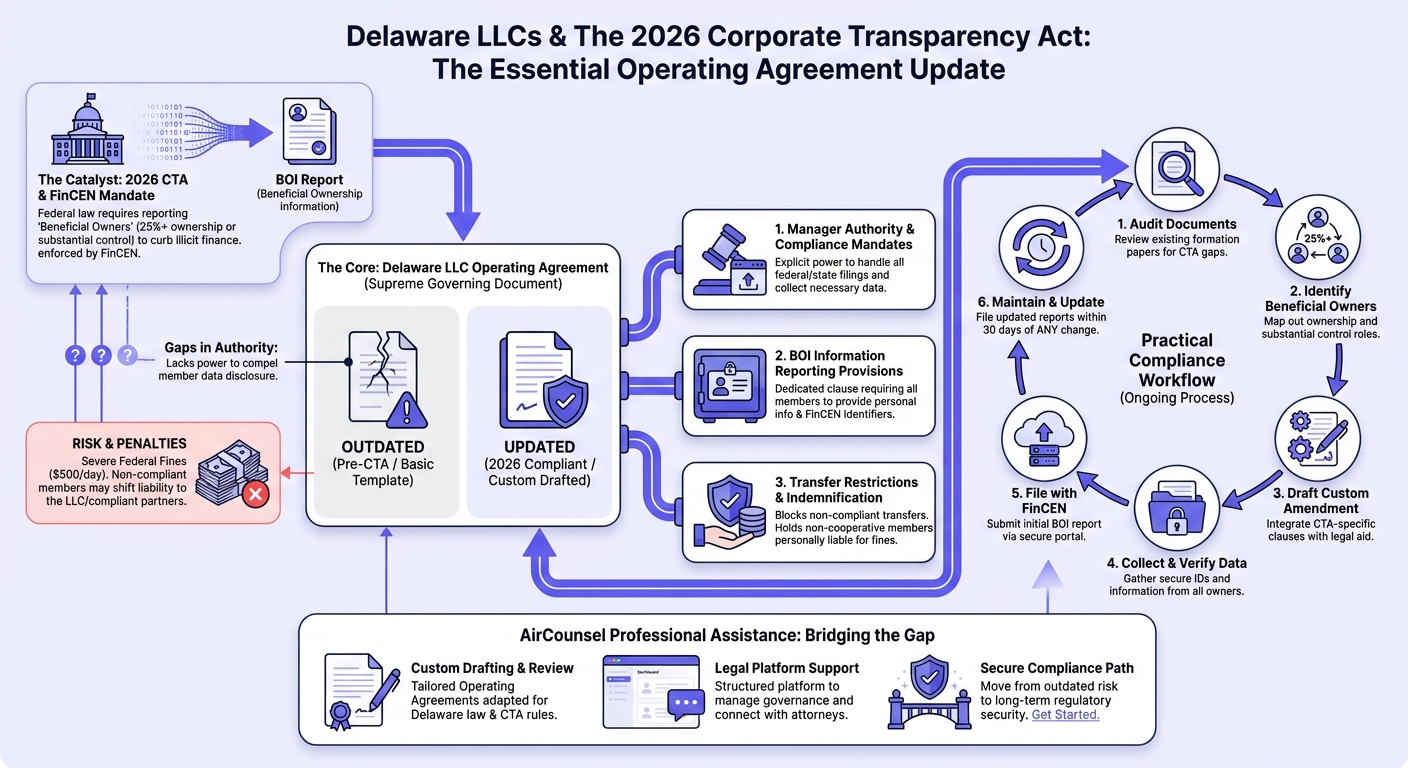
The Corporate Transparency Act, enforced by the Financial Crimes Enforcement Network (FinCEN), was designed to curb illicit financial activities by requiring businesses to report who ultimately owns or controls them. Under these rules, reporting companies must submit a Beneficial Ownership Information Report detailing their beneficial owners.
A beneficial owner is any individual who directly or indirectly exercises "substantial control" over the company or owns or controls at least 25% of its ownership interests. Because Delaware entities are frequently utilized by foreign investors, multi-member partnerships, and complex corporate structures, establishing a clear tracking mechanism is absolutely vital.
Why Delaware LLC Operating Agreements Must Be Updated
Under the Delaware Limited Liability Company Act, the Operating Agreement is the supreme governing document of the company. It dictates how the business is run, how decisions are made, and how members interact.
Historically, these agreements focused solely on equity splits, management roles, and distribution terms. However, because the CTA places the legal burden of reporting on the entity rather than individual members, the entity must have the legal authority to extract highly sensitive personal information (such as passports or driver's licenses) from its owners. Without explicit language in your Operating Agreement, a disgruntled or unresponsive member could refuse to provide this data, leaving the LLC open to steep federal fines of up to $500 per day.

Key Clauses to Update in Your Operating Agreement
Manager Authority and Compliance Mandates
The manager or managing member should have the explicit authority and obligation to handle all federal, state, and local compliance filings. This includes submitting initial, updated, and corrected BOI reports to FinCEN.
Beneficial Ownership Information Reporting Provisions
Your agreement must include a dedicated "CTA Compliance" or "Information Disclosure" clause. This clause should explicitly require every current and future member, manager, and officer to provide the company with the necessary personal information, FinCEN Identifiers, and copies of identification documents.
Transfer Restrictions and Indemnification
Prevent members from transferring their interest to new owners who refuse to comply with CTA disclosure rules. Additionally, include an indemnification clause stating that if a member's failure to provide accurate BOI details results in a fine or penalty for the LLC, that specific member must personally reimburse the company.
Who Is Most Affected by CTA Rules?
Not all Delaware LLCs handle compliance the same way. The administrative burden and risk level vary widely based on how your entity is structured:
| LLC Structure Type | Key Compliance Risk under CTA | Action Required |
|---|---|---|
| Single-Member LLCs | Low complexity, but high risk of oversight if the sole owner changes addresses or gets a new passport without updating FinCEN. | Keep personal records updated; ensure basic operating templates are adapted. |
| Multi-Member Partnerships | High risk of member non-cooperation or delayed response times. | Add strict disclosure mandates and indemnification clauses in the governance documents. |
| Investor-Backed Startups | Complex capital tables, convertible notes, and voting rights make determining "substantial control" difficult. | Review investor rights agreements alongside the Operating Agreement. |
| Foreign-Owned Entities | International owners may lack standard US identification, complicating the BOI filing process. | Require foreign members to obtain a FinCEN Identifier immediately. |
Practical Compliance Workflow for Your Delaware LLC
- Conduct a Document Audit: Review your current formation documents. If you utilized budget llc formation services, you may only have a generic template that lacks CTA-specific language.
- Identify Your Beneficial Owners: Map out who owns 25% or more of the equity and who exercises substantial control (e.g., managers, CEOs, key decision-makers).
- Draft a Custom Amendment: Work with legal professionals to draft a custom amendment or adopt a newly updated LLC Operating Agreement that integrates CTA requirements.
- Collect and Verify Member Data: Gather secure, encrypted copies of identification documents from all beneficial owners.
- File with FinCEN: Submit your report directly via the FinCEN secure portal. If any reported information changes (e.g., a member moves or renews their passport), you must file an updated report within 30 days.
Common Pitfalls of Outdated Operating Agreements
- Assuming "Set It and Forget It": Many founders assume their business registration is a one-time event. However, SBA business structure guidelines stress that maintaining corporate compliance is an ongoing process.
- Unclear "Control" Definitions: Failing to define who has "substantial control" can lead to incomplete BOI reports, which FinCEN treats as a compliance violation.
- Mismatched Records: Having state-level filings that conflict with federal BOI details can trigger audits or investigations.
- No Penalty Allocation: If a minority partner refuses to hand over their passport copy, and the LLC is fined, without an updated Operating Agreement, the remaining compliant partners have to split the financial damage.
Get Professional Assistance
Using high-quality llc formation services or a structured legal platform is the easiest way to bridge the gap between initial setup and long-term regulatory compliance. Online templates frequently fall short because they do not account for state-specific Delaware laws and federal transparency updates.
Rather than relying on outdated legal documents, partnering with a flat-fee service ensures your governance paperwork is robust, modern, and legally compliant.
Get Started with AirCounsel
Protecting your Delaware LLC from structural risks and federal compliance fines does not have to be expensive or time-consuming. AirCounsel offers transparent, flat-fee solutions tailored for modern founders and growing small businesses.
Whether you need a brand-new entity, a tailored governance framework, or a quick answer to a pressing legal scenario, we are here to support your venture.
- USA Entity and Company Formation – Form your company the right way, with comprehensive legal and compliance support from day one.
- LLC Operating Agreement – Get a custom-drafted, CTA-compliant operating agreement designed specifically for your business.
- Ask a U.S Attorney a Question – Have a specific question about your Delaware compliance roadmap? Connect with an expert attorney within 2 hours.
This article provides general information and is not legal advice.
Frequently Asked Questions
Do Delaware LLC operating agreements need to be updated whenever ownership changes?
Yes. Under both Delaware state law and federal Corporate Transparency Act rules, ownership changes require internal and federal updates. If an equity transfer alters who owns 25% or more of the company, or who holds substantial control, you must update your Operating Agreement and file an amended BOI report within 30 days of the change.
Does the Corporate Transparency Act require every LLC to file beneficial ownership information?
Nearly all small business LLCs are classified as "reporting companies" and must file. While there are 23 specific exemptions (such as for highly regulated financial institutions, public utilities, and large operating companies with over 20 employees and $5,000,000 in gross receipts), the vast majority of startups and small businesses must comply.
What parts of an operating agreement matter most for compliance review?
The most critical sections are those covering member information disclosure, transfer of membership interests, manager powers, and indemnification. You must ensure the company has a legal right to demand personal identification from its members and can block transfers to non-compliant individuals.
Can a formation service help with ongoing CTA-related document updates?
Yes, robust llc formation services and legal platforms provide the templates, custom amendment drafting, and advisory support needed to keep your internal paperwork aligned with changing federal standards.
Recommended
Need Legal Assistance?
Our expert legal team is ready to help you navigate complex legal matters with confidence.