Why USA Digital Marketing Agencies Need Custom Contract Drafting Services for Client Retainers

Digital marketing agencies rely on monthly retainer agreements to build predictable, recurring revenue. However, operating on loose verbal agreements or outdated online templates leaves your business vulnerable to scope creep, payment defaults, and intellectual property disputes. Engaging professional contract drafting services ensures your client retainers clearly define deliverables, isolate ad spend liabilities, and establish enforceable payment schedules.
In recurring client relationships, small ambiguities quickly compound into costly conflicts. Industry data indicates that over 60% of creative and marketing agencies face persistent scope creep and payment disputes when relying on generalized agreements rather than custom-tailored legal contracts. A single unbilled campaign revision or an uncollected media budget can wipe out an agency's profit margin on an account.
A professionally drafted retainer agreement provides the legal guardrails necessary to scale your agency safely. By establishing transparent boundaries around intellectual property, client approvals, performance representations, and regulatory compliance under US law, you protect your bottom line while delivering consistent value to your clients.
Table of Contents
- Why Generic Templates Fail Marketing Retainers
- Key Elements of an Agency Retainer Contract
- Retainer Agreement vs. Statement of Work (SOW)
- Common Retainer Mistakes and How to Avoid Them
- Cost and Timelines for Custom Legal Drafting
- Protect Your Agency With Expert Legal Drafting
- Frequently Asked Questions
- Recommended
Quick Summary
| Takeaway | Explanation |
|---|---|
| Scope Protection | Establishes strict deliverable boundaries to prevent unbilled work and continuous revisions. |
| Media Spend Liability | Isolates third-party ad spend so the agency is never legally liable for client platform charges. |
| IP Safeguards | Retains ownership of pre-existing agency frameworks while assigning final assets only upon full payment. |
| Regulatory Allocation | Allocates responsibility for advertising claims, truth-in-advertising rules, and FTC compliance to the client. |
| Smooth Offboarding | Details 30-day notice periods, asset handoffs, and final invoicing for seamless client transitions. |
Why Generic Templates Fail Marketing Retainers
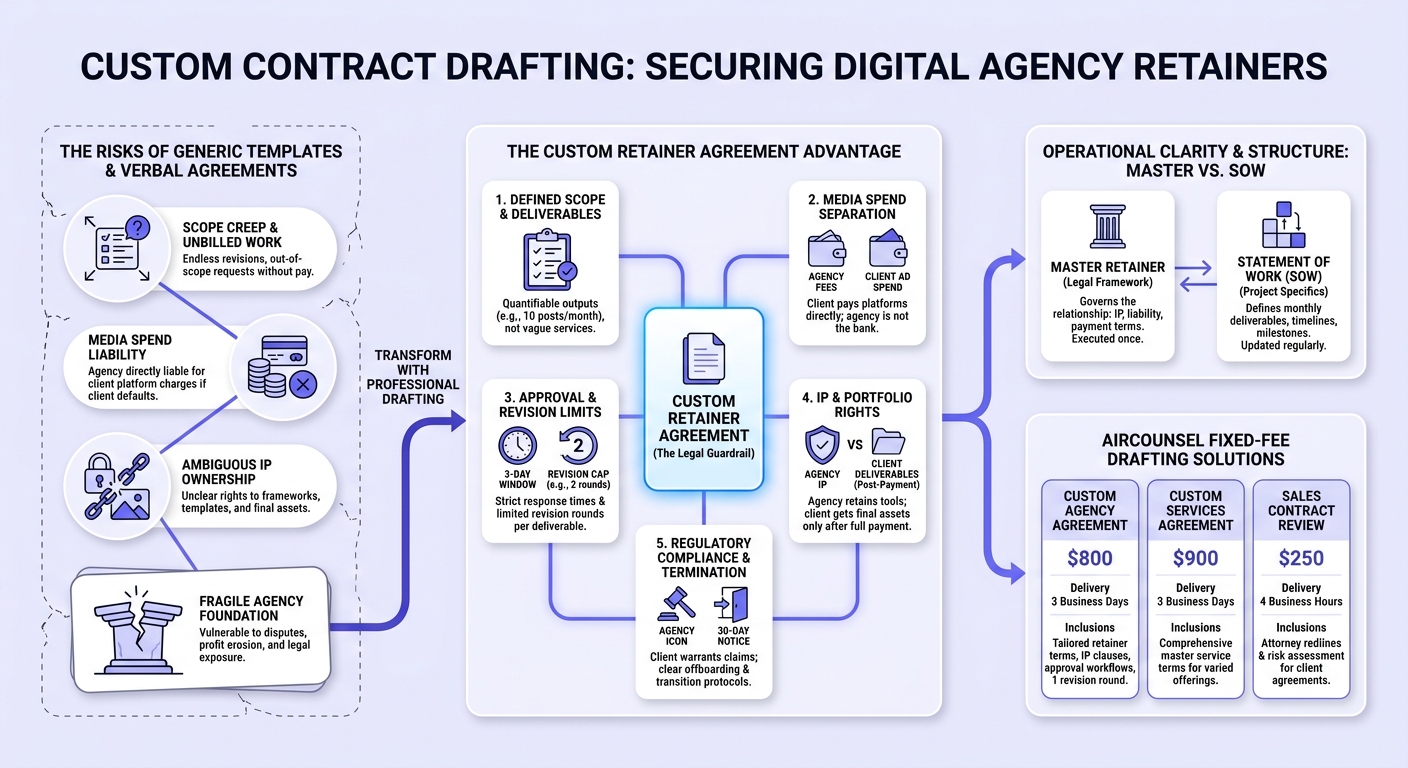
Free online templates and generic service contracts are rarely designed to handle the fast-paced, multi-channel nature of modern digital marketing. Retainers involve complex ongoing interactions—such as managing ad platforms, running automated email sequences, collaborating with third-party influencers, and deploying conversion tracking.
When you use a boilerplate contract, you expose your agency to distinct operational risks:
- Unclear Ad Spend Handling: Generic contracts often fail to separate agency management fees from direct ad spend on platforms like Google Ads or Meta, leaving agencies exposed if a client defaults on payment.
- Uncapped Revisions: Standard templates rarely specify turnarounds or revision limits, encouraging clients to request endless creative variations without additional compensation.
- Missing Regulatory Protections: Modern digital campaigns must comply with state and federal advertising regulations; standard contracts often leave agencies vulnerable to liability for client-provided marketing claims.
Utilizing dedicated contract drafting services allows you to customize terms to match your exact workflow, billing cycle, and deliverables.
Key Elements of an Agency Retainer Contract
A robust agency retainer contract serves as an operational roadmap and a legal shield. It aligns expectations between your team and your client from day one.

Scope of Work and Deliverable Boundaries
Every retainer contract must detail the specific services included in the recurring monthly fee. Rather than using vague language like "social media management," the agreement should outline quantifiable deliverables, such as the number of monthly posts, strategy calls, or ad sets created. Any task falling outside these boundaries should automatically trigger an additional hourly rate or a separate Statement of Work (SOW).
Fee Structures and Media Spend Separation
Your contract must clearly delineate agency fees from direct ad spend and third-party software subscriptions. Agencies should mandate that clients link their own payment methods directly to ad platforms (such as Meta Business Manager or Google Ads). If the agency advances ad spend on behalf of the client, the contract must include strict reimbursement timelines, credit card authorization terms, and late fee provisions.
Approval Workflows and Revision Limits
Client delays can easily stall marketing campaigns and disrupt agency resourcing. A well-drafted retainer specifies:
- Response Windows: The timeframe (e.g., 3 business days) within which a client must approve creative proofs or campaign copy.
- Deemed Approval Clauses: Language stating that if the client does not provide feedback within the allotted window, the deliverable is deemed approved to prevent campaign delays.
- Revision Limits: The exact number of revision rounds included per deliverable before out-of-scope hourly charges apply.
Intellectual Property and Portfolio Rights
Creative assets, custom copy, and strategic frameworks involve critical intellectual property (IP) considerations. Under federal copyright law, independent contractor work is not automatically a "work made for hire" unless explicitly stated in writing, as outlined by the U.S. Copyright Office.
Your agreement should clarify that:
- Assignment on Payment: Final deliverable ownership transfers to the client only after all associated invoices and retainer fees are paid in full.
- Agency Background IP: The agency retains full ownership of its proprietary templates, internal processes, algorithms, and analytical tools.
- Portfolio Rights: The agency retains the irrevocable right to showcase non-confidential deliverables in case studies, pitch decks, and website portfolios.
Regulatory and Advertising Compliance
Agencies must ensure that marketing campaigns comply with consumer protection standards and platform rules. Under guidelines from the Federal Trade Commission, advertisements, influencer partnerships, and customer endorsements must feature clear disclosures and substantiated claims.
Your retainer should require the client to warrant that all claims made about their products or services are truthful, while indemnifying the agency against regulatory fines or third-party claims arising from client-provided materials.
Termination and Transition Protocols
Retainer engagements inevitably conclude, and clear offboarding terms prevent disputes during the transition. A custom retainer agreement should define:
- Notice Periods: Standard 30-day or 60-day written notice requirements for contract cancellation.
- Offboarding Fees: Payment terms for work in progress and transition support, such as transferring account admin access or exporting historical campaign data.
- Access Revocation: The exact sequence for disconnecting agency access to client marketing channels, analytics tools, and ad accounts.
Retainer Agreement vs. Statement of Work (SOW)
Agencies often confuse a master retainer agreement with an operational Statement of Work. Using both instruments properly creates legal clarity and operational flexibility.
| Agreement Type | Primary Purpose | Key Provisions Covered | Recommended Use |
|---|---|---|---|
| Master Agency Retainer | Sets the overarching legal framework and recurring commercial relationship. | IP ownership, payment terms, confidentiality, liability limits, and termination rules. | Executed once at the start of the ongoing client relationship. |
| Statement of Work (SOW) | Outlines project-specific deliverables, deadlines, and variable milestones. | Deliverable lists, specific monthly targets, timelines, and specialized asset handoffs. | Issued alongside or updated under the master retainer as projects evolve. |
Pairing a master Custom Agency Agreement with modular SOWs allows you to adjust monthly service tiers without renegotiating your core legal terms every time.
Common Retainer Mistakes and How to Avoid Them
Even established agencies frequently make avoidable errors in their client contracts. Review this checklist to ensure your agency avoids these common pitfalls:
- Vague Performance Guarantees: Promising specific sales figures or search engine rankings creates breach-of-contract liability. Always clarify that marketing services involve strategic efforts rather than guaranteed financial outcomes.
- Unrestricted Account Ownership: Failing to specify who owns advertising accounts can lead to disputes over historical campaign data and custom audiences.
- Ambiguous Late Payment Remedies: Without explicit late fees and work suspension clauses, non-paying clients can demand ongoing campaign management without consequence.
- Omission of Independent Contractor Status: Ensure your agreement explicitly affirms your status as an independent business to avoid employment misclassification issues.
Cost and Timelines for Custom Legal Drafting
Securing customized legal agreements for your agency does not require paying unpredictable hourly attorney rates. Modern legal platforms provide transparent, fixed-fee solutions with rapid turnaround times.
| Legal Service | Fixed Pricing | Typical Delivery | Key Inclusions |
|---|---|---|---|
| Custom Agency Agreement | $800 | 3 business days | Tailored retainer terms, IP clauses, approval workflows, and 1 revision round. |
| Custom Services Agreement | $900 | 3 business days | Comprehensive master service terms for varied digital agency offerings. |
| Sales Contract Review | $250 | 4 business hours | Attorney redlines and risk assessment for incoming client-provided master agreements. |
Investing in custom drafting ensures you receive enforceable, state-compliant documents tailored specifically to your agency's business model.
Protect Your Agency With Expert Legal Drafting
Running a digital marketing agency requires balancing client performance with legal protection. Securing tailored, attorney-drafted contracts safeguards your revenue, clarifies client responsibilities, and protects your intellectual property from day one.
AirCounsel provides fixed-price, fast-turnaround legal services drafted by licensed US attorneys. Whether you need a comprehensive Custom Agency Agreement for recurring client retainers or require general contract drafting services for tailored business terms, our team delivers enforceable contracts within 3 business days.
Frequently Asked Questions
What clauses should a digital marketing agency retainer agreement include?
A digital marketing agency retainer agreement should include clear scopes of work, retainer fee schedules, ad spend payment mechanics, client approval deadlines, revision caps, IP assignment terms, portfolio usage rights, FTC compliance indemnification, and structured termination protocols.
How is a retainer agreement different from a monthly service contract or SOW?
A master retainer agreement establishes the governing legal framework—including liability limits, payment defaults, and IP ownership—for an ongoing business relationship. A Statement of Work (SOW) defines the specific monthly deliverables and campaign milestones executed under that master agreement.
Who owns the creative and ad account assets created during the engagement?
By default, ownership rules must be explicitly negotiated. Agency retainers typically stipulate that final client-specific creative deliverables are transferred to the client upon receipt of full payment, while the agency retains ownership over its proprietary processes, templates, and pre-existing IP.
How should the contract handle scope changes, extra revisions, and termination?
The contract should establish fixed revision limits per deliverable and state that out-of-scope requests will be billed at a designated hourly rate or through an approved change order. Termination clauses should mandate a 30-day written notice and require full payment for work performed through the end of the notice period.
Recommended
- Secure your agency relationships with a tailored Custom Agency Agreement.
- Protect client service terms and IP rights using a Custom Services Agreement.
- Review third-party vendor or incoming enterprise agreements with our fast Sales Contract Review.
Need Legal Assistance?
Our expert legal team is ready to help you navigate complex legal matters with confidence.