What Happens When USA Founders Bypass Contract Drafting Services for Early-Stage Stock Purchase Agreements?

When launching a new venture in the United States, equity allocation often feels straightforward. Founders agree on percentages over coffee, sketch a cap table on a whiteboard, and assume formal legal paperwork can wait until an institutional funding round. However, skipping professional contract drafting services for early-stage stock purchase agreements is one of the most expensive shortcuts a startup team can take.
According to data from the U.S. Small Business Administration, over 99% of all American enterprises operate as small businesses, yet structural cofounder fallout and equity disputes remain leading drivers of early-stage company dissolution. Informal arrangements leave vital questions unanswered: What happens if a technical cofounder leaves after three months? Who owns the core intellectual property? How will the Internal Revenue Service treat unvested shares?
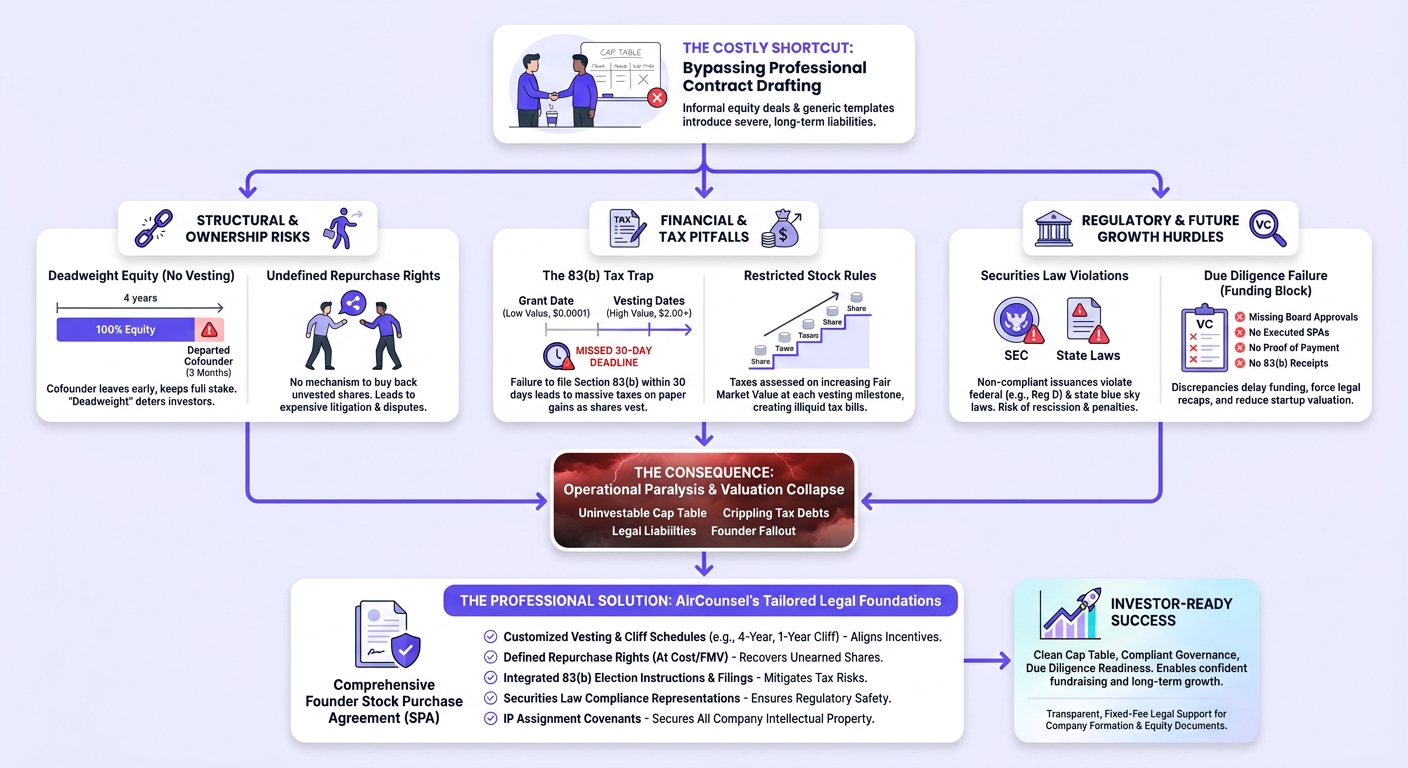
A founder stock purchase agreement (SPA) is not a mere bureaucratic formality. It governs equity ownership, transfer restrictions, vesting schedules, and company repurchase rights. Bypassing customized legal drafting exposes founders to crippling tax liabilities, unresolvable ownership disputes, and immediate red flags during venture capital due diligence.
Table of Contents
- Quick Summary
- What Is a Founder Stock Purchase Agreement?
- The Structural Risks of Bypassing Professional Drafting
- The 83(b) Tax Trap and Restricted Stock Rules
- Securities Law Compliance for Early Issuances
- Governance, IP Assignment, and Due Diligence Readiness
- Core Provisions in an Investor-Ready Stock Agreement
- Secure Your Startup Equity with AirCounsel
- Frequently Asked Questions
- Recommended
Quick Summary
| Takeaway | Explanation |
|---|---|
| Vesting Protection | Protects the company from departed cofounders keeping large equity stakes without earning them. |
| 83(b) Election Timing | Requires filing with the IRS within 30 days of stock grant to avoid massive future tax hits. |
| Securities Exemptions | Stock issuances must satisfy federal and state private placement exemptions to avoid illegal offerings. |
| IP Protection | Stock issuance must be explicitly tied to complete intellectual property assignment to the company. |
| Investor Diligence | Venture capitalists require clean, documented founder equity agreements before deploying capital. |
What Is a Founder Stock Purchase Agreement?
A founder stock purchase agreement is a formal, legally binding contract between a newly formed corporation (typically a Delaware or state C-corporation) and its founding team members. This contract outlines the sale and issuance of common stock to the founders, defining the purchase price (often par value, such as $0.0001 per share), the method of payment (cash, past services, or assigned intellectual property), and the conditions governing that equity over time.
Securing tailored contract drafting services ensures that the agreement establishes clear parameters for how equity is earned, protected, and transferred. Rather than granting unrestricted ownership on day one, a properly drafted founder SPA implements structural safeguards that align long-term incentives across the founding team.
Founder Stock Purchase Agreements vs. Informal Cap Tables
Many early-stage teams confuse a cap table spreadsheet or incorporation certificate with an executed stock purchase agreement. While the Certificate of Incorporation authorizes the total number of shares a company can issue, it does not actually issue them to individuals.
An informal cap table represents an intention, but it lacks legal enforceability. Without an executed stock purchase agreement paired with formal board consent and stock ledger entries, founders do not legally own their shares. This creates significant ambiguity regarding voting rights, dividend distribution, and corporate governance.
The Structural Risks of Bypassing Professional Drafting
Relying on generic web templates or oral understandings introduces immediate operational and legal vulnerabilities. Professional legal drafting addresses contingencies that founders rarely anticipate during the initial excitement of building a company.

Deadweight Equity and Missing Vesting Schedules
The most common failure in unreviewed founder agreements is the omission of reverse vesting. In standard startup practice, founders earn their equity over a defined timeline—typically a 4-year schedule with a 1-year cliff. If a founder departs before the cliff, they forfeit their unvested shares.
Without a vesting mechanism, a cofounder who departs after two months retains 100% of their initial equity grant. This leaves the remaining team with "deadweight equity"—a substantial portion of the company owned by an inactive party. New investors will rarely fund a startup where an ex-founder holds 30% or 40% of the equity without ongoing service obligations.
Undefined Repurchase Rights on Founder Exit
When a departing founder holds unvested or restricted stock, the corporation must possess an express contractual right to repurchase those shares. A sound founder SPA specifies:
- Repurchase Price: Setting the buyout price for unvested shares at the lower of the original purchase price or fair market value.
- Exercise Window: Granting the board a defined timeframe (such as 60 to 90 days post-termination) to exercise the repurchase option.
- Involuntary Transfers: Protecting against share reallocation in the event of divorce, bankruptcy, or death through mandatory company buyout rights.
If these clauses are poorly constructed or omitted, the business may be forced into expensive litigation simply to reclaim unearned shares.
The 83(b) Tax Trap and Restricted Stock Rules
When founders receive stock subject to vesting (restricted stock), the IRS considers that stock to be compensation for services under Internal Revenue Code Section 83. By default, taxes are assessed as the shares vest over time, based on the fair market value of the stock at each vesting milestone.
If a startup's valuation increases significantly from $0.0001 per share to $2.00 per share by year three, a founder without proper tax planning could face massive ordinary income tax bills on illiquid shares they cannot sell.
To prevent this, founders must execute a Section 83(b) election with the IRS within exactly 30 days of receiving the restricted stock. This election allows the founder to pay taxes on the value of the shares at the time of initial grant (when the value is nominal), eliminating tax events at subsequent vesting dates. Professional drafting ensures that stock grants include express 83(b) filing acknowledgments, detailed instructions, and protective election forms.
Securities Law Compliance for Early Issuances
Issuing stock to founders constitutes a sale of securities under federal and state law. Under guidelines from the Securities and Exchange Commission, any offer or sale of securities must either be registered with the SEC or qualify for an exemption from registration.
Early-stage startups rely on private offering exemptions, most commonly Section 4(a)(2) of the Securities Act of 1933 or Rule 506 of Regulation D. Additionally, companies must navigate state "blue sky" laws, which regulate securities offerings at the state level.
Improperly drafted stock agreements that fail to capture required investor representations—such as investment intent, access to financial information, and residency—can jeopardize these exemptions. Rescission liabilities (where the company is legally required to refund share purchases) can emerge if securities rules are violated during initial issuance.
Governance, IP Assignment, and Due Diligence Readiness
Equity issuance does not occur in a vacuum. A complete founder onboarding package ties equity grants directly to corporate governance and proprietary asset protection. When preparing your company's foundation, founders should also secure a dedicated custom IP assignment agreement to ensure all software, patents, and branding developed prior to incorporation belong strictly to the corporate entity.
During institutional due diligence (Series Seed or Series A), venture capital counsel conducts a comprehensive audit of the company's capitalization history. They scrutinize:
- Board Authorizations: Duly executed board resolutions approving the exact share issuances.
- Stock Purchase Agreements: Fully executed SPAs for every founder and early employee.
- Proof of Payment: Bank records or intellectual property transfer receipts proving the stock was paid for.
- 83(b) Election Receipts: Certified mail receipts proving timely IRS filings.
Discrepancies in these records often delay funding rounds, force costly legal recaps, or lead to reduced startup valuations.
Core Provisions in an Investor-Ready Stock Agreement
A comprehensive founder stock purchase agreement balances individual protections with the long-term viability of the company.
| Agreement Provision | Legal Function | Risk if Missing |
|---|---|---|
| Vesting & Cliff Schedule | Defines service-based equity accrual (typically 4 years with 1-year cliff). | Departing founders retain unearned equity blocks. |
| Right of First Refusal (ROFR) | Requires founders to offer shares back to the company before selling to third parties. | Competitors or hostile third parties acquire company shares. |
| Market Stand-Off (Lock-Up) | Prohibits selling shares for 180 days following an Initial Public Offering (IPO). | Underwriters refuse to manage future public offerings. |
| Drag-Along Rights | Compels minority shareholders to vote in favor of a board-approved company sale. | Disgruntled minority shareholders block a viable acquisition. |
| IP Assignment Covenant | Conditions stock issuance on the complete assignment of all business IP. | Founder leaves and claims ownership of core product code. |
Secure Your Startup Equity with AirCounsel
Founding a company requires speed, but cutting corners on equity structure creates catastrophic long-term risks. AirCounsel delivers transparent, fixed-fee legal support from licensed attorneys to ensure your company formation, equity documents, and corporate records are clean, compliant, and investor-ready.
Whether you need a tailored custom sale of stock agreement to handle equity transactions, or an enforceable custom employment agreement to formalize founder and executive roles, AirCounsel protects your business without hourly billing surprises or unnecessary delays.
Frequently Asked Questions
What is a founder stock purchase agreement and why does it matter at formation?
A founder stock purchase agreement is the legal contract that issues equity from the corporation to a founding member. It defines the purchase price, ownership percentage, vesting terms, and transfer restrictions. Without it, founders lack legal title to their shares, creating substantial governance and ownership ambiguities.
Do early-stage founder share issuances need SEC registration or an exemption?
Yes. Every sale of corporate stock in the United States must either be registered with the SEC or qualify for an exemption under federal and state securities laws. Founder issuances typically rely on private placement exemptions under Section 4(a)(2) or Regulation D, which require specific contractual representations.
What happens if a founder skips vesting language or repurchase rights in the agreement?
If vesting and repurchase rights are missing, a cofounder who leaves the company after a short period keeps all of their allocated stock. The remaining team cannot force a buyout, leaving large amounts of "deadweight equity" on the cap table that will deter future venture capital investors.
When does a founder need to file an 83(b) election after receiving restricted stock?
An 83(b) election must be filed with the IRS within exactly 30 days of receiving restricted stock subject to vesting. Missing this deadline by even one day is irreversible and may result in substantial income tax liabilities as the stock increases in value and vests over time.
Recommended
- Custom Sale of Stock Agreement — Deal-specific, attorney-drafted stock purchase agreements for U.S. businesses.
- Custom IP Assignment Agreement — Secure complete company ownership over all founder-created technology and branding.
- USA Entity and Company Formation — Comprehensive formation packages with foundational legal protections.
Need Legal Assistance?
Our expert legal team is ready to help you navigate complex legal matters with confidence.