4 Critical Clauses Every US Franchisee Needs to Protect Intellectual Property

Buying a franchise is an exciting milestone for any entrepreneur. According to the SBA Office of Advocacy, 99.9% of U.S. businesses are small businesses, showing just how many independent operators power the American economy. However, joining a franchise network requires signing a highly unilateral contract where the brand owner retains almost all the leverage.
To avoid costly legal battles down the road, you must pay close attention to intellectual property (IP), proprietary systems, and brand assets. Consulting a specialized franchise attorney to review your Franchise Disclosure Document (FDD) and Franchise Agreement is the most critical step you can take before signing on the dotted line.
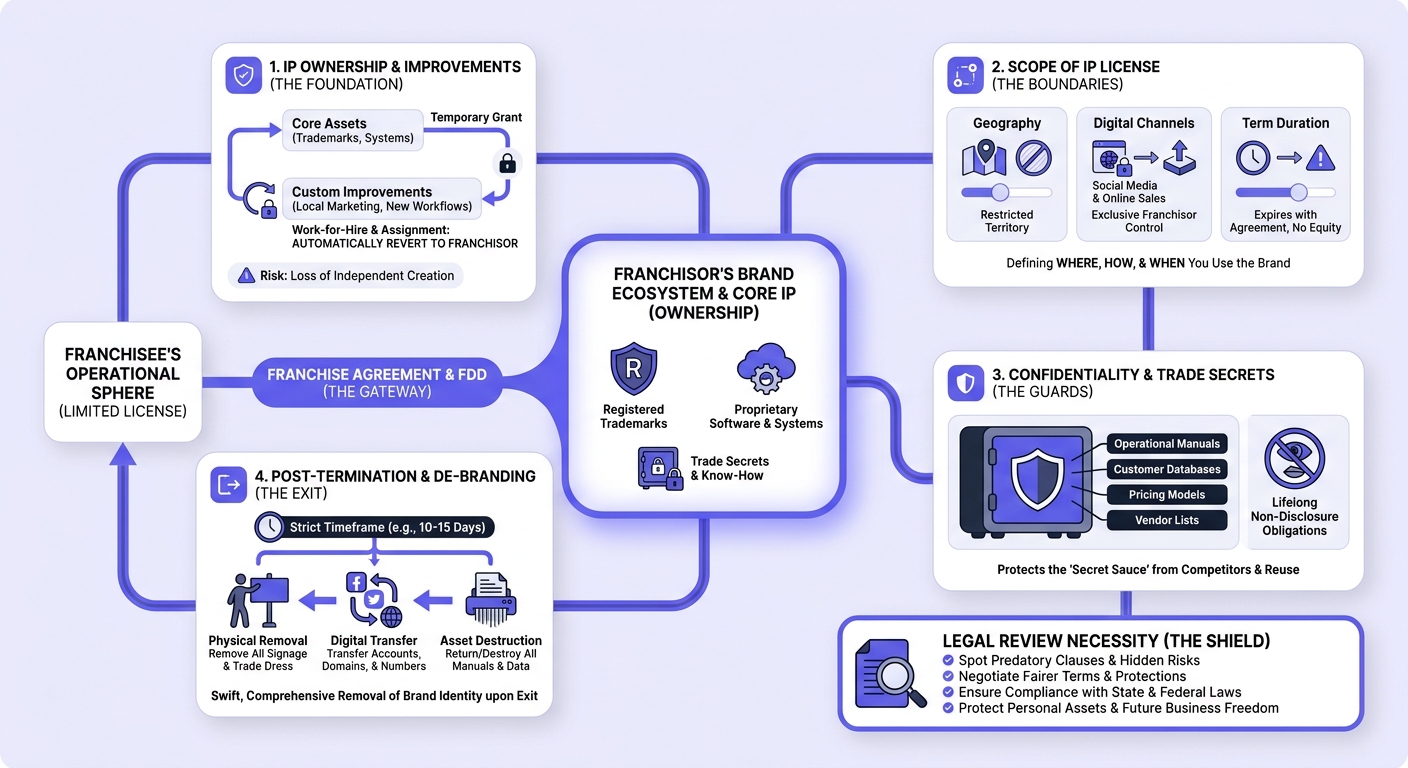
This guide walks you through the four core IP and brand clauses you must evaluate with a legal professional to protect your business.
Table of Contents
- Quick Summary
- Clause 1: IP Ownership, Improvements, and Custom Branding
- Clause 2: The Scope of the Intellectual Property License
- Clause 3: Confidentiality and Trade Secret Restrictions
- Clause 4: Post-Termination Obligations and De-Branding
- Additional Risks: Marketing Approvals, Indemnity, and Audits
- Why State and Federal Laws Require Expert Review
- Secure Your Investment with AirCounsel
- Frequently Asked Questions
- Recommended
Quick Summary
| Takeaway | Explanation |
|---|---|
| IP Ownership | The franchisor owns all core assets. Any improvements or custom materials you create usually revert to them. |
| License Scope | Defines exactly how, where, and when you can use trademarks, logos, and proprietary software. |
| Confidentiality | Restricts your ability to share or reuse operational manuals, customer data, and trade secrets. |
| De-Branding | Requires swift removal of signage, paint colors, and digital assets immediately upon contract termination. |
| Legal Support | A flat-fee contract review protects your business from predatory operational restrictions. |
Clause 1: IP Ownership, Improvements, and Custom Branding
In a franchise system, the franchisor owns the primary intellectual property. This includes the registered trademarks, proprietary software, design systems, and trade secrets. However, friction often arises when a franchisee creates custom local marketing materials, builds local operational workflows, or suggests system improvements.
Under standard "work-for-hire" and assignment provisions, most franchise agreements state that any modification or improvement you make automatically becomes the sole property of the franchisor. If you design an innovative workflow or draft custom training guides, you will not own them.
A franchise attorney will carefully review these terms to ensure:
- You retain ownership over truly independent, non-brand business assets.
- You are not inadvertently violating the U.S. Copyright Act by using unauthorized creative assets.
- Any "improvements" you develop are clearly defined so you do not face claims of IP infringement if you exit the franchise network.
Clause 2: The Scope of the Intellectual Property License
The right to run a franchise is essentially a limited legal license. The franchisor grants you permission to use their brand name, logos, and system for a set duration, under specific conditions.
According to USPTO Trademark Basics, a registered trademark is a core asset that must be protected. If a franchisor does not strictly control how their mark is used, they risk losing their trademark protection. Consequently, your franchise agreement will contain highly restrictive terms regarding the license scope.

When evaluating this clause, check for limits on:
- Geography: Is your license restricted to a single physical location, or do you have exclusive rights to a broader territory?
- Channels: Are you permitted to market on digital platforms, or does the franchisor maintain exclusive online sales rights?
- Term: Does your license expire immediately upon the non-renewal of your franchise agreement, leaving you with zero brand equity?
Clause 3: Confidentiality and Trade Secret Restrictions
Franchisors carefully guard their operational "secret sauce." This includes proprietary software, training manuals, recipes, vendor lists, and customer databases. Under federal law, specifically 18 U.S. Code § 1836, trade secrets are protected by civil proceedings.
Franchise agreements impose strict, lifelong confidentiality obligations. You must ensure that:
- Definition of Confidential Info: The definition is not so broad that it prevents you from using general industry knowledge in your future career.
- Employee Liability: You are not held personally liable for a standard employee accidentally leaking proprietary information, provided you took reasonable protective measures.
- Data Privacy: Customer lists and historical transaction data are managed in compliance with modern state data laws.
Clause 4: Post-Termination Obligations and De-Branding
What happens when your franchise relationship ends, or if you decide to transfer your business? This is where many independent operators face catastrophic financial surprises.
Post-termination clauses require swift, comprehensive "de-branding." Within a strict timeframe (often 10 to 15 days), you must:
- Remove all signage, physical trade dress, custom paint schemes, and brand fixtures at your own expense.
- Return or destroy all physical and digital operational manuals.
- Transfer ownership of all local social media accounts (such as Facebook pages or Instagram handles), domain names, and local phone numbers directly to the franchisor.
- Stop using any proprietary business processes immediately.
Without careful negotiation by a franchise attorney, you may find yourself unable to run any similar business in your local area due to overly broad non-compete covenants tied to de-branding obligations.
Additional Risks: Marketing Approvals, Indemnity, and Audits
Beyond the four primary clauses, several secondary contract terms shift risk heavily toward the franchisee:
- Marketing Approvals: Most systems require absolute franchisor sign-off on any local ads, co-branded materials, or local event promotions. Accidental trademark misuse can lead to immediate default.
- Indemnity and Infringement: If a third party sues you because the franchisor's brand name infringes on another business's trademark, the contract should guarantee that the franchisor will defend and indemnify you.
- Audit and Recordkeeping: Franchisors retain the right to audit your digital footprint, POS systems, and financial books to ensure you are paying correct royalties and respecting their intellectual property.
Why State and Federal Laws Require Expert Review
Franchising in the United States is regulated at both the federal and state levels. The Federal Trade Commission enforces the FTC Franchise Rule, which dictates how franchisors must disclose information. Additionally, many states have specific franchise relationship laws that override unfair contract clauses.
Because contract law, trademark law, and state-specific franchise rules interact in complex ways, relying on a generic business template or attempting to self-negotiate is highly risky. A qualified attorney will spot illegal, unenforceable clauses in your FDD and draft formal addenda to protect your personal assets and capital.
Secure Your Investment with AirCounsel
Protecting your brand assets and understanding your contract obligations shouldn't cost tens of thousands of dollars in open-ended hourly fees. At AirCounsel, we offer transparent, fixed-price legal solutions tailored for modern business owners and solo entrepreneurs.
Our experienced attorneys will review your documents quickly and identify hidden traps, high-risk operational terms, and unfair de-branding clauses. Get the clarity and asset protection you deserve before signing.
Let us help you review your paperwork today:
- Franchise Agreement and FDD Review: Get a fast, clear legal review of your US franchise documents by an expert attorney for a flat fee of $800.
- Custom Franchise Agreement: If you are looking to scale your own business into a brand, obtain an attorney-drafted, scalable franchise agreement for $1,900.
This article provides general information and is not legal advice.
Frequently Asked Questions
Who owns the trademarks and other intellectual property in a franchise relationship?
The franchisor retains complete ownership of all trademarks, brand assets, logos, and proprietary systems. As a franchisee, you are granted a temporary, non-exclusive license to use these assets solely for running your franchise location under strict operational guidelines.
Can a franchise agreement let the franchisor control my website, ads, or social media?
Yes. Most modern franchise contracts give the franchisor absolute control over all digital footprints. They typically require you to use their centralized website, post only pre-approved marketing materials, and hand over local social media accounts or domain names upon request.
What happens to my branded materials and domain names when the franchise ends?
You are legally obligated to "de-brand." This means removing all signs, physical brand indicators, and trade dress from your commercial space at your own cost. You must also transfer all local domain names, social media handles, and phone numbers back to the franchisor immediately.
Why should I have a franchise attorney review IP clauses before I sign?
A franchise attorney can identify high-risk terms that could prevent you from operating a similar business in the future. They can negotiate fairer terms, secure regional protections, and make sure you are fully indemnified if the franchisor faces brand infringement claims.
Recommended
Need Legal Assistance?
Our expert legal team is ready to help you navigate complex legal matters with confidence.