The 2026 USA Franchisor Legal Checklist for Structuring Item 19 Disclosures with a Franchise Attorney

When expanding a business concept into a national franchise, Item 19 of the Franchise Disclosure Document (FDD) is often the single most influential factor for prospective buyers. Item 19 allows franchisors to make Financial Performance Representations (FPRs)—historical or projected sales, gross revenues, and operational costs. However, presenting financial data to prospects is strictly regulated under federal and state law, making the guidance of an experienced franchise attorney vital for long-term brand protection.
According to data cited by the Small Business Administration, there are over 850,000 franchise establishments across the United States, with 99.4% operating as small businesses. In an increasingly competitive franchise marketplace, presenting transparent and accurate financial disclosures helps brands attract qualified operators while minimizing regulatory friction.
Under the Federal Trade Commission (FTC) Franchise Rule, franchisors are prohibited from providing any earnings claims unless those figures are formally integrated into Item 19. Developing an airtight, compliant financial disclosure requires a structured legal strategy, verifiable accounting data, and clear risk mitigation protocols.
Table of Contents
- What Is Item 19 and Why Does It Matter?
- Quick Summary
- Mandatory Legal Standards for Financial Performance Representations
- Compliant Structuring Models for Item 19 Disclosures
- Step-by-Step Item 19 Drafting and Maintenance Checklist
- Common Item 19 Pitfalls and Regulatory Risks
- How a Franchise Attorney Streamlines FDD Compliance
- Scale Your Franchise System with Confidence
- Frequently Asked Questions
- Recommended
Quick Summary
| Takeaway | Explanation |
|---|---|
| Item 19 Is Optional but Regulated | Franchisors are not legally required to provide financial figures, but any earnings claims made anywhere must appear inside Item 19. |
| Strict Substantiation Mandate | Every figure must have a reasonable factual basis and written substantiation available upon request. |
| Ban on Unauthorized Sales Claims | Franchise sales representatives and brokers cannot provide off-book numbers, verbal estimates, or pro forma spreadsheets. |
| Multi-State Registration Nuances | State franchise regulators in registration states scrutinize Item 19 disclosures for misleading comparisons and missing disclosures. |
| Annual Updates Required | Item 19 data must be refreshed within 120 days of the fiscal year-end or immediately updated upon material operational changes. |
What Is Item 19 and Why Does It Matter?
Under the FTC Franchise Rule, an FDD must contain 23 standard disclosure sections. Item 19 is reserved exclusively for Financial Performance Representations (FPRs). An FPR is defined as any oral, written, or visual representation given to a prospective franchisee that states, suggests, or implies a specific level or range of actual or potential sales, income, gross profits, or net profits.
While franchisors may elect not to provide an FPR—inserting a standardized negative disclosure stating that the franchisor does not make financial representations—doing so can severely restrict sales conversations. Franchise candidates routinely seek objective revenue data before committing capital. However, drafting Item 19 without legal counsel exposes franchisors to severe liability under both federal law and state franchise relationship statutes.
Mandatory Legal Standards for Financial Performance Representations
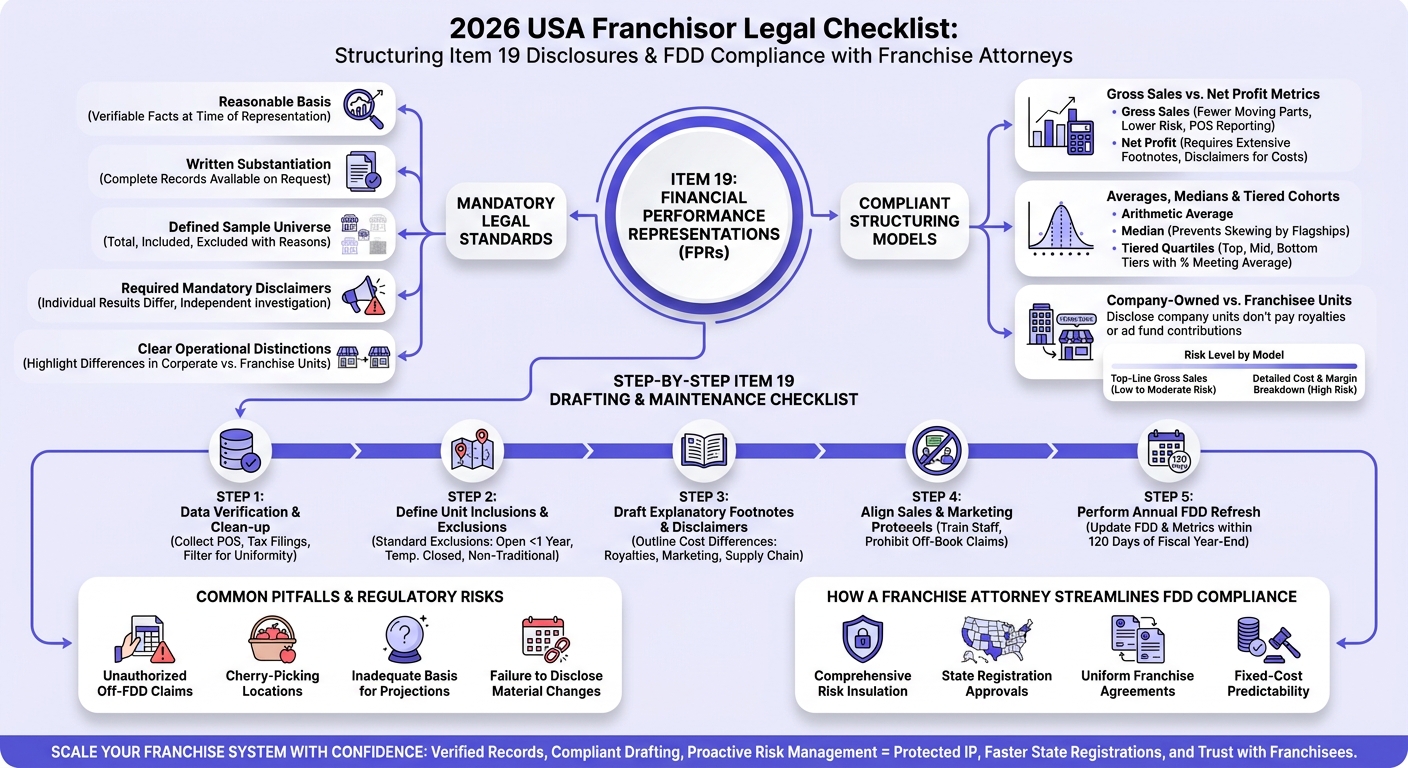
If a franchisor chooses to provide financial data in Item 19, the disclosure must satisfy core statutory standards established by the FTC and enforced across state registration jurisdictions.

To remain compliant, every Item 19 disclosure must incorporate the following elements:
- Reasonable Basis: The franchisor must possess objective, verifiable facts supporting the figures presented at the time the representation is made.
- Written Substantiation: Franchisors must maintain complete underlying records (such as POS data, audited financials, or tax returns) and make them available to prospective franchisees and regulators upon reasonable request.
- Defined Sample Universe: The disclosure must specify the total number of outlets open, the number of outlets included in the data set, and the number excluded, along with clear reasons for exclusion (such as units operating for less than 12 full months).
- Required Mandatory Disclaimers: Disclosures must state that individual results may differ and that prospective franchisees should conduct independent financial investigations.
- Clear Distinctions in Operational Profiles: If data combines corporate-owned units and franchised outlets, the differences in labor models, royalties, and purchasing power must be clearly highlighted.
Compliant Structuring Models for Item 19 Disclosures
There is no single mandatory template for Item 19 disclosures. Franchisors, working alongside a franchise attorney, can structure their disclosures using several models depending on their system size, historical data, and accounting sophistication.
Gross Sales vs Net Profit Metrics
Most emerging franchisors begin with gross revenue or top-line sales figures. Gross sales representations carry fewer moving parts and lower compliance risk because they rely directly on Point-of-Sale (POS) reporting.
In contrast, disclosing net profits requires accounting for rent, local labor, insurance, royalties, marketing fund fees, and operating expenses. Because these cost structures vary dramatically across US markets, net profit representations require extensive explanatory footnotes and precise disclaimers.
Averages, Medians, and Tiered Cohorts
When presenting financial performance data, presenting both averages and medians is standard practice:
- Arithmetic Average: The sum of all unit revenues divided by the total number of reporting units.
- Median: The exact midpoint of the data set, which prevents high-performing flagship units from skewing the overall outlook.
- Tiered Cohorts: Grouping units into quartiles or top, middle, and bottom tiers (e.g., top 25%, middle 50%, and bottom 25%). When using cohorts, franchisors must disclose the percentage and number of units in each tier that met or exceeded the group average.
Company-Owned Outlets vs Franchisee Units
If an emerging brand only operates corporate-owned locations, it can still present an Item 19 disclosure based on company operations. However, the document must disclose that company-owned units do not pay royalty fees, technology fees, or standard franchisee ad fund contributions, which directly impacts net profitability.
| Disclosure Model | Primary Data Points | Best Suited For | Risk Level |
|---|---|---|---|
| Top-Line Gross Sales | Annual gross receipts, ticket sizes | Emerging franchisors with 1–10 units | Low to Moderate |
| Tiered Quartile Averages | Sales grouped by top 25%, mid 50%, bottom 25% | Mid-sized systems (15+ units) | Moderate |
| Historical Unit Cohorts | Performance categorized by vintage or year opened | Rapidly expanding franchise networks | Moderate |
| Detailed Cost & Margin Breakdown | Gross sales minus COGS, labor, and fixed fees | Mature systems with audited franchisee books | High |
Step-by-Step Item 19 Drafting and Maintenance Checklist
To draft a compliant Item 19 and keep it current throughout the franchise lifecycle, franchisors should execute a structured five-step compliance process:
- Step 1: Conduct Data Verification and Clean-up: Collect POS records, gross receipts reports, and tax filings from all operating units. Filter the data to ensure uniform reporting periods across all outlets.
- Step 2: Define Unit Inclusions and Exclusions: Establish clear parameters for which locations are included. Standard exclusions include outlets open less than one calendar year, temporarily closed locations, or non-traditional kiosks.
- Step 3: Draft Explanatory Footnotes and Disclaimers: Draft clear footnotes outlining the cost differences between reporting units and new prospective franchises, including royalties, required local marketing spend, and supply chain pricing.
- Step 4: Align Sales and Marketing Protocols: Train franchise development representatives, internal brokers, and executive staff to ensure no off-book statements, emails, or spreadsheets contradict the formal Item 19 disclosure.
- Step 5: Perform the Annual FDD Refresh: Under federal law, update the FDD and Item 19 metrics within 120 days after the franchisor’s fiscal year ends, filing required renewals in state registration jurisdictions.
Common Item 19 Pitfalls and Regulatory Risks
Mistakes in Item 19 disclosures can trigger formal investigations by state regulators, stop-orders halting franchise sales, and private lawsuits seeking full rescission of franchise agreements plus legal fees.
- Unauthorized Off-FDD Claims: Sales representatives providing prospective buyers with customized profit models, cash flow calculators, or historical bank statements outside of Item 19.
- Cherry-Picking Locations: Including only top-performing flagship stores in the data set while silently excluding underperforming or struggling suburban locations.
- Inadequate Basis for Projections: Providing future financial projections for newly formed systems without substantial operational history or validated market assumptions.
- Failure to Disclose Material Operational Changes: Retaining outdated Item 19 figures after major economic, supply chain, or pricing shifts have materially reduced average store revenues.
When expanding operations into complex commercial locations, franchisors must also account for property-level variances. Operators often benefit from reviewing our detailed guide on business contract review for independent contractor agreements to ensure operational labor standards remain insulated from joint-employer liability risks.
How a Franchise Attorney Streamlines FDD Compliance
Constructing an effective FDD requires aligning commercial objectives with strict regulatory constraints. Working with a dedicated franchise attorney provides several clear advantages for growing brands:
- Comprehensive Risk Insulation: A franchise attorney identifies ambiguous metrics, strengthens mandatory disclaimers, and ensures all financial data satisfies FTC and state regulatory guidelines.
- State Registration Approvals: States like California, New York, Washington, and Illinois conduct thorough administrative reviews of Item 19 disclosures; experienced legal counsel navigates examiner comments swiftly.
- Uniform Franchise Agreements: Attorneys harmonize Item 19 representations with the core obligations inside your Custom Franchise Agreement, ensuring integration clauses and audit rights function cohesively.
- Fixed-Cost Predictability: Modern legal platforms provide upfront, fixed-fee solutions for drafting, reviewing, and filing disclosure documents, eliminating unpredictable hourly billing.
Scale Your Franchise System with Confidence
Launching and expanding a national franchise network requires legal precision, transparent disclosures, and proactive risk management. Ensuring your Item 19 disclosures are backed by verified records and compliant legal drafting protects your intellectual property, speeds up state regulatory registrations, and builds lasting trust with high-caliber franchisees.
At AirCounsel, our experienced US franchise attorneys deliver comprehensive, fixed-fee solutions tailored to emerging and established franchisors. Whether you need a fully compliant Custom Franchise Disclosure Document (FDD) prepared from the ground up or require multi-state registration via our FDD Filing Service, we provide fast, transparent legal support to keep your expansion on track.
Frequently Asked Questions
What can a franchisor include in Item 19 of an FDD?
A franchisor can include historical or projected financial performance metrics, such as gross sales, average transaction sizes, gross margins, labor costs, and operational expenses. All metrics must have a reasonable factual basis, written substantiation, and clear explanatory footnotes detailing the operational profiles of the reporting units.
Is Item 19 required in every franchise disclosure document?
No, including an earnings claim in Item 19 is optional. If a franchisor chooses not to provide financial representations, Item 19 must contain a standardized negative disclosure stating that the brand does not furnish any financial projections or historical earnings data to prospective buyers.
What support is needed to make an Item 19 earnings claim?
Franchisors must maintain written substantiation, including Point-of-Sale (POS) summaries, accounting records, income statements, or tax returns. These records must substantiate every figure disclosed and must be made available to state franchise examiners and prospective franchisees upon request.
Can a franchisor or broker make sales or earnings claims outside Item 19?
No. Under the FTC Franchise Rule and state franchise regulations, neither the franchisor nor its sales brokers may provide oral estimates, unauthorized pro forma spreadsheets, or written earnings figures that do not appear directly within Item 19 of the delivered FDD.
Recommended
- Custom Franchise Disclosure Document (FDD) Drafting – Federal and state-compliant 23-item FDD prepared by licensed franchise attorneys.
- FDD Multi-State Filing Service – Streamlined registration and renewal filings across all US franchise registration states.
- Franchise Agreement and FDD Legal Review – Comprehensive risk analysis and redline review for franchisors and prospective franchisees.
Need Legal Assistance?
Our expert legal team is ready to help you navigate complex legal matters with confidence.