7 FTC Rules to Prevent UDAAPs in Your 2026 SaaS Terms of Service

SaaS founders and developers frequently assume that limitation of liability clauses inside their customer agreements protect them from legal action. However, the Federal Trade Commission (FTC) is aggressively policing how software companies structure their checkouts, subscription cycles, and cancellation flows to prevent consumer exploitation. Regulatory compliance is now a core requirement to avoid administrative charges targeting unfair, deceptive, or abusive acts or practices, commonly known as udaaps.
In today's digital economy, hiding unfavorable provisions deep inside your terms of service is no longer a viable defense. In fact, 45% of US adults report being surprised by a subscription renewal charge they did not remember signing up for, proving why regulators are prioritizing compliance enforcement in subscription billing. Failing to structure your operations and user agreements around honest consumer communication can lead to devastating enforcement penalties.
To safeguard your business from legal liabilities, you must proactively audit your customer contracts and billing pathways. Understanding and mitigating these compliance issues is essential for your organization's longevity. Use the following 7 essential rules to ensure your 2026 documentation avoids violations.
Table of Contents
- Quick Summary
- What Are UDAAPs and Why Do They Matter to SaaS?
- Rule 1: Fast and Simple Click-to-Cancel Requirements
- Rule 2: Complete Transparency Before any Billing Occurs
- Rule 3: Express Informed Consent Without Pre-Ticked Boxes
- Rule 4: Zero Tolerance for Deceptive Dark Patterns
- Rule 5: Clear Upfront Pricing Without Hidden Fees
- Rule 6: High Standards for Sensitive Data Privacy
- Rule 7: Limits on Liability Clause Ineffectiveness Against the FTC
- Protect Your SaaS Platform from Regulatory Liability
- Frequently Asked Questions
- Recommended
Quick Summary
| Core Rule Topic | Compliance Action Required |
|---|---|
| Easy Cancellations | Ensure the cancellation process is just as easy as the sign-up mechanism. |
| Upfront Transparency | Disclose all material terms (costs, frequencies, price increases) before taking payment info. |
| Explicit Consent | Stop using pre-ticked checkmarks or deceptive design flows for automatic renewals. |
| Pricing Integrity | Show the total actual cost at the beginning of the transaction, eliminating unexpected surcharges. |
| Regulatory Limits | Remember that standard contractual liability shields do not stop federal enforcement agencies. |
What Are UDAAPs and Why Do They Matter to SaaS?
Unfair, deceptive, or abusive acts or practices collectively represent illegal behavior in consumer transactions. Historically associated with retail banking, these standards are now heavily enforced by the FTC against SaaS structures. The commission has legal authority to sue platforms that mislead, pressure, or lock customers into unwanted services.
If your marketing messages or user agreements cause substantial injury that consumers cannot reasonably avoid, you are in danger of administrative penalties. These actions result not only in steep monetary fines but also in mandatory, long-term federal monitoring.
Establishing transparent business terms is the first step toward showing federal regulators you operate in good faith. Plain-English guidelines on pricing, cancellation, and data processing are crucial to building legal compliance. Business operators can find detailed regulatory instructions directly through the Federal Trade Commission Business Guidance portal.
Rule 1: Fast and Simple Click-to-Cancel Requirements
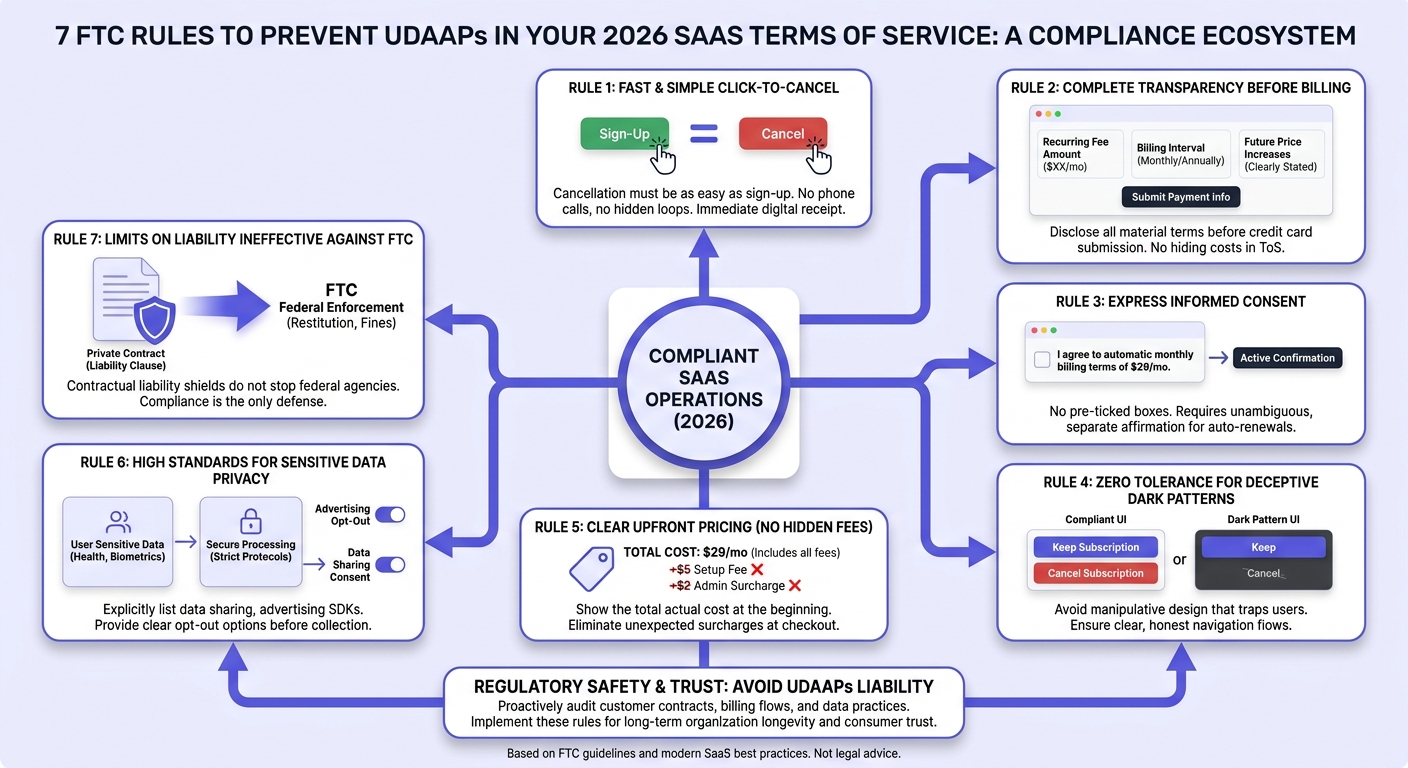
The core of the click-to-cancel rule is simple: canceling a subscription must be just as fast and straightforward as signing up for one. If a user can subscribe with a single click, they must be able to cancel with equal convenience.
- Prohibited Obstacles: You can no longer force digital subscribers to make phone calls, sit on hold, or interact with a live chat bot to cancel their active account.
- Excessive Retention Prompts: Design paths that guide consumers through several steps of counter-offers or feedback forms are increasingly classified as non-compliant.
- Transparent Instructions: Your platform must offer a clear, easy-to-find cancellation button or dashboard action that stops recurring bills instantly.
Rule 2: Complete Transparency Before any Billing Occurs
You must explicitly disclose all material conditions of your subscription before a customer submits registration or credit card information. Material terms include the recurring fee amount, the billing interval (such as monthly or annually), and any future price increases.
If you operate on a free-trial model that transitions into a paid tier, this detail must be displayed adjacent to the primary offer. Your Terms of Service cannot serve as a hiding place for crucial cost declarations. These disclosures must reside exactly where the purchase decision is made.
Rule 3: Express Informed Consent Without Pre-Ticked Boxes
SaaS checkouts must gain express, affirmative consent from users before processing charges for recurring services. This step must be separate from agreeing to general website policies.
- No Pre-Ticked Selections: Checkboxes that automatically enroll users in auto-renewals or add-on modules violate federal consent principles.
- Unambiguous Confirmations: Incorporate a specific, active confirmation step, such as a checkbox that says, "I agree to the automatic monthly billing terms of $29 per month."
- Clear Confirmations: Send an immediate digital receipt detailing how the user was enrolled, what they paid, and instructions on how to stop future billing.
Rule 4: Zero Tolerance for Deceptive Dark Patterns
Dark patterns are user interface designs that intentionally lead users into taking actions they might not otherwise choose. The FTC targets manipulation setups that exploit cognitive behaviors.
Examples of dark patterns include design styles that highlight the "Keep Subscribing" option in deep blue while rendering the "Cancel Subscription" button practically invisible. Other deceptive design methods include utilizing confusing double negatives in setup screens or timing out cancellation sessions to trap users.

Rule 5: Clear Upfront Pricing Without Hidden Fees
A primary driver of customer friction and regulatory scrutiny is hidden pricing. Under federal guidelines, you must show the total cost of your SaaS product upfront, including any standard processing fees, platform surcharges, or set-up charges.
According to FTC press files, unexpected price additions at checkout are a primary source of complaint filings. The table below outlines how compliant enterprises handle pricing changes compared to vulnerable setups.
| Pricing Category | Compliant Approach | Non-Compliant Approach (Risking Violations) |
|---|---|---|
| Base Rates | Displays "Plan starts at $15/mo including platform processing charges" at initial inquiry. | Advertises "$10 per month" but appends a mandatory $5 technology fee only at checkout. |
| Tier Upgrades | Clearly declares the true cost increase when switching tiers. | Uses buttons like "Try Pro Features Free" that immediately convert to premium pricing without consent. |
| Administrative Fees | Bundles administrative overhead directly into the advertised base cost. | Appends unexpected administrative surcharges to the billing receipt in the final step. |
Rule 6: High Standards for Sensitive Data Privacy
If your SaaS system collects, monitors, or processes sensitive personal, biometric, or health-related information, your data handling protocols must remain extremely strict. Regulatory authorities actively penalize businesses that share user tracking information with advertising agencies without clear consent.
You cannot slip data sharing allowances into a generic privacy disclosure. Software tools must explicitly list advertising SDKs, monitoring pixels, and marketing integrations, giving consumers clear options to opt out before software installation or account creation.
Rule 7: Limits on Liability Clause Ineffectiveness Against the FTC
Some business leaders think that adding robust "Limitation of Liability" clauses inside their website legal documents shields them from administrative enforcement. In reality, private contractual limitations hold zero weight against federal authorities.
A customer cannot sign away their federal protection, and contractual disclaimers will not stop the FTC from pursuing restitution, civil fines, or operating limitations. Crafting a regulatory compliant user transaction pathway remains your primary defense mechanism against ongoing liabilities.
Protect Your SaaS Platform from Regulatory Liability
Avoiding the danger of modern consumer protection liabilities requires expert drafting of your digital platform documents. Leaving your operational guidelines, checkout funnels, and cancellation procedures to basic templates can leave your enterprise vulnerable to massive regulatory fines and processing interruptions.
The experienced legal team at AirCounsel provides clear, fixed-price legal solutions designed to keep your SaaS platform fully compliant with modern federal consumer rules. We examine your operations, checkouts, and customer agreements to identify risks and help you clear up dark patterns, confusing payment paths, and hidden vulnerabilities.
- Protect your online tool with a professional SAAS Application Terms of Service draft designed for ongoing regulatory compliance.
- Get a comprehensive Review of your Contract or Legal Document to pinpoint and neutralize dark patterns or subscription compliance gaps.
- Acquire a tailored document designed for your platform via our Custom Application, Software or Website Terms of Service service.
This article provides general information and is not legal advice.
Frequently Asked Questions
What does the FTC's "Click-to-Cancel" rule require for subscription services?
The rule requires that canceling any subscription service must be just as easy and simple as the process to sign up. If you offer online enrollment, you must offer a simple online cancellation mechanism (like a one-click cancellation button) without forcing users to make phone calls or navigate deceptive retention loops.
Can a Terms of Service liability clause protect a company from FTC enforcement actions?
No. Private contracts cannot limit a federal agency's authority to enforce consumer protection laws. Standard limitations of liability or waiver clauses in your terms of service are completely ineffective against FTC interventions, consumer refunds, and statutory penalties.
Are pre-ticked boxes for automatic renewals compliant with FTC informed consent rules?
No, pre-ticked checkmarks for upgrades, automatic renewals, or additional services are non-compliant. They do not constitute express informed consent under modern federal rules because they assume user agreement without an active confirmation step.
What information must be disclosed before collecting billing data under the FTC transparency rule?
You must explicitly disclose all material costs, the billing schedule frequency, when charges repeat, and the exact process to cancel the fee obligations. These details must be placed clearly visible in the transaction path, prior to collecting credit card or payment credentials.
Recommended
Need Legal Assistance?
Our expert legal team is ready to help you navigate complex legal matters with confidence.