Why You Need a Contract Review Lawyer for Post-FTC Executive Employment Agreements

Engaging key leaders is one of the highest-stakes moments for any growing business. However, recent federal regulatory shifts and evolving state statutes have transformed how restrictive covenants operate across the country. According to the Federal Trade Commission, senior executives represent less than 0.75% of workers, yet their restrictive covenants account for the vast majority of enterprise trade secret, talent retention, and unfair competition disputes.
For founders, startups, and small-to-medium businesses (SMBs), working with an experienced contract review lawyer is critical when drafting or revising leadership agreements. Relying on outdated templates or overbroad non-competes creates significant regulatory liability and leaves your core intellectual property vulnerable if key personnel depart.
Navigating the intersection of federal rules, state enforcement trends, and commercial realities requires a proactive approach to contract drafting. This guide explains the current legal landscape for executive covenants, how to audit existing agreements, and how targeted legal reviews protect your company assets.
Table of Contents
- The Post-FTC Non-Compete Landscape for Executives
- Who Qualifies as a Senior Executive?
- Executive Contract Review Checklist
- State Law Variations and Blue-Pencil Risks
- The Sale-of-Business Exception vs Employment Covenants
- Actionable Steps to Audit and Update Executive Agreements
- Protect Your Business with Professional Contract Review
Quick Summary
| Takeaway | Explanation |
|---|---|
| Regulatory Evolution | The FTC rule establishes distinct standards for senior executives versus ordinary workers, alongside active federal court challenges. |
| Senior Executive Criteria | Requires meeting both an annualized earnings threshold of at least $151,164 and holding broad policy-making authority. |
| Multi-Layered Protection | Non-competes must be backed by robust non-disclosure, non-solicitation, and IP assignment clauses. |
| State Law Supremacy | State statutes frequently impose stricter restrictions on non-competes than federal guidelines. |
| Regular Agreement Audits | Proactive contract reviews eliminate unenforceable terms and prevent catastrophic trade secret exposure. |
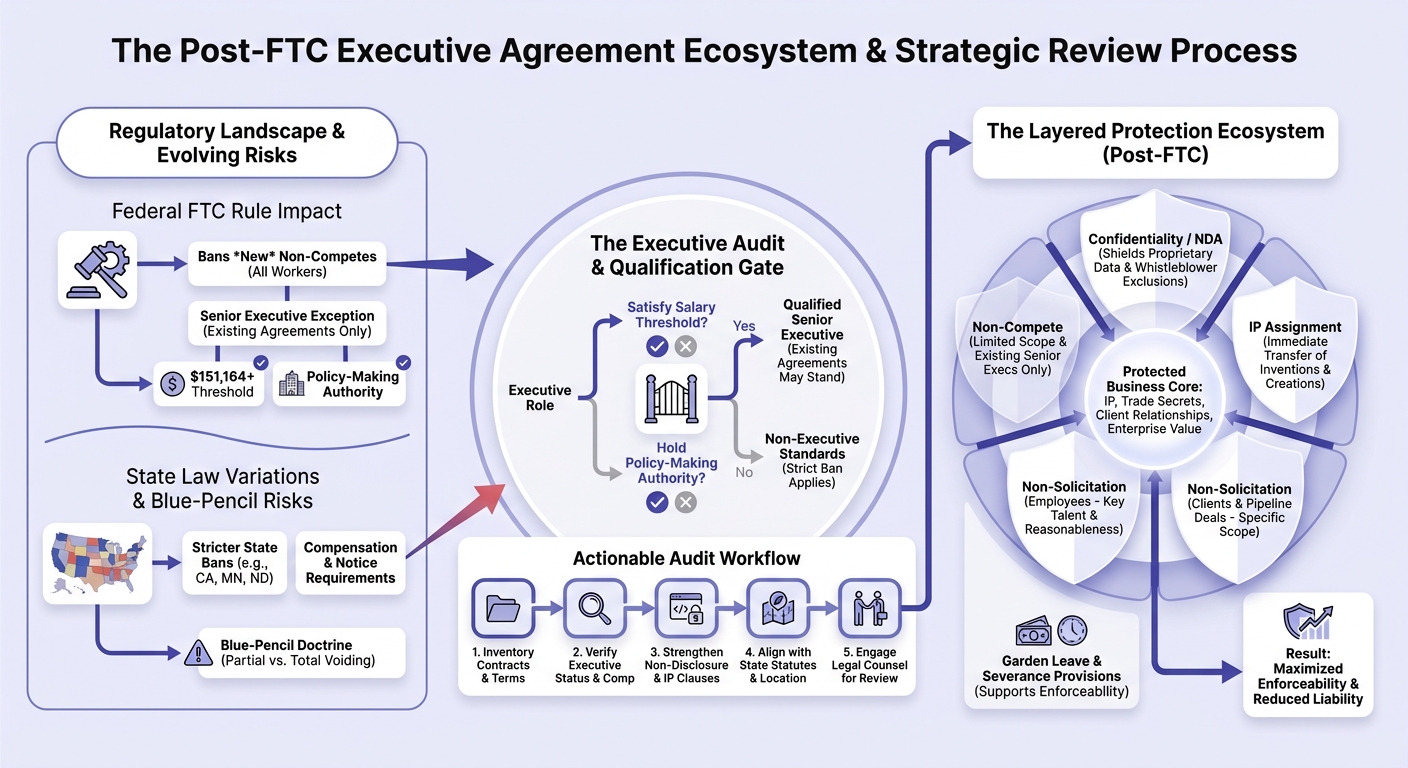
The Post-FTC Non-Compete Landscape for Executives
The FTC issued a final rule designed to ban post-employment non-compete clauses across the US economy. While the rule broadly prohibits entering into new non-competes for all workers, it created a narrow carve-out for existing agreements signed by senior executives prior to the rule's effective date.
Federal litigation has introduced ongoing uncertainty regarding nationwide enforcement. According to legal analyses by the Congressional Research Service, federal courts have issued conflicting preliminary rulings and injunctions regarding the FTC's statutory authority.
Because of this shifting judicial and regulatory landscape, employers cannot assume that a legacy non-compete will hold up in court. Relying on a single sweeping non-compete clause creates unnecessary risk. Employers must work with a contract review lawyer to construct layered protections that remain enforceable regardless of federal regulatory developments.
Who Qualifies as a Senior Executive?
Under the FTC framework, not every employee with an impressive title qualifies for executive treatment. Qualifying as a senior executive requires satisfying a two-prong legal test:
- Compensation Threshold: The worker must have received total annual compensation of at least $151,164 in the preceding year (or an annualized equivalent if employed for only part of the year).
- Policy-Making Position: The worker must serve as the president, chief executive officer, or an officer with policy-making authority over the entire enterprise (similar to a corporate officer or a partner with substantial governance control).
If an employee earns above $151,164 but lacks final authority over company-wide strategic decisions (such as a regional sales director or lead engineer), they do not meet the senior executive threshold. For these roles, entering into new post-employment non-compete restrictions faces severe enforceability challenges.
Executive Contract Review Checklist

When evaluating an executive employment contract, a legal review must look far beyond the non-compete paragraph. Strong executive agreements rely on a network of enforceable covenants to protect business goodwill, proprietary code, and strategic data.
| Covenant Type | Primary Function | Key Review Focus |
|---|---|---|
| Non-Compete | Restricts working for a direct market competitor | Geographic scope, temporal limit (e.g., 12 months), and clear definition of competing business. |
| Non-Solicitation (Clients) | Prevents diverting existing clients or pipeline deals | Must define specific customers the executive personally managed, not the entire market. |
| Non-Solicitation (Employees) | Bars recruiting former colleagues or key talent | Must avoid unreasonable hiring restrictions on non-essential personnel. |
| Confidentiality / NDA | Shields trade secrets and proprietary data | Must clearly exclude publicly available information and whistleblower disclosures. |
| IP Assignment | Transfers invention ownership to the company | Must confirm immediate assignment of rights created during employment. |
Garden Leave and Severance Provisions
To maximize the enforceability of restrictive covenants, many companies implement garden leave provisions. Under a garden leave clause, the company pays the executive their regular salary and benefits for a designated period (such as 90 days) while they remain an employee but perform no active work. Because the individual continues to receive compensation, courts are far more likely to uphold restrictions on their ability to join a competitor immediately.
Severability and Blue-Penciling
A critical clause in any executive agreement is the severability provision. In some states, courts apply the "blue-pencil doctrine," crossing out invalid clauses while enforcing the remainder of the agreement. In other jurisdictions, a single overbroad clause can void the entire non-compete agreement. Having an attorney review these mechanics prevents a poorly phrased restriction from compromising your entire agreement.
State Law Variations and Blue-Pencil Risks
Federal rules set a baseline, but state law governs the day-to-day enforcement of employment covenants. Even if a covenant passes federal standards, it may be completely void under state legislation:
- Complete Prohibitions: States such as California, North Dakota, Oklahoma, and Minnesota maintain near-total statutory bans on employee non-compete clauses.
- Compensation Thresholds: States like Washington, Colorado, Illinois, and Massachusetts enforce strict statutory minimum salaries before any non-compete or non-solicitation agreement can be enforced.
- Notice Requirements: Several states require employers to provide written notice of non-compete terms before the candidate accepts an offer, typically between 10 to 14 days in advance.
Because multi-state remote hiring is standard for modern startups, your executive agreements must account for choice-of-law provisions and the actual physical location of your leadership team.
The Sale-of-Business Exception vs Employment Covenants
It is vital to distinguish between employment-based restrictive covenants and those entered into during a corporate transaction.
When a founder or executive sells their equity or business assets, non-competes remain widely recognized and enforced across almost all US jurisdictions, including California. In a sale context, courts recognize that the buyer is purchasing the company's enterprise value and customer relationships. As long as the seller receives reasonable consideration for their ownership interest, non-competes tied to a business sale face far less legal scrutiny than standard employment agreements.
Actionable Steps to Audit and Update Executive Agreements
Founders and operators should follow a structured approach when onboarding new executives or updating legacy contracts:
- Step 1: Conduct a Contract Inventory: Collect all existing executive agreements, offer letters, equity award agreements, and severance terms across your leadership team.
- Step 2: Verify Executive Status: Confirm whether each individual meets both the earnings and policy-making authority tests under current federal definitions.
- Step 3: Strengthen Non-Disclosure and IP Clauses: Ensure your trade secret definitions, non-disclosure terms, and assignment of inventions clauses provide independent, comprehensive protection.
- Step 4: Align with State Statutes: Check where each executive resides and ensure the agreement complies with mandatory local notice periods and salary minimums.
- Step 5: Engage Legal Counsel: Work with a professional to draft clean redlines, remove invalid provisions, and clarify dispute-resolution mechanics.
Protect Your Business with Professional Contract Review
Safeguarding your company's proprietary data, customer relationships, and enterprise value requires precise legal drafting. Overbroad restrictive covenants expose your business to legal disputes and unenforceable contracts, while insufficient protections leave your trade secrets exposed.
AirCounsel connects founders and small business operators with licensed US attorneys who deliver fast, transparent, and fixed-fee contract reviews. Whether you need a comprehensive Employment Contract Review for a new C-suite hire, a customized Custom Employment Agreement, or an on-demand Review of your Contract or Legal Document, our platform provides the legal clarity you need within 2 business days.
This article provides general information and is not legal advice.
Frequently Asked Questions
Are new non-compete clauses still allowed for executives in the US?
Under the FTC rule, employers cannot enter into new post-employment non-compete agreements with any workers, including senior executives, after the effective date. However, active federal litigation and court stays mean businesses should work with legal counsel to structure compliant alternatives like robust confidentiality agreements, garden leave, and targeted customer non-solicitation provisions.
Can existing executive non-competes still be enforced under the FTC rule?
The FTC rule permits existing non-competes for senior executives entered into before the rule's effective date to remain in force. To qualify, the executive must have earned at least $151,164 annually and held true policy-making authority across the enterprise.
What contract language should be reviewed besides the non-compete clause?
An executive review should thoroughly evaluate intellectual property assignments, proprietary data protections, non-solicitation of clients and staff, severance triggers, arbitration provisions, and choice-of-law clauses. Strong IP and confidentiality terms often provide better protection than non-competes without the same regulatory hurdles.
Do state non-compete laws still matter if there is a federal FTC rule?
Yes. State employment laws continue to apply whenever they provide greater worker protection or stricter bans than federal regulations. If an executive resides in a state that completely bans non-competes, such as California or Minnesota, state law invalidates the clause even if federal rules would otherwise permit it.
Recommended
- Employment Contract Review: Get a detailed risk analysis and plain-English redlines for executive and contractor agreements.
- Review of your Contract or Legal Document: Protect your business with upfront fixed-fee attorney reviews delivered in two business days.
- Custom Employment Agreement: Secure your leadership team with an attorney-drafted, enforceable employment contract tailored to your state.
Need Legal Assistance?
Our expert legal team is ready to help you navigate complex legal matters with confidence.