The US Founder's Legal Checklist for Engaging a Contract Lawyer During Series A Diligence

Welcome to the high-stakes world of venture capital. When your startup transitions from early-stage growth to raising a Series A round, the speed of your closing depends heavily on the state of your commercial agreements. To survive the intense scrutiny of investor legal teams, engaging an experienced contract lawyer is one of the most critical moves a founder can make.
While founders often focus on pitch decks and financial modeling, the reality of legal diligence can bring a deal to a grinding halt. In fact, research shows that 99.9% of businesses in the United States are small businesses, and those seeking institutional venture capital face strict regulatory disclosures under guidelines from the SEC Office of Small Business Advocacy. Unsigned agreements, missing IP assignments, and poorly drafted customer contracts are prime targets for investor redlines.
Hiring a specialized contract lawyer allows you to spot compliance risks, clean up historic paperwork, and present a structured data room that instills investor confidence. This guide outlines how to strategically onboard outside counsel to protect your cap table and keep your financing timeline on track.
Table of Contents
- Quick Summary
- When to Hire a Contract Lawyer for Series A Diligence
- Prioritizing Your Contracts for Review
- Critical Diligence Risks Your Attorney Will Spot
- Preparing a Diligence-Ready Contract Package
- How to Evaluate and Onboard Counsel Efficiently
- US-Specific Regulatory and Compliance Hurdles
- Secure Your Series A Funding with AirCounsel
- Frequently Asked Questions
- Recommended
Quick Summary
| Takeaway | Explanation |
|---|---|
| Immediate Onboarding | Engage a contract lawyer at least 4 to 6 weeks before your expected term sheet to avoid closing delays. |
| IP Assignment is Non-Negotiable | Every founder, employee, and contractor must have a fully signed IP assignment agreement in place. |
| Prioritize Customer MSAs | Investors audit your Master Services Agreements (MSAs) to ensure revenue predictability and check for liability caps. |
| Structured Data Room | Keep fully executed, unredacted PDFs organized in a secure, logical directory system (like Box, Google Drive, or specialized VDRs). |
| Fixed-Price over Hourly | Use flat-fee contract reviews to manage legal budget predictability during the capital raise. |
When to Hire a Contract Lawyer for Series A Diligence
Series A diligence is not the time to realize you have missing signatures. Many founders mistakenly wait until they have a signed term sheet before organizing their legal agreements. By then, the transaction clock is ticking, and any friction in the data room can lead to investor fatigue or renegotiated valuations.
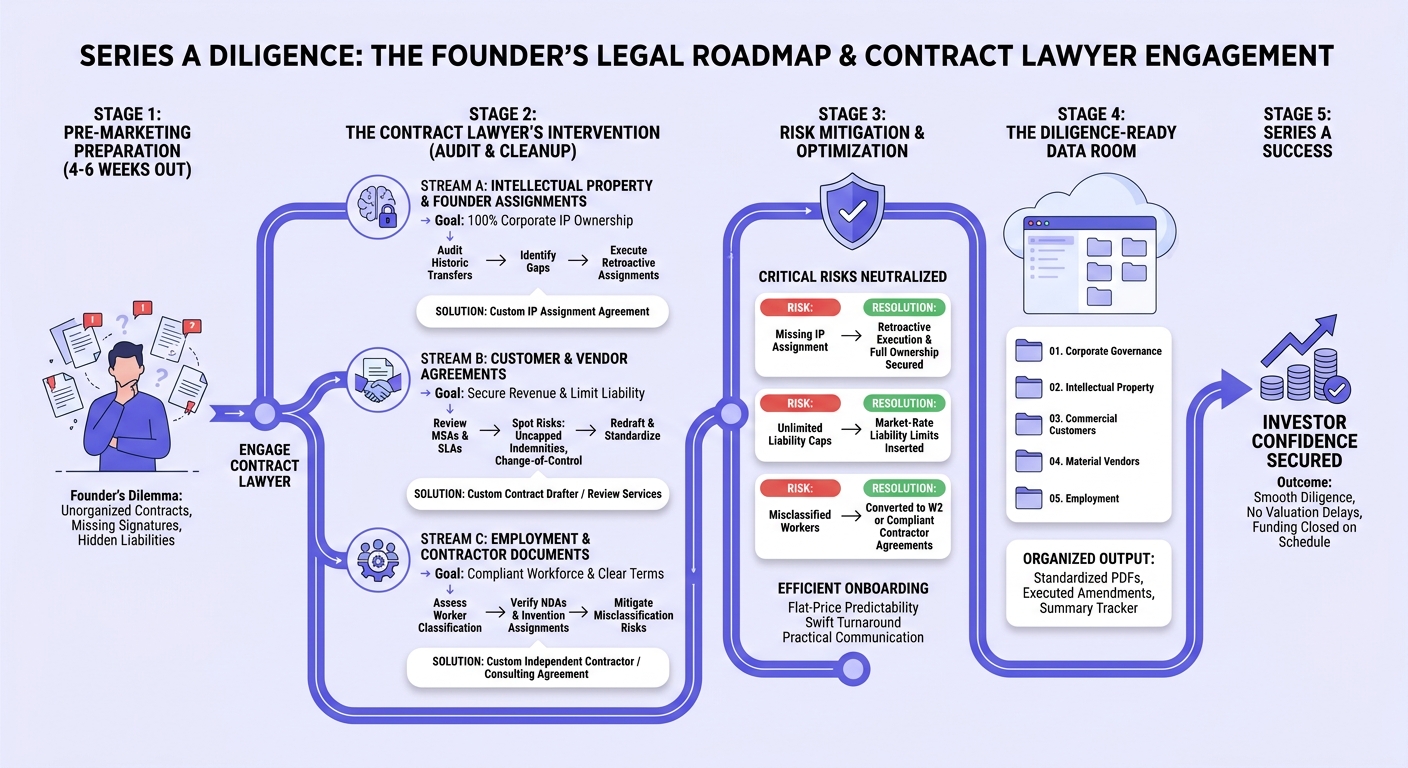
The ideal time to engage a contract lawyer is during your pre-marketing phase, roughly 4 to 6 weeks before you expect your first term sheet. This gives your legal partner time to review your commercial templates, check for missing execution blocks, and redraft problematic clauses.
If you are already in active conversations with venture capital firms, certain triggers demand immediate legal support:
- A diligence request list lands in your inbox containing queries on historical customer liabilities.
- You realize that key customer contracts were executed on old, unreviewed templates.
- You find gaps in founder or early-employee intellectual property assignments.
In these fast-moving scenarios, leveraging a professional Review of your Contract or Legal Document can resolve high-impact vulnerabilities before they disrupt investor confidence.
Prioritizing Your Contracts for Review
Not all business contracts carry equal weight during a Series A raise. Investors prioritize agreements that tie directly to corporate governance, proprietary value, and continuous revenue streams. Your contract lawyer will help you focus on three primary tiers of documentation.
1. Intellectual Property and Founder Assignments
Your startup’s core value lies in its intellectual property (IP). Investors must be absolutely certain that the corporate entity, rather than individual founders or contractors, owns 100% of the software, designs, and branding.
A specialized contract lawyer will audit your historical transfers to ensure compliance with the USPTO Assignment and Recordation Branch guidelines. Every past and present team member must have an executed Custom IP Assignment Agreement in place.
2. Customer and Vendor Agreements
Your customer agreements are the engine of your business. Investors review Master Services Agreements (MSAs), Service Level Agreements (SLAs), and terms of service to assess the stability of your monthly recurring revenue (MRR).
They will search for "most favored nation" clauses, uncapped indemnities, or unusual termination-for-convenience rights that could compromise your revenue predictability. If your core commercial templates are weak, your attorney can step in as a Custom Contract Drafter to standardize your customer contracts and safeguard your liabilities.
3. Employment and Contractor Documents
VC legal teams pay close attention to employee classification and worker agreements. They will check to ensure your team is bound by robust non-disclosure agreements (NDAs) and invention assignment terms.
Furthermore, misclassifying workers can trigger massive retroactive tax and benefit issues under the US Department of Labor Wage and Hour Division regulations. Utilizing a tailored Custom Independent Contractor / Consulting Agreement prevents worker classification errors from becoming a diligence deal-breaker.
Critical Diligence Risks Your Attorney Will Spot

During Series A diligence, investor lawyers look for specific contractual liabilities that might expose the company to future legal action. A seasoned contract lawyer acts as your defensive line, identifying and neutralizing these hazards beforehand.
- Assignment Restrictions and Change-of-Control: Many enterprise contracts contain provisions that prevent a startup from assigning the agreement to a third party without written consent. If your startup undergoes a corporate restructure or acquisition, these clauses can block the transition.
- Uncapped Indemnification: If your standard commercial agreements pledge to hold customers harmless for any damages without a liability limit, you are taking on massive corporate risk. Investors will demand that these liabilities are strictly capped.
- Auto-Renewal and Non-Standard Termination: Contracts that lock you into unfavorable pricing terms or allow clients to terminate with immediate notice without cause disrupt future cash flow projections.
- Incomplete Executions: It is surprisingly common for busy startups to have unsigned, partially signed, or missing counterparty pages on key customer contracts.
| Diligence Risk | Potential Impact on Deal | Resolution Strategy |
|---|---|---|
| Missing IP Assignment | Investor refuses to close until IP ownership is resolved. | Execute retroactive assignments with employees/founders immediately. |
| No Change-of-Control Clause | Competitor acquisition or financing could trigger contract termination. | Renegotiate or amend key customer contracts prior to close. |
| Unlimited Liability Caps | Uncapped financial risk makes the business an unattractive investment. | Request contract reviews and insert market-rate liability limits. |
| Misclassified Workers | Significant back-tax penalties and wage-and-hour compliance fines. | Convert long-term 1099 contractors to W2 employees. |
Preparing a Diligence-Ready Contract Package
To maintain momentum during a financing round, you need a highly organized, professional virtual data room (VDR). Your contract lawyer can guide you through a step-by-step preparation plan:
- Step 1: Categorize and Standardize: Organize all company documents into clean, logical folders: Corporate Governance, Intellectual Property, Commercial Customers, Material Vendors, and Employment.
- Step 2: Collect Redlines and Amendments: Ensure that every signed contract includes its accompanying amendments, addenda, and exhibits. Loose paperwork triggers suspicion.
- Step 3: Align with Governance Documents: Ensure your commercial arrangements match up perfectly with the corporate rules laid out in your LLC Operating Agreement or corporate charter.
- Step 4: Create a Contract Summary Tracker: Draft a comprehensive spreadsheet summarizing critical terms for your top 10 customer accounts, including MRR/ARR, term lengths, liability limits, and change-of-control requirements.
This organized approach demonstrates to investors that your operation is mature, clean, and ready for institutional scale.
How to Evaluate and Onboard Counsel Efficiently
Not all lawyers are built for the speed of startup transactions. To keep your financing round moving, you need a contract lawyer who understands venture capital dynamics and operates at the speed of business.
When evaluating potential attorneys, focus on the following:
- Scope of Work: Ensure they can handle the specific commercial, employment, and IP issues typical of early-stage US startups.
- Turnaround Time: Ask about standard delivery windows. Diligence issues require swift action, often within 24 to 48 hours.
- Pricing Transparency: Avoid open-ended hourly billing wherever possible. Opt for flat-rate, transparent pricing packages so your legal spend remains completely predictable.
- Practical Communication: Look for attorneys who explain legal terms in plain English, prioritize practical business solutions over theoretical risks, and suggest actionable workarounds.
US-Specific Regulatory and Compliance Hurdles
While startup business standards are increasingly globalized, raising capital in the US introduces distinct state and federal regulatory challenges.
First, state laws vary significantly regarding non-compete clauses, employee classification, and contract enforcement. For example, while your corporate entity might be registered in Delaware, your operational contracts must comply with the local employment laws of the states where your remote workers reside.
Second, your contract lawyer must coordinate legal cleanup with tax classification issues. The IRS Small Business and Self-Employed Tax Center strictly monitors how corporate entities classify independent contractors.
If any material commercial agreements require amendment prior to close, your contract lawyer will need to draft and execute these changes without alerting your clients to sensitive, pre-close transaction terms.
Secure Your Series A Funding with AirCounsel
Navigating the stressful waters of Series A venture diligence requires speed, accuracy, and clear budget oversight. Don't let unorganized contract files or hidden liability clauses derail your hard-earned term sheet.
Our expert, US-licensed attorneys can jump in immediately with upfront, flat-rate pricing to audit your agreements and make your startup diligence-ready. Protect your IP, resolve contractual red flags, and complete your raise with absolute confidence.
Use the following services to streamline your legal preparation:
- Get a comprehensive Review of your Contract or Legal Document to catch hidden risks in customer and vendor agreements.
- Ensure all intellectual property is fully transferred with a Custom IP Assignment Agreement.
- Draft robust contractor templates using a Custom Independent Contractor / Consulting Agreement.
This article provides general information and is not legal advice.
Frequently Asked Questions
When should a founder hire a contract lawyer during Series A diligence?
Ideally, founders should engage a contract lawyer 4 to 6 weeks before signing a term sheet. This provides adequate runway to clean up any missing document signatures, execute backdated assignments, and audit key commercial agreements before the investor's legal team begins their exhaustive review.
What documents do investors usually review during contract diligence?
Investors scrutinize every agreement that could impact the company's valuation or liability. This includes custom customer MSAs, key vendor agreements, employment offer letters, IP assignment agreements, active non-disclosure agreements (NDAs), lease terms, and capital structure documents.
What contract issues most often delay a Series A closing?
The most common delays stem from missing founder or contractor intellectual property assignments, change-of-control clauses that require customer consent, uncapped indemnification obligations, and unorganized, unsigned copies of historic commercial contracts.
Should founders use fixed-fee or hourly counsel for diligence cleanup?
For standard cleanup tasks like contract audits, contractor templates, and routine amendments, fixed-fee counsel is highly recommended. It keeps your legal expenses predictable, prevents unexpected billable hours, and ensures outside counsel is incentivized to work efficiently under tight timelines.
Recommended
- Get quick, expert advice on any specific agreement: Review of your Contract or Legal Document
- Draft tailored compliance terms for your service providers: Custom Independent Contractor / Consulting Agreement
- Clean up and protect proprietary assets: Custom IP Assignment Agreement
Need Legal Assistance?
Our expert legal team is ready to help you navigate complex legal matters with confidence.