Why Custom Contracts Are Critical for Series A Side Letters

Closing a Series A round is a monumental milestone for any high-growth startup. While primary term sheets and stock purchase agreements establish the broad strokes of the deal, sophisticated venture investors often demand specific, customized promises. These carve-outs are typically formalized using side letters—agreements that modify or add rights for specific shareholders.
Managing these requests requires precision. While templates exist, relying on generic forms can introduce structural risks, conflicting terms, and future compliance issues. Securing custom contracts by an attorney ensures that your side letters align with Delaware corporate law, safeguard founder control, and keep your company legally compliant. According to data published by the Small Business Administration (SBA), 99.9% of all US enterprises are small businesses, highlighting that structured, high-stakes corporate scaling is underpinned by the same fundamental need for secure and professional business documentation.
Handling venture financing demands an understanding of specialized corporate mechanics, governance rules, and fiduciary duties. Let us break down how founders can successfully navigate customized side letters during their Series A transition.
Table of Contents
- Quick Summary
- What Is a Series A Side Letter?
- Commonly Negotiated Terms in Side Letters
- Consistency Risks: Keeping Your Deal Documents Aligned
- Step-by-Step Checklist for Drafting Investor-Ready Side Letters
- Why Generic Templates Fail Series A Founders
- Streamline Your Series A Side Letters with AirCounsel
- Frequently Asked Questions
- Recommended
Quick Summary
| Takeaway | Explanation |
|---|---|
| Side Letter Purpose | Used in Series A rounds to grant specific, customized rights to individual investors without rewriting the core financing documents. |
| Key Risk | Inconsistencies between side letters and main documents (like the Investor Rights Agreement) can lead to breach of contract or governance disputes. |
| Common Terms | Typically covers observer rights, information rights, pro rata rights, and Most-Favored-Nation (MFN) clauses. |
| The Solution | Relying on custom contracts by an attorney ensures terms are legally enforceable and compliant with Delaware or local state law. |
What Is a Series A Side Letter?
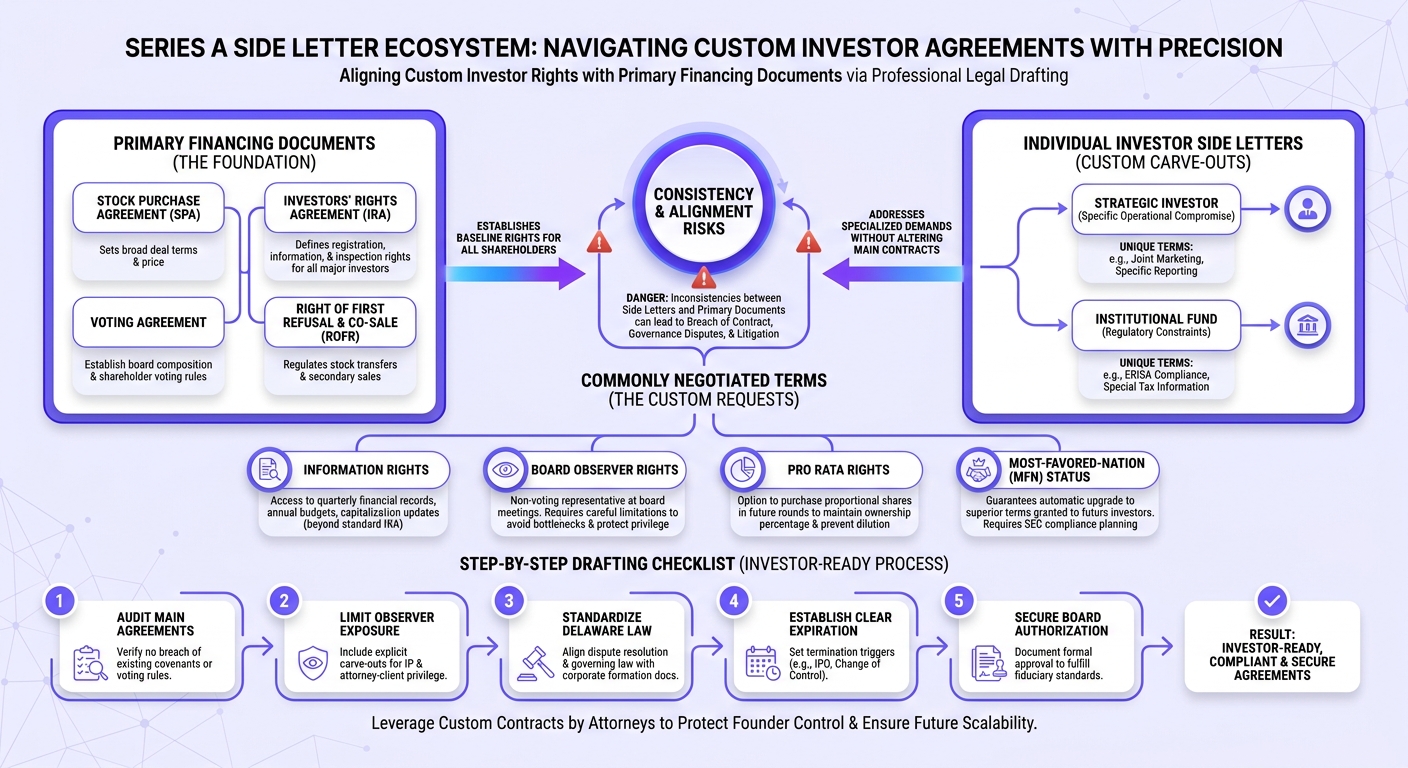
A side letter is a bilateral agreement executed alongside primary transaction documents during a financing round. In a standard Series A round, the primary documents include the Stock Purchase Agreement (SPA), the Investors’ Rights Agreement (IRA), the Voting Agreement, and the Right of First Refusal and Co-Sale Agreement (ROFR).
While these primary files are signed by all participating investors, side letters are executed only between the company and a single investor. Founders use them to address specialized investor demands without cluttering the main contracts or forcing all class shareholders to agree to identical, hyper-customized privileges.
Using side letters is helpful when an institutional fund has highly specific regulatory constraints or when a strategic investor requires a unique operational compromise. However, because these documents operate in tandem with your main capital agreements, they must be drafted with extreme precision.
Commonly Negotiated Terms in Side Letters
Venture capital firms and specialized funds frequently come to the table with a standard set of custom requests. Some are benign regulatory requirements, while others can significantly shift power dynamics in your startup.
Information and Observer Rights
While major investors automatically receive access to company financial records under standard IRAs, smaller or specialized funds often use side letters to secure similar privileges.
- Information Rights: These grant rights to receive quarterly balance sheets, annual budgets, and capitalization updates.
- Board Observer Rights: This allows an investor to send a non-voting representative to attend your board of directors meetings, which can lead to governance bottlenecks if not carefully limited.
Pro Rata Participation and MFN Status
Investors want to protect their equity from dilution in future rounds. To do this, they request specific mechanisms that guaranty preemptive rights.
- Pro Rata Rights: These provide the investor with the option to purchase their fractional share of any new stock issued in future rounds, ensuring their ownership percentage remains stable.
- Most-Favored-Nation (MFN) Status: This clause ensures that if the company grants more favorable terms to any other investor in the future, those superior terms automatically apply to this investor as well. MFN issues require a clear compliance plan under federal guidelines, such as those maintained by the U.S. Securities and Exchange Commission (SEC), to avoid creating unequal tiers of stockholders that disrupt future financing rounds.
Consistency Risks: Keeping Your Deal Documents Aligned
The primary danger of utilizing unvetted side letters is contract inconsistency. If a side letter grants a right that directly contradicts the terms of your main Investors’ Rights Agreement (IRA) or your Certificate of Incorporation, you open the door to serious internal governance disputes.
For example, if your standard IRA states that board observer seats must be approved by a majority of the board, but a side letter unilaterally promises an observer seat to a specific angel investor, your company is immediately in breach of its obligations to one of the parties.

When customizing side letters, you must audit them against your core charter and equity documents. Failing to maintain this alignment can severely complicate future Series B rounds, as subsequent institutional investors will review the complete legal historical chain during their due diligence.
Step-by-Step Checklist for Drafting Investor-Ready Side Letters
When a major investor delivers a side letter request during Series A drafting, founders should follow a structured review and negotiation framework to protect startup autonomy.
| Step | Action Item | Critical Legal Focus |
|---|---|---|
| Step 1 | Audit Main Agreements | Verify that the side letter does not breach any existing covenants or voting agreements. |
| Step 2 | Limit Observer Exposure | Ensure observer clauses include explicit carve-outs for proprietary IP discussions and attorney-client privilege. |
| Step 3 | Standardize Delaware Choice of Law | Align the dispute resolution venue and governing law with your Delaware corporate formation documents. |
| Step 4 | Establish Clear Expiration | Set definite termination triggers, such as upon an initial public offering (IPO) or a change of company control. |
| Step 5 | Secure Board Authorization | Document formal board approval for every customized side letter to fulfill fiduciary standards. |
Why Generic Templates Fail Series A Founders
Using generic side letter templates found online can lead to significant problems. First, templates often lack definitions that match your main transaction files, creating gaps in litigation environments. Second, standard forms rarely address local regulatory shifts, Delaware corporate codes, or state-specific corporate governance constraints.
Relying on generic documents can inadvertently lock you into bad terms. For instance, broad MFN clauses can force you to extend premium rights to earlier investors when you bring on strategic partners later.
By working with custom contracts by an attorney, you can construct targeted agreements that address your immediate needs while protecting your cap table. This avoids the traps of auto-extension clauses, unvetted board obligations, and compliance oversights.
Streamline Your Series A Side Letters with AirCounsel
Closing a Series A round is stressful enough without worrying about conflicting, unenforceable investor agreements. AirCounsel connects high-growth founders with experienced US-licensed lawyers who draft and review custom side letters tailored to your business goals. Protect your control, preserve your cap table, and get the peace of mind that only custom documents can provide.
Explore our transparent, fixed-price services to secure your financing documents today. Work with a specialized Custom Contract Drafter starting at just $800, or secure a thorough Review of your Contract or Legal Document for $250. Let our team do the heavy lifting while you focus on scaling your business.
This article provides general information and is not legal advice.
Frequently Asked Questions
What is a side letter in a Series A financing?
An agreement between a startup and a specific investor that runs parallel to the primary financing documents to grant special rights (e.g., observer rights, MFN status).
When should a founder use custom contracts by an attorney instead of a template?
A founder should always use customized legal reviews when drafting side letters, as templates often fail to resolve conflicts with existing Investor Rights Agreements or Delaware corporate laws, leaving the company open to litigation risks.
Can a side letter conflict with the main investment documents?
Yes. If a side letter promises rights that conflict with the charter or the multi-party Investor Rights Agreement, it can create a breach of contract claim or make the side letter unenforceable.
Do investors need to disclose side letters to the other parties in the round?
Yes, typically. Lead investors and other major institutional players often require visibility into all side agreements to ensure transparency and prevent fiduciary duty complications.
Recommended
- Custom Contract Drafter - Get custom, attorney-drafted contracts, terms, or policies tailored to your Series A round.
- Review of your Contract or Legal Document - Have a seasoned US-licensed attorney review your investor-provided side letters for hidden traps.
- Online Consultation - Discuss your corporate governance structure and side letter mechanics with legal experts.
Need Legal Assistance?
Our expert legal team is ready to help you navigate complex legal matters with confidence.