The Essential 2026 Checklist for Evaluating State FDD Registration Compliance with a USA Franchise Review Lawyer

Buying a franchise can provide an established brand and operating model, but signing an agreement without verifying regulatory compliance exposes your capital to severe legal and financial risks. While federal guidelines require baseline disclosures across the country, 14 franchise registration states require franchisors to formally register their Franchise Disclosure Document (FDD) before marketing or executing any franchise sale.
If a franchisor offers territories or collects deposits without active state registration, the franchise agreement may face state enforcement actions, stop orders, or rescission claims. Working with a dedicated franchise review lawyer allows prospective franchisees and entrepreneurs to verify state-level filing compliance, evaluate contract balance, and uncover structural risks before signing binding agreements.
This guide provides a practical compliance checklist for reviewing state FDD filings, delivery timelines, and disclosure addenda under US franchise law.
Table of Contents
- State FDD Registration Compliance Overview
- Federal vs State Franchise Regulations
- The 2026 State FDD Compliance Checklist
- Top Compliance Red Flags to Spot Before Signing
- Protect Your Franchise Investment with AirCounsel
- Frequently Asked Questions
- Recommended
Quick Summary
| Takeaway | Explanation |
|---|---|
| FTC Federal Baseline | Franchisors must deliver a 23-item FDD at least 14 calendar days before accepting fees or signing contracts. |
| 14 Registration States | States like California, New York, and Illinois require state agency review and approval before franchise sales. |
| State Addenda Protection | Mandatory state riders modify standard franchise terms regarding non-competes, termination, and dispute venues. |
| Financial Assurances | States may impose fee impounds or escrow conditions if a franchisor exhibits weak operating capitalization. |
| Legal Diligence Role | A franchise review lawyer confirms active state filings, checks Item 19 claims, and negotiates terms. |
State FDD Registration Compliance Overview
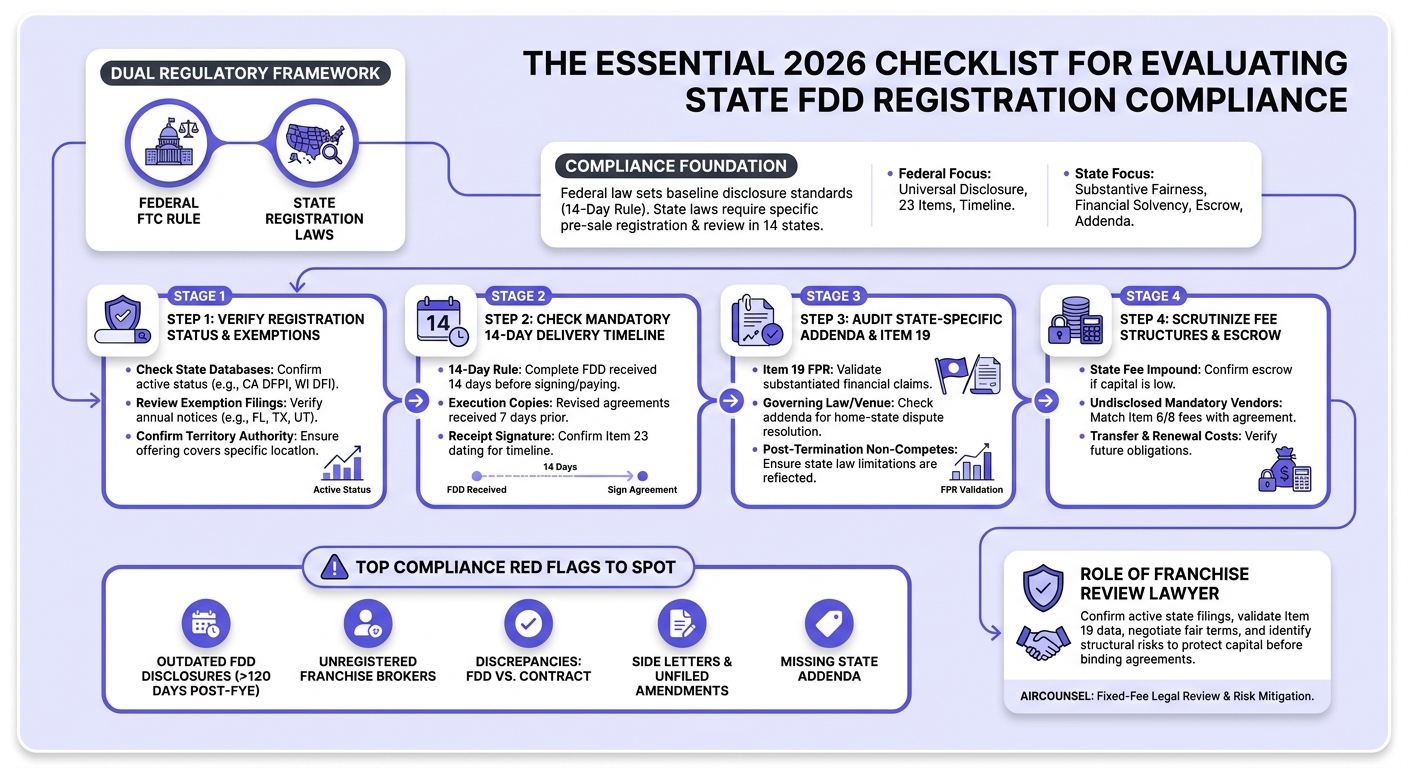
Franchise regulation in the United States operates under a dual system of federal disclosure rules and state-specific registration laws. The Federal Trade Commission enforces the FTC Franchise Rule, which establishes minimum disclosure standards across all 50 states.
However, federal law does not require franchisors to file their FDD with any federal agency. Instead, oversight of registration falls to individual states. For buyers, this means an FDD valid in one state may be completely unauthorized for use in another without specific state registration or notice filings.
When an emerging or established brand expands, an experienced franchise review lawyer confirms that the franchisor has met all local filing obligations before you pay an initial franchise fee or commit personal assets.
Federal vs State Franchise Regulations
Understanding how federal and state laws interact helps prospective operators understand what legal protections apply to their territory.
| Regulatory Layer | Governing Body | Primary Requirements | Buyer Protection Focus |
|---|---|---|---|
| Federal Rule | Federal Trade Commission (FTC) | 23-item disclosure document delivered 14 days prior to signing | Universal disclosure of litigation, fees, turnover, and financials |
| Registration States | State Securities / Banking Divisions (e.g., CA DFPI, NY AG) | Pre-sale review, annual registration, filing fees, state addenda | Substantive contract fairness, financial solvency checks, escrow rules |
| Filing / Notice States | State Business Divisions (e.g., Texas, Florida) | One-time or annual notice filing and business opportunity exemption | Basic verification of franchisor identity and trademark license |
| Non-Registration States | None (Federal FTC rule governs) | Compliance with FTC 14-day disclosure rule only | Relies entirely on federal enforcement and private legal diligence |
In registration states (such as California, Hawaii, Illinois, Indiana, Maryland, Michigan, Minnesota, New York, North Dakota, Rhode Island, South Dakota, Virginia, Washington, and Wisconsin), state regulators examine the FDD for compliance before approving sales.

The 2026 State FDD Compliance Checklist
Before committing capital to a franchise system, work through these 4 verification steps with your legal counsel.
Step 1: Verify State Registration Status and Exemption Filings
Never assume a franchisor is registered simply because they delivered an FDD. Registration must be actively maintained and renewed annually.
- Check State Databases: Verify active registration status through state portals such as California's DFPI or Wisconsin's Department of Financial Institutions database.
- Review Exemption Filings: In exemption-based states like Florida, Utah, or Texas, confirm that the franchisor has filed an annual notice or trademark exemption before offering the unit.
- Confirm Territory Authority: Ensure the franchisor's registered offering covers the exact city, county, or development territory you plan to operate in.
Step 2: Check the Mandatory 14-Day Delivery Timeline
Federal law establishes clear timing requirements under the FTC Franchise Rule:
- 14-Day Rule: A prospective franchisee must receive the complete FDD at least 14 calendar days before signing any binding agreement or paying money to the franchisor.
- Execution Copies: If the franchisor makes unilateral, material changes to the standard franchise agreement, you must receive the revised execution version at least 7 calendar days before signing.
- Receipt Signature: Confirm that Item 23 (Receipts) was properly dated and signed, as this page establishes the legal timeline for compliance.
To understand why procedural missteps in contract timing matter, you can read our guide on why you need a franchise review lawyer before signing to explore standard contract traps.
Step 3: Audit State-Specific Addenda and Item 19 Disclosures
Standard national franchise agreements often contain provisions that violate state relationship laws. Registration states require special state addenda attached to the end of the FDD.
- Item 19 Financial Performance Representations (FPR): If the franchisor makes claims about average revenue or profits, confirm they are documented in Item 19 with clear substantiation. Regulators prohibit undocumented verbal claims.
- Governing Law and Venue: State addenda often nullify franchisor-friendly venue clauses, requiring dispute resolution to occur in the franchisee's home state.
- Post-Termination Non-Competes: In states like California, statutory law prohibits broad post-termination non-compete clauses; ensure the state addendum explicitly reflects this limitation.
Step 4: Scrutinize Fee Structures and Escrow Requirements
State regulators assess franchisor balance sheets (Item 21) to ensure the system has adequate working capital to fulfill its obligations.
- State Fee Impound Conditions: If a franchisor has limited operating capital, state regulators may order an escrow or fee deferral condition. Under these rules, your initial franchise fee must remain in escrow until you open for business.
- Undisclosed Mandatory Vendors: Ensure all required technology, marketing, and supply-chain fees listed in Item 6 and Item 8 match the franchise agreement terms.
- Transfer and Renewal Costs: Verify conditions and fees required to renew or transfer the franchise entity down the road.
If you are structuring a multi-unit investment or scaling across state borders, review our analysis on due diligence for multi-unit franchise operators for advanced portfolio considerations.
Top Compliance Red Flags to Spot Before Signing
A qualified franchise attorney looks for distinct warning signs that signal regulatory non-compliance or heightened financial exposure:
- Outdated FDD Disclosures: Using an FDD older than 120 days post-fiscal-year-end without an updated annual registration.
- Unregistered Franchise Brokers: Using sales brokers who are not properly registered or disclosed in Item 4 of the state filing.
- Discrepancies Between FDD and Contract: Differences between the Item 5 and Item 6 fee summaries and the actual binding franchise agreement.
- Side Letters and Unfiled Amendments: Promising negotiated territory protections or fee waivers without formal state-compliant amendment addenda.
- Missing State Addenda: Providing a standard national agreement in a registration state without the required state rider attached.
Protect Your Franchise Investment with AirCounsel
Navigating franchise disclosure compliance requires experienced legal oversight. AirCounsel provides fixed-fee, transparent legal reviews led by licensed US attorneys who evaluate your FDD, flag state filing discrepancies, and identify aggressive contract provisions within 2 business days.
Get your documents reviewed or prepare your commercial corporate structure with our specialized legal services:
- Have your complete disclosure packet analyzed with our Franchise Agreement and FDD Review.
- Structure your holding entity properly using our USA Entity and Company Formation package.
- Protect your physical location terms with our Commercial Lease Agreement Review.
Frequently Asked Questions
What is the difference between the FTC Franchise Rule and state FDD registration requirements?
The FTC Franchise Rule applies nationally and requires franchisors to disclose a 23-item FDD at least 14 days before signing or taking payment, but it does not require government pre-approval. State registration laws require franchisors to submit their FDD to a state regulator for review and active approval before offering franchises within that state.
Which states require franchise registration before offering or selling a franchise?
There are 14 registration states in the US: California, Hawaii, Illinois, Indiana, Maryland, Michigan, Minnesota, New York, North Dakota, Rhode Island, South Dakota, Virginia, Washington, and Wisconsin. Several other states require business opportunity notice filings or trademark exemptions.
How long before signing or paying must I receive the FDD?
Under federal law, you must receive the complete FDD at least 14 calendar days before you sign any contract or pay any non-refundable fee. If the franchisor makes unilateral, negotiated material changes to the agreement, you must receive those finalized terms at least 7 days before execution.
What are the most common red flags a franchise review lawyer looks for in an FDD?
Attorneys primarily look for expired state registrations, unsupported Item 19 financial claims, pending litigation with former franchisees in Item 3, high franchisee turnover rates in Item 20, missing state addenda, and aggressive personal guarantee terms.
Recommended
- Franchise Agreement and FDD Review Service - Comprehensive attorney review of your franchise agreement and FDD.
- Custom Franchise Agreement - Professional franchise drafting for emerging franchisors.
- USA Entity and Company Formation - Form your franchisee LLC or operating corporation.
Need Legal Assistance?
Our expert legal team is ready to help you navigate complex legal matters with confidence.