How to Structure a SAFE for a US Seed Round and When to Hire a Contract Attorney Near Me

Building a high-growth startup requires rapid execution, strategic planning, and solid financial foundations. According to the Small Business Administration (SBA), 99.9% of US businesses are small businesses, representing a massive ecosystem of innovation where securing early-stage capital is a critical milestone. For most modern founders, the Simple Agreement for Future Equity (SAFE) is the preferred instrument to raise seed funding.
However, many founders rush into signing these documents without fully grasping how future dilution will impact their cap table. Before finalizing deal terms with investors, smart founders look for a qualified contract attorney near me to review the structural nuances of their agreements and prevent costly mistakes.
This guide walks you through the mechanics of structuring a founder-friendly SAFE, navigating investor expectations, and managing dilution in today's tight capital market.
Table of Contents
- Quick Summary
- What is a SAFE and Why Use It?
- Key SAFE Terms That Matter Most
- How Today's Market Affects SAFE Negotiations
- Common Drafting Mistakes to Avoid
- When to Work With a Contract Attorney Near Me
- Step-by-Step SAFE Preparation Checklist
- Secure Your Funding with Confidence
- Frequently Asked Questions
- Recommended
Quick Summary
| Takeaway | Explanation |
|---|---|
| SAFE Definition | A deferred-equity contract where investors receive stock in a future priced round rather than immediate shares. |
| Valuation Cap | The maximum valuation at which an investor's cash converts into equity; highly protective of the investor. |
| Founder Protection | Ensure you use pre-money vs. post-money SAFEs intentionally to avoid unexpected cap table dilution. |
| Legal Review | Working with a contract lawyer near you prevents hidden pro rata traps and ensures securities law compliance. |
What is a SAFE and Why Use It?
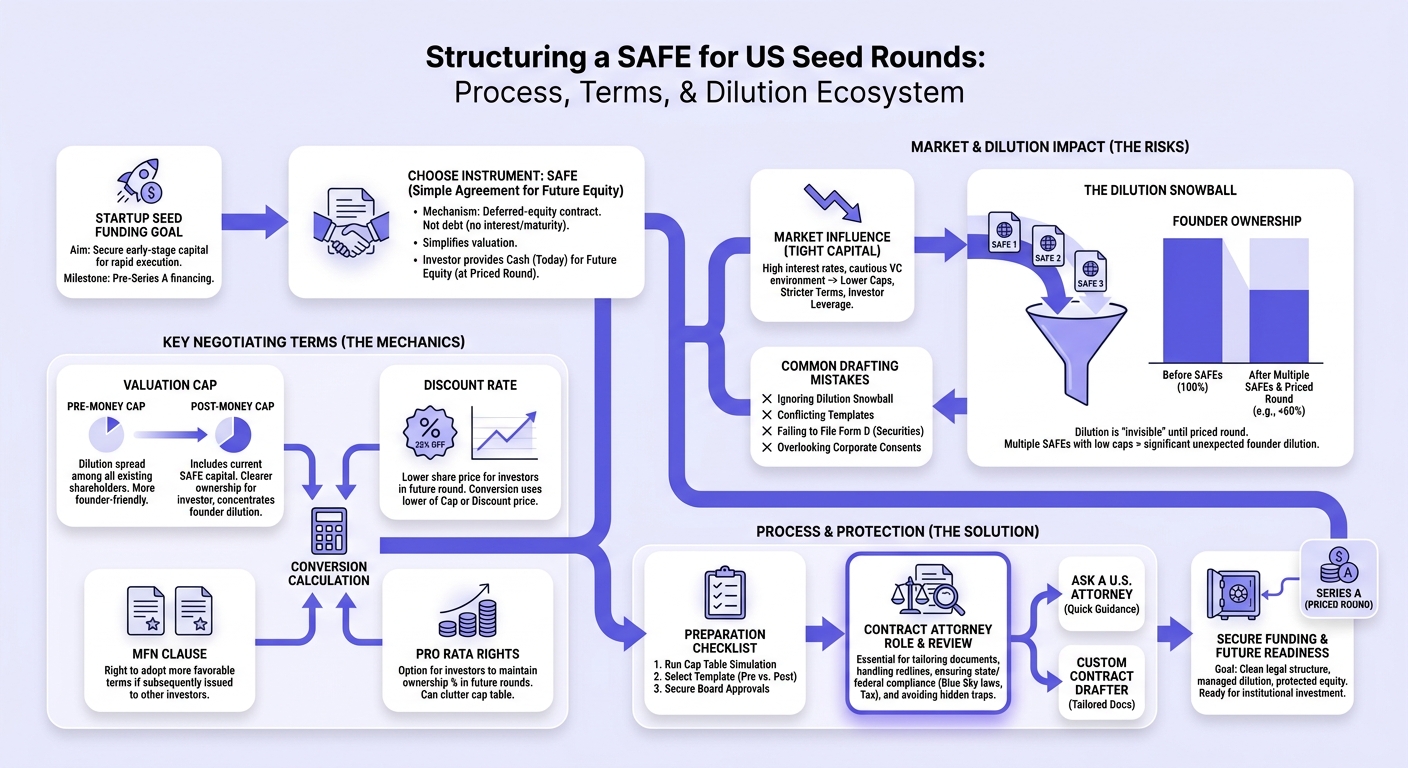
A SAFE is a contract between a startup and an investor. Under this agreement, the investor provides upfront cash to the startup. In exchange, the investor receives the right to obtain stock at a future date when the company completes a priced equity round (typically a Series A).
Unlike convertible notes, SAFEs are not debt. They do not carry interest rates, maturity dates, or repayment requirements. This makes them highly appealing to founders who want to avoid the administrative burden and existential pressure of accumulating debt. According to the SEC's Investor Bulletin on SAFEs, these instruments are designed to simplify the capital-raising process, but they still carry substantial long-term financial consequences for startup ownership.
Using SAFEs allows startups to postpone the complex task of valuing an early-stage company. Instead of arguing over whether your pre-revenue company is worth $3,000,000 or $5,000,000, you can secure the capital you need today and defer the valuation conversation until institutional investors lead a formal priced round.
Key SAFE Terms That Matter Most
While SAFEs are designed to be simple, a few specific clauses control how much of your company you will ultimately give away. Understanding these terms is vital before signing any investor documents.
Valuation Cap
The valuation cap is the most critical term in a SAFE. It sets the maximum company valuation at which the investor's money will convert into shares. If your company later prices its shares at a valuation higher than the cap, the SAFE investor still gets to convert their funds at the lower capped price, granting them more shares for their money.
- Pre-Money SAFE: The valuation cap does not factor in the money raised in the current SAFE round. This is generally more founder-friendly because it spreads dilution among all existing shareholders.
- Post-Money SAFE: The valuation cap includes the current SAFE round capital. This gives investors precise clarity on their ownership percentage but concentrates the dilution risk onto the founders.
Discount Rate
A discount rate grants the investor a percentage discount on the share price of the future priced round. For example, if you negotiate a 20% discount, and your Series A shares are eventually priced at $1.00 each, your SAFE investor gets to purchase those shares for $0.80.
If a SAFE contains both a valuation cap and a discount rate, the conversion typically uses whichever calculation yields the lower share price (which means more shares for the investor).
Most-Favored-Nation (MFN) Clause
An MFN clause states that if the company issues subsequent SAFEs or convertible notes on better terms (such as a lower valuation cap), the investor has the right to adopt those more favorable terms. This is highly common when closing early "angel" checks before setting final terms for the rest of the round.
Pro Rata Rights
Pro rata rights allow the investor to pay additional money to maintain their ownership percentage in future financing rounds. While standard for institutional venture funds, granting pro rata rights to small, early-stage investors can clutter your cap table and limit allocation space for future lead investors.
How Today's Market Affects SAFE Negotiations
The economic landscape has shifted significantly over the past few years. High interest rates and a more cautious venture capital environment mean founders are facing stricter investor demands.
In today's climate, uncapped SAFEs with simple discounts are rare. Investors are aggressively negotiating for lower post-money valuation caps to insulate themselves from market downturns. Additionally, investors frequently request side letters containing information rights, board observer seats, or strict pro rata options.
To balance these demands without compromising your company's future, you must thoroughly model your potential dilution. If you raise multiple SAFEs with different caps, a spreadsheet error could easily cost you a controlling interest in your own company upon conversion.
Common Drafting Mistakes to Avoid
Even experienced entrepreneurs can make critical mistakes when drafting or modifying standard SAFE templates. Some of the most common pitfalls include:
- Ignoring the Dilution "Snowball": Many founders raise multiple sequential SAFE rounds. Because the dilution does not officially hit the cap table until a priced round occurs, founders often fail to realize they have sold 30% or 40% of their company before the Series A even begins.
- Using Conflicting Templates: Mixing elements of old pre-money templates with newer post-money templates can create legal ambiguities that delay future funding rounds.
- Failing to File Form D: Raising capital via SAFEs constitutes a securities offering. Even though it is a private placement, you must file a Form D with the SEC and comply with state "Blue Sky" laws.
- Overlooking Corporate Consents: Issuing a SAFE requires formal board approval and, in many cases, shareholder consent. Skipping these corporate governance steps can invalidate the agreement.
When to Work With a Contract Attorney Near Me
While template agreements are widely available online, they are rarely ready to sign without modification. Working with a local legal specialist is essential for tailoring these forms to your specific corporate structure.
If you search for a qualified contract attorney near me, you can find a professional to review your documents, handle investor redlines, and ensure state-level compliance. Different states have unique rules regarding securities filings and corporate authority. For example, a startup registered in Delaware but operating out of Texas or California must navigate distinct state-level tax and reporting obligations.
A dedicated lawyer can help you build custom capital-raising models, draft clear side letters, and avoid hidden clauses that could restrict your operational freedom. If you have a quick question about a specific investor term sheet, you can also use a targeted service to Ask a U.S Attorney a Question for fast, affordable, and practical guidance.
Step-by-Step SAFE Preparation Checklist
Before presenting a SAFE to potential seed-round investors, follow these structured steps to ensure your business is fully protected.
| Step | Action Item | Goal |
|---|---|---|
| 1 | Run a Cap Table Simulation | Model multiple conversion scenarios to visualize founder dilution. |
| 2 | Select the Right Template | Decide whether a pre-money or post-money SAFE is appropriate for your round. |
| 3 | Secure Board Approvals | Draft and sign the corporate resolutions authorizing the SAFE issuance. |
| 4 | Conduct Professional Review | Hire an attorney to check for conflicting terms, MFN traps, or predatory covenants. |
| 5 | Close and File | Execute signatures, receive funds, and submit federal and state securities filings within 15 days. |
Secure Your Funding with Confidence
Navigating a seed round is a defining moment for your business. Protecting your equity, managing dilution, and keeping your legal structure clean are vital to attracting future venture capital. You do not have to handle these complex agreements alone or pay exorbitant hourly fees to traditional law firms.
At AirCounsel, we offer transparent, fixed-price legal solutions tailored for founders and growing businesses. If you want a fast, clear review of your investor documents before you sign, connect with us today.
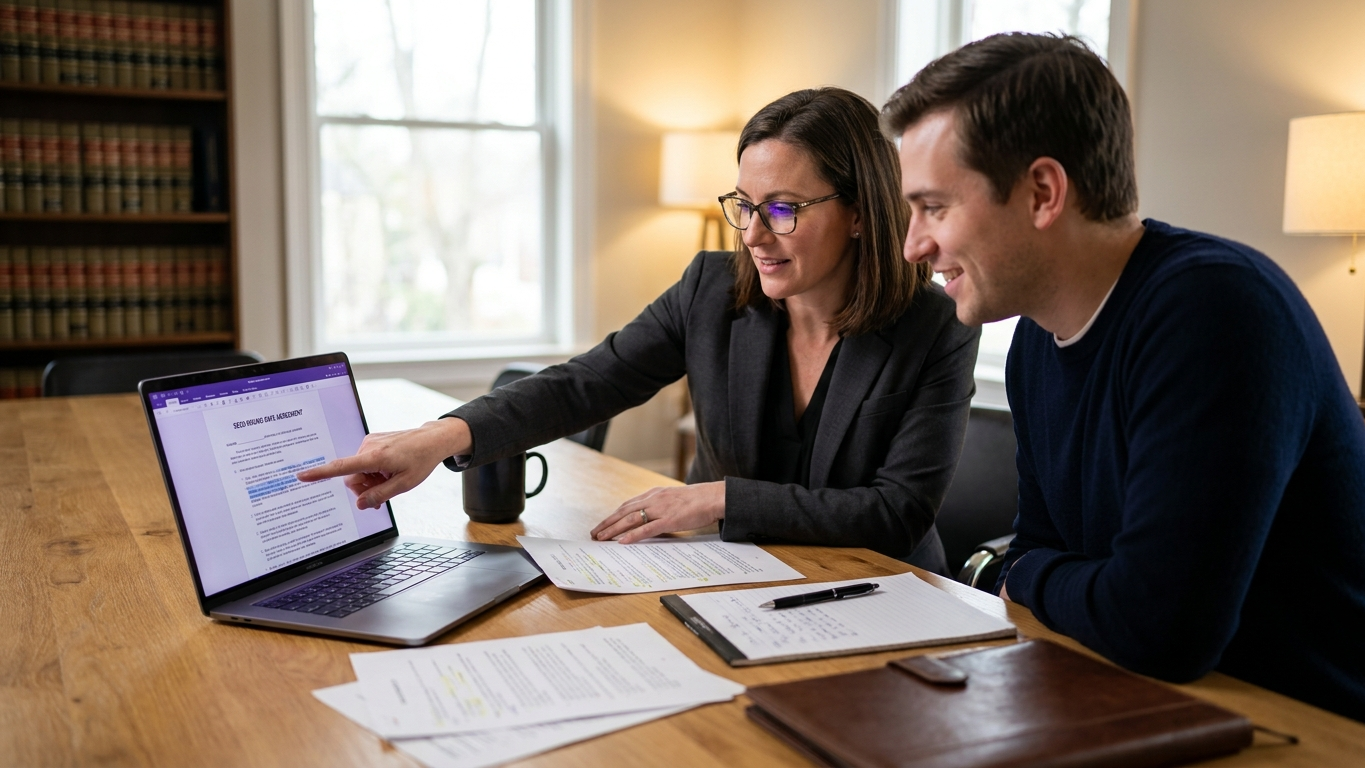
Our experienced attorneys can review your agreements to identify hidden risks and ensure your cap table remains protected. Get started by exploring our Review of your Contract or Legal Document service, or hire a dedicated specialist to draft a completely customized set of financing documents using our Custom Contract Drafter package.
This article provides general information and is not legal advice.
Frequently Asked Questions
What is a SAFE in a seed round?
A SAFE is an agreement where an investor provides immediate capital to a startup in exchange for the right to receive equity during a future priced funding round, such as a Series A.
Which SAFE terms matter most for founders?
The valuation cap, discount rate, most-favored-nation (MFN) clause, and pro rata rights are the most critical terms. These dictate the conversion price of the investment and directly control how much dilution the founders will experience.
How does a SAFE affect dilution and future pricing?
Because SAFEs do not convert into shares until a priced equity round occurs, the dilution remains "invisible" on your cap table until that event. If you raise too much money on SAFEs with low valuation caps, you may discover that you have diluted your own ownership far more than anticipated once the priced round concludes.
When should I have a contract attorney review my SAFE?
You should have an attorney review your SAFE before presenting it to investors, or immediately after an investor returns a redlined copy. This ensures that you do not agree to unfavorable custom terms, side letters, or incorrect valuation calculations that could damage your business.
Recommended
Need Legal Assistance?
Our expert legal team is ready to help you navigate complex legal matters with confidence.