AI Regulation Australia: Why AI SaaS Providers Need Tailored Terms of Service

Australian founders and technology operators are shipping artificial intelligence capabilities at breakneck speed. From automated customer support bots to predictive analytics engines, software-as-a-service (SaaS) platforms increasingly rely on generative and agentic models to deliver core product features.
However, deploying AI into commercial workflows creates immediate legal exposure under domestic law. According to data published by the Australian Government, 43% of Australian SMEs reported active AI adoption in early 2026, marking a rapid operational shift that has drawn direct scrutiny from domestic regulatory bodies.
Navigating ai regulation australia does not require waiting for future statutory overhauls. The Australian Consumer Law (ACL) and existing privacy regimes already regulate AI-driven products, penalizing misleading representations, inaccurate outputs, and undisclosed data handling. To protect your company and accelerate enterprise sales, your platform requires terms of service engineered specifically for AI risks.
Table of Contents
- The Legal Framework: How Australian Consumer Law Governs AI
- Core Risks Under Australian Consumer Law
- Essential Contract Clauses for AI SaaS Providers
- Compliance Blueprint: Steps to Protect Your AI Platform
- Estimated Costs and Timelines for AI Contract Compliance
- Common Mistakes AI Startups Make in Australia
- Secure Your AI SaaS Business with AirCounsel
- Frequently Asked Questions
- Recommended
Quick Summary
| Takeaway | Explanation |
|---|---|
| Existing Frameworks Apply | The Australian Consumer Law directly regulates AI goods and services without needing new specific legislation. |
| Misleading Conduct Exposure | Overstating model capabilities or hiding AI involvement creates immediate statutory liability under Section 18 of the ACL. |
| Mandatory Disclosures | Customer contracts must explicitly disclaim absolute accuracy and clarify the non-deterministic nature of AI outputs. |
| Data Governance Rules | Platforms must obtain unambiguous consent if customer prompts or uploads are reused for model fine-tuning. |
| Commercial Benefits | Tailored terms reduce dispute liability, satisfy enterprise procurement audits, and shorten enterprise sales cycles. |
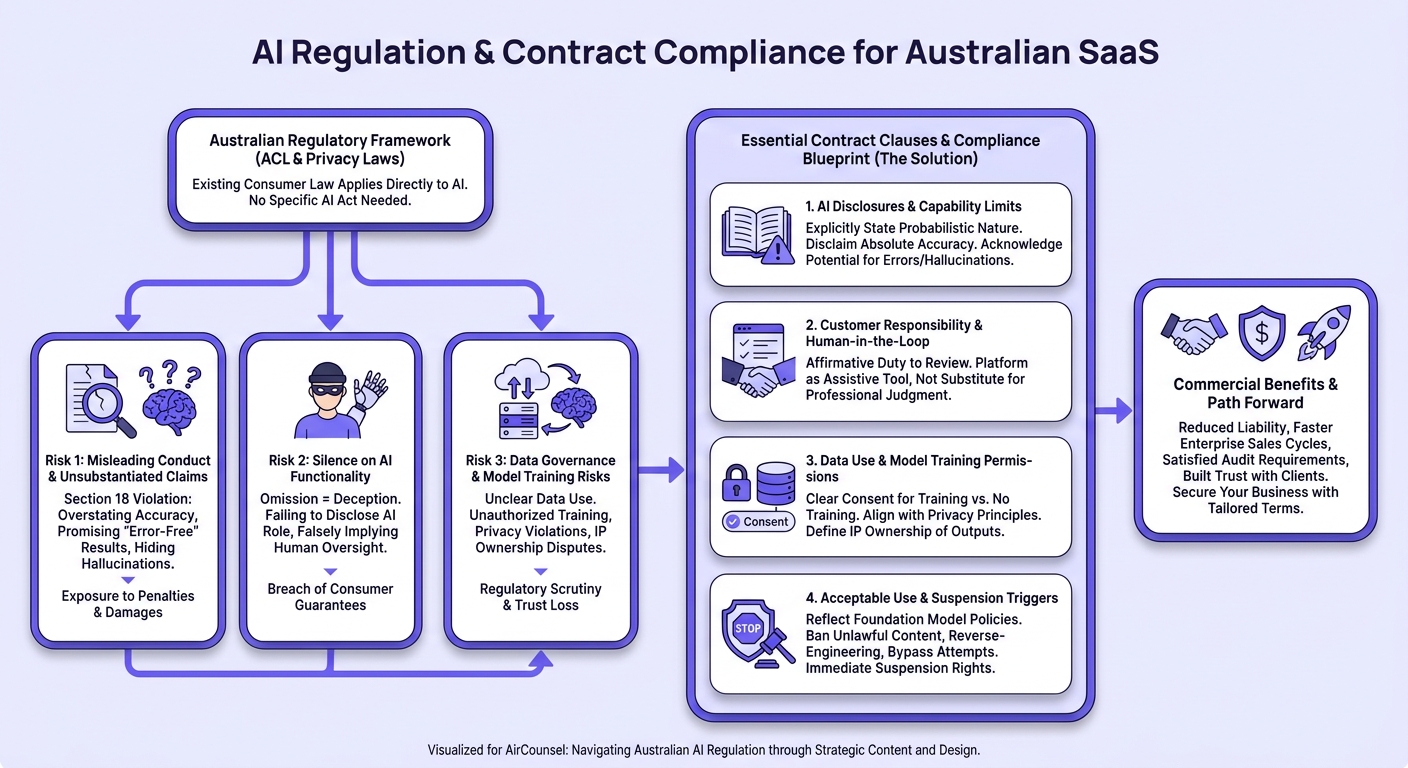
The Legal Framework: How Australian Consumer Law Governs AI
Many tech companies mistakenly assume that because Australia has not yet enacted a standalone "AI Act," their algorithms operate in an unregulated environment. In reality, Australian regulators enforce strict standards using established commercial legislation.
The Treasury's formal Review of AI and the Australian Consumer Law confirmed that the ACL serves as the primary enforcement vehicle for AI-enabled products and services. Under Schedule 2 of the Competition and Consumer Act 2010, businesses selling software to Australian consumers or enterprises must adhere to statutory consumer guarantees and fair trading rules.
When an AI model generates inaccurate data, produces hallucinated advice, or fails to meet advertised standards, liability falls squarely on the service provider. The Australian Competition and Consumer Commission (ACCC) treats AI-generated outputs the same as human-delivered representations.
Core Risks Under Australian Consumer Law
Understanding where regulatory risk arises helps software providers structure their customer-facing agreements and landing page copy effectively.
Misleading and Deceptive Conduct
Section 18 of the ACL prohibits conduct in trade or commerce that is misleading or deceptive, or likely to mislead or deceive. If your marketing claims that your tool provides "100% compliant tax advice" or "error-free contract review," and the underlying model hallucinates, your business is directly exposed to regulatory penalties and customer damages claims.
Unsubstantiated Performance Claims and Hallucinations
Generative models are probabilistic rather than deterministic. They predict likely language patterns rather than verifying absolute factual truth. When platforms market AI features as authoritative decision-making tools without qualifying their limitations, they risk violating statutory guarantees regarding fitness for purpose and acceptable quality.
Silence Regarding AI Functionality
Under the ACL, silence or omission can constitute misleading conduct. If a customer reasonably believes they are receiving human-generated work or human-curated analysis, but the work is entirely synthesized by an autonomous agent, failing to disclose that automation can expose the vendor to deceptive conduct claims.

Essential Contract Clauses for AI SaaS Providers
Standard, legacy software agreements fail to address the probabilistic nature of modern machine learning tools. AI SaaS contracts require specific risk-allocation mechanisms.
AI Disclosures and Capability Limits
Your terms should transparently state that features rely on machine learning models that generate probabilistic outputs. Explicitly state that outputs may occasionally contain errors, biases, or hallucinations, and disclaim any implied warranty of absolute accuracy.
Customer Responsibility and Human-in-the-Loop Terms
To limit product liability, contracts must place an affirmative duty on the end-user to review and verify all generated content prior to relying on it for business, financial, or legal operations. The terms should frame the platform as an assistive workflow tool rather than a fully autonomous substitute for professional judgment.
Data Use and Model Training Permissions
Explain clearly what happens to customer inputs, prompts, and uploaded documents:
- No Training vs. Training: Specify whether customer data is used to train or fine-tune public models, private foundation models, or third-party Large Language Model (LLM) APIs.
- Privacy Compliance: Ensure your practices align with Australian Privacy Principles, and read our guide on Australian SaaS privacy reforms to understand evolving data governance standards.
- IP Ownership of Outputs: Define who owns the intellectual property in the generated output and how third-party foundational model terms interact with customer rights.
Acceptable Use and Suspension Triggers
Given that foundation model providers strictly enforce downstream acceptable use policies, your platform terms must reflect these boundaries. Include provisions allowing immediate account suspension if a user attempts to generate unlawful content, reverse-engineer model parameters, or bypass safety guardrails.
Compliance Blueprint: Steps to Protect Your AI Platform
Adopting a systematic approach ensures your contracts protect your business without slowing down product development:
- Audit Your Feature Claims: Review all marketing pages, onboarding copy, and sales decks to eliminate absolute performance guarantees or claims of human oversight that do not exist.
- Map Data Flows: Identify which third-party APIs (e.g., OpenAI, Anthropic, AWS Bedrock) process your users' prompts, and document data retention windows.
- Draft Tailored Terms: Replace off-the-shelf software templates with custom agreements that incorporate AI disclosures, input/output risk shifting, and clear training-data permissions.
- Implement UI Disclosures: Ensure end-users see clear notices within the product interface clarifying that outputs are AI-generated and require verification.
Estimated Costs and Timelines for AI Contract Compliance
Upgrading commercial terms to comply with Australian consumer and privacy standards is straightforward when approached with fixed pricing and clear scope.
| Approach | Timeline | Typical Cost (AUD) | Risk Level |
|---|---|---|---|
| Unmodified Generic Template | Immediate | $0 | High: Fails to disclaim AI errors or address ACL statutory warranties. |
| Traditional Law Firm Engagement | 2–4 Weeks | $3,500 – $7,000+ | Low: High quality, but slow turnaround and unpredictable hourly billing. |
| AirCounsel Fixed-Fee Drafting | 2–3 Days | $1,000 – $1,400 | Low: Fast delivery, bespoke drafting by Australian lawyers, transparent fixed pricing. |
Common Mistakes AI Startups Make in Australia
- Relying on US-Standard Terms: US terms often rely heavily on blanket disclaimers that are rendered void by mandatory statutory consumer guarantees under Australian law.
- Burying AI Disclosures: Hiding the fact that automated models generate core deliverables creates immediate Section 18 misleading conduct liability.
- Ignoring Sub-Processor Chains: Failing to inform enterprise clients that their proprietary prompts are processed by overseas third-party LLM APIs.
- Promising Uncapped Indemnities: Agreeing to enterprise indemnity clauses for intellectual property infringement without checking whether the underlying generative model provides upstream IP indemnification.
Secure Your AI SaaS Business with AirCounsel
Launching and scaling an AI product in Australia requires legal documents that protect your intellectual property, mitigate consumer law liability, and build trust with business clients. AirCounsel provides fast, fixed-fee legal solutions drafted by experienced Australian solicitors.
Protect your software business with comprehensive SAAS Application Terms of Service, align your data disclosures with a tailored Privacy & Cookies Policy, or govern enterprise data pipelines using a Custom Data Processing Agreement. Get legally compliant documents delivered in as few as three business days with full cost certainty.
Frequently Asked Questions
Does Australian Consumer Law apply to AI SaaS products and services?
Yes. The Australian Consumer Law applies to all goods and services supplied in trade or commerce to Australian consumers and businesses within statutory threshold limits. AI SaaS products must satisfy consumer guarantees of acceptable quality and fitness for purpose, and marketing claims are strictly subject to prohibitions against misleading and deceptive conduct.
What contract terms should an AI SaaS provider include to reduce ACL risk?
Providers should include explicit AI disclaimers, clear statements regarding the non-deterministic nature of outputs, clauses requiring human review before reliance, well-defined service limitations, and transparent data use policies regarding model training.
Do AI disclosures need to say when outputs are generated or assisted by AI?
Yes. If omitting the role of AI creates a false impression that content was created, vetted, or guaranteed by a human professional, failing to disclose AI involvement can constitute misleading conduct by silence under Section 18 of the ACL.
How do Australian privacy and consumer laws affect AI data collection and use in SaaS terms?
Australian laws require businesses to be transparent about how personal data and proprietary inputs are handled. If your platform uses customer prompts to train or fine-tune models, you must obtain clear, informed consent in your terms of service and privacy documentation to avoid privacy breaches and deceptive conduct claims.
Recommended
Need Legal Assistance?
Our expert legal team is ready to help you navigate complex legal matters with confidence.