Is Your Website Legal? Navigating Australia's Privacy Act 1988

For modern Australian founders and small business owners, operating a website means constantly handling user data. Every time a visitor fills out a contact form, signs up for a newsletter, or browses your store, they leave a trail of personal information. Handling this data correctly is not just a customer service preference; it is a legally mandated obligation governed by the privacy act 1988.
According to the Office of the Australian Information Commissioner (OAIC), 69 percent of data breaches were caused by malicious or criminal attacks in the 2023-24 financial year. This stark reality underscores why weak website controls and outward-facing policy omissions pose a severe risk to your operations. Failing to establish proper privacy protections can result in legal vulnerability, direct financial penalties, and a total loss of commercial trust.
This guide simplifies your compliance path. We will outline who must comply, the essential components of a robust privacy program, and practical steps to secure your website against regulatory and cybersecurity risks.
Table of Contents
- Who Must Comply with the Privacy Act 1988?
- Key Elements of a Compliant Website Privacy Policy
- Cookies Tracking and Direct Marketing
- Cross-Border Data Disclosures and Overseas Hosting
- Practical Step-by-Step Website Compliance Check
- High-Risk Areas That Warrant Professional Legal Review
- Protect Your Business with a Professional Privacy Review
- Frequently Asked Questions
- Recommended
Quick Summary
| Takeaway | Explanation |
|---|---|
| Regulatory Standard | The Privacy Act 1988 regulates the collection, handling, and transfer of personal information. |
| 3 Million Threshold | Businesses with a turnover exceeding $3,000,000 must comply, but many smaller startups are pulled in by active exemptions. |
| Essential Documents | A clear Privacy Policy and context-specific collection notices are mandatory for compliance. |
| Technical Integrations | Tracking pixels, Google Analytics, and foreign cloud hosting trigger mandatory disclosure parameters. |
| Risk Management | Handling sensitive files, medical data, or running direct marketing campaigns requires immediate professional legal review. |
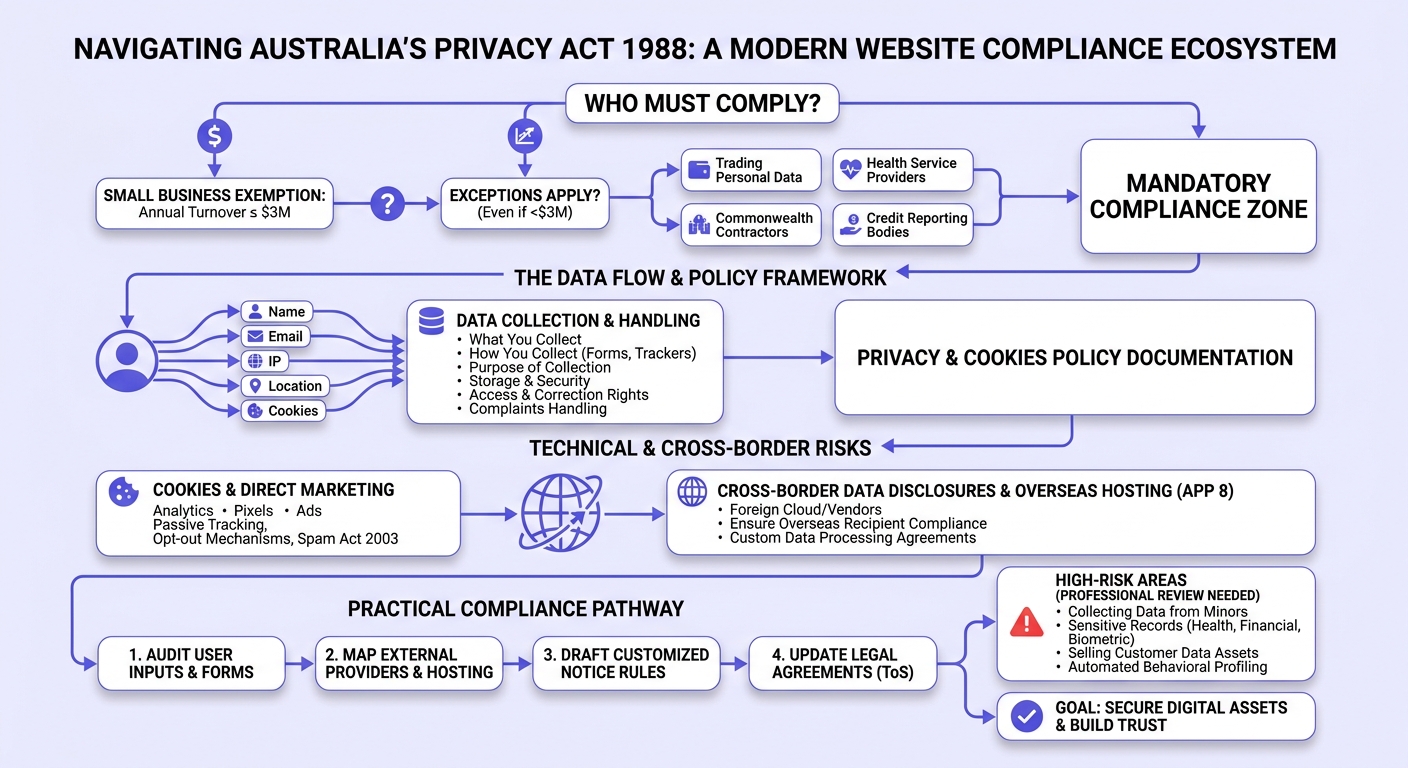
Who Must Comply with the Privacy Act 1988?
The first step in planning your website audit is understanding whether your business is legally bound by the Australian Privacy Principles (APPs) set out under the national legislation.
The Small Business Exemption
The law includes a general exemption for small businesses. Under the Office of the Australian Information Commissioner Small Business Guidelines, an organization with an annual turnover of $3,000,000 or less is typically exempt from the Privacy Act 1988. However, relying blindly on this threshold is one of the most common legal mistakes Australian startups make.
When the Exemption Does Not Apply
Multiple exceptions bypass the $3,000,000 threshold. If your company fits into any of the following categories, you are legally required to comply with the ACT, regardless of your standard annual revenue:
- Trading in personal information: If you buy, sell, or trade personal data (such as providing email marketing lists or scoring leads for third parties).
- Health service providers: This includes gyms, medical consultants, telehealth software developers, or therapists who utilize online booking portals.
- Contractors to the Commonwealth: Any business operating under a federal government contract.
- Credit reporting bodies: Entities processing credit scores or financial evaluations.
Even if you are technically exempt, choosing to comply voluntarily can build significant user trust, facilitate partnerships with enterprise clients, and prepare your brand as it scales past the revenue threshold.
Key Elements of a Compliant Website Privacy Policy
Your strategy starts with a clear, honest, and up-to-date documentation framework. Under Australian Privacy Principle 1 (APP 1), you must have a clearly expressed personal info management strategy readily accessible on your website.
A tailored Privacy & Cookies Policy must explain:
- What you collect: Explicitly call out fields like names, physical addresses, billing details, IP tracking, and email addresses.
- How you collect it: State whether the info is gathered directly via manual entry forms or passively using back-end browser trackers.
- The purpose of collection: Inform readers why you need the data, such as executing client invoices, optimizing software layouts, or running promotional marketing.
- Storage and security protocols: Outline standard safeguards used to protect user data from breach incidents.
- Access and correction rights: Detail how users can contact your compliance officer to request updates to their profiles.
- Complaints handling: State your dispute resolution process for users who suspect their information was mishandled.
Cookies Tracking and Direct Marketing
When websites deploy digital analytics tools like Google Analytics, hotjar, or tracking pixels, they passively collect metadata that can identify individual users.
According to the OAIC Guidelines on Cookies and Online Marketing, processing tracking identifiers often places your software directly in the scope of regulated data practices.
If your company uses behavioral tracking mechanisms, you must explain:
- What distinct categories of tracking cookies are installed upon a user loading your application.
- How visitors can opt out of browser profiling.
- How those trackers integrate with third-party advertising platforms like Facebook or Google Ads.
Additionally, under the Spam Act 2003, direct marketing emails require clear opt-in mechanics. Your subscription boxes must contain clear collection notices that let prospects know they will receive marketing emails, and every message sent must include an easy opt-out mechanism.
Cross-Border Data Disclosures and Overseas Hosting
Modern websites rarely operate strictly within Australian geographic borders. For example, your database may use AWS instances in Virginia, your newsletter platform may be headquartered in Europe, and your helpdesk tool might rely on servers based in the United States.

Under APP 8, before disclosing personal data to an overseas recipient, your company must take reasonable steps to ensure the recipient does not breach the Australian Privacy Principles.
This cross-border liability makes it critical to maintain a robust Custom Data Protection Policy. Furthermore, when engaging third-party software service vendors, securing a structured Custom Data Processing Agreement helps shield your enterprise from third-party breach liabilities.
Practical Step-by-Step Website Compliance Check
To simplify your path to compliance, run your active web platforms through this review checklist:
| Step | Compliance Objective | Key Action Item |
|---|---|---|
| Step 1 | Audit User Inputs | List every interactive web form, checkout field, search bar, and portal entry point. |
| Step 2 | Detail External Providers | Map out where your customer databases, hosting APIs, and analytic trackers store target files. |
| Step 3 | Draft Customized Notice Rules | Embed plain-language collection notices on checkout and registration pages. |
| Step 4 | Update Legal Agreements | Ensure your app terms, vendor contracts, and client documents form a cohesive ecosystem. |
If your brand provides software services or interactive membership portals, having clear Application, Software or Website Terms of Service is vital to govern user interactions alongside your privacy protocols.
High-Risk Areas That Warrant Professional Legal Review
Some business practices carry a higher legal risk. If your operations involve any of the following, do not rely on standard online templates:
- Collecting details from minors under the age of 18.
- Storing highly sensitive health, financial, racial, or biometric records.
- Selling database customer assets as a core revenue stream.
- Employing automated behavioral profiling to score credit or access levels.
For these operations, securing a professional Review of your Contract or Legal Document or preparing a robust Custom Data Breach Policy is essential. Having professional advisors review your system architecture helps protect your business from class action litigation, regulatory fines, and corporate disruptions.
Protect Your Business with a Professional Privacy Review
Navigating the Privacy Act 1988 shouldn't stall your business growth. Copied internet templates often fail to meet Australian standards and can expose your business to significant liability.
At AirCounsel, we deliver tailored, professional, and reliable legal services designed for growing Australian startups. Whether you need a robust Privacy & Cookies Policy built around your unique data flows or a comprehensive Custom Data Protection Policy for your operations, our qualified Australian lawyers provide fast turnaround times and clear, transparent pricing. Let us help you secure your digital assets so you can focus on building your business with confidence.
This article provides general information and is not legal advice.
Frequently Asked Questions
Does the Privacy Act 1988 apply to my small business website?
It applies if your annual business turnover exceeds $3,000,000, or if you fall under specific exemptions such as trading in personal information, handling healthcare records, or working as a federal government contractor.
What should an Australian website privacy policy include?
Your policy must detail what kinds of personal information you collect, how you gather it, your secure storage methods, whether you disclose details to overseas vendors, and how users can request corrections or lodge a formal complaint.
Do cookies and Google Analytics require consent in Australia?
Yes, if your analytics systems collect details that could reasonably identify individuals (such as tracking IDs or precise location parameters), you must disclose this in your policy and outline clear options for users to opt out.
When does sharing data with overseas providers create extra privacy obligations?
If your website uses foreign services (such as US-based cloud hosting or overseas email platforms) to store or process user databases, APP 8 requires you to list those target countries and take steps to ensure your vendors comply with Australian standards.
Recommended
Need Legal Assistance?
Our expert legal team is ready to help you navigate complex legal matters with confidence.