Why Australian SaaS Founders Need Specific Data Processing Agreements Following the Privacy Act Review

Operating a software-as-a-service (SaaS) platform in Australia is no longer a low-risk regulatory endeavor. Following the recent legislative updates and the comprehensive Privacy Act Review, the legal landscape surrounding how businesses handle personal information is shifting rapidly beneath founders' feet.
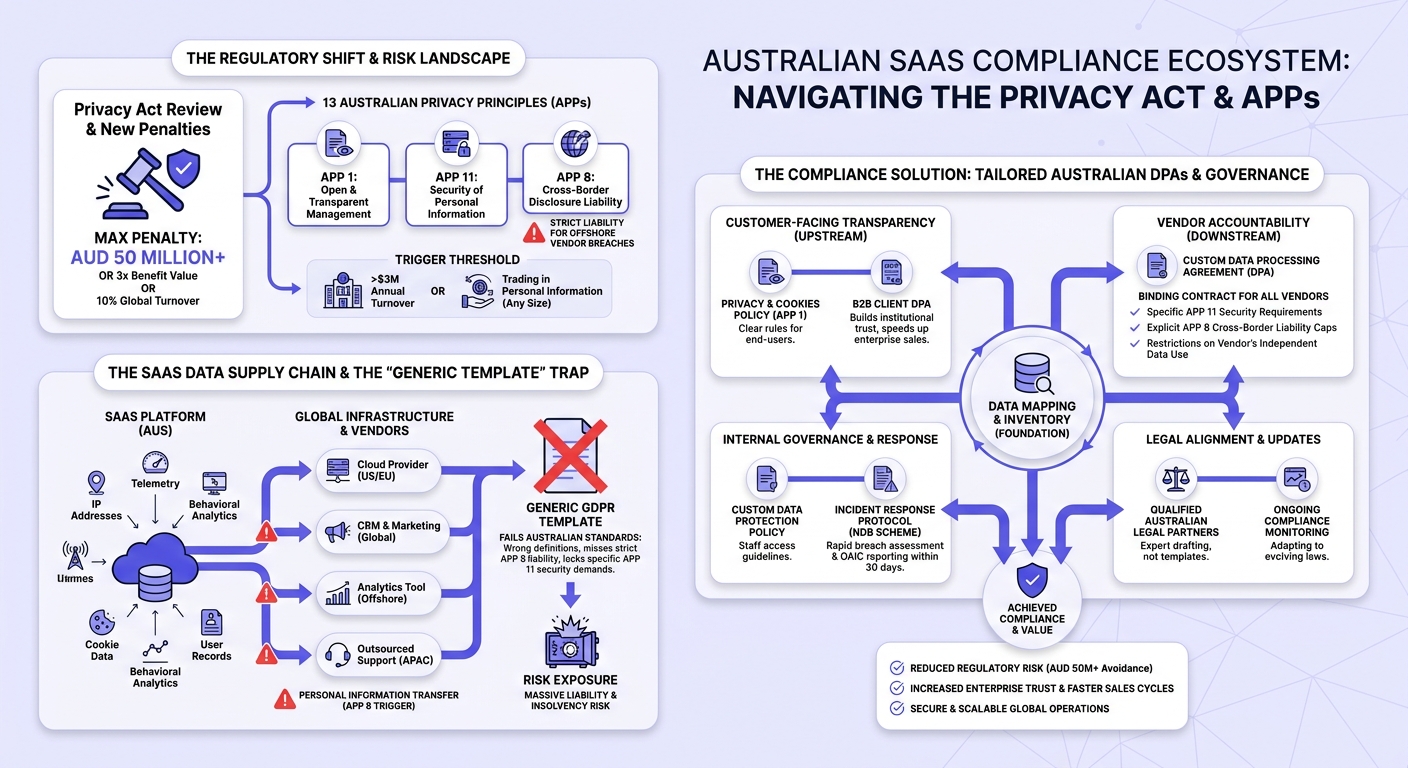
In late 2022, the federal parliament passed the Privacy Legislation Amendment (Enforcement and Other Measures) Act, which took full effect in 2023. This amendment dramatically increased the maximum penalty for serious or repeated privacy breaches to AUD 50 million or more, making compliance with the 13 australian privacy principles a critical boardroom priority rather than a minor IT checklist issue.
To bridge the gap between building software and staying compliant, SaaS founders must look closely at their data supply chain. Every time your platform shares data with an external database, marketing tool, CRM, or cloud provider, you engage in a transfer of "personal information" as defined by Australian law. Safely managing these relationships requires a robust, contractually binding Data Processing Agreement (DPA) tailored specifically to the Australian regulatory regime.
Table of Contents
- Understanding the 13 Australian Privacy Principles for SaaS
- Quick Summary
- Why Generic GDPR Templates Fall Short for Australian Compliance
- The Critical Role of Data Processing Agreements
- Cross-Border Data Transfers under APP 8
- How the AUD 50 Million Penalty Landscape Changes Your Risk Profile
- Step-by-Step Guide to Aligning Your DPAs with the APPs
- Align Your SaaS Business Safely Today
- Frequently Asked Questions
- Recommended
Quick Summary
| Core Compliance Element | SaaS Relevance & Action Item |
|---|---|
| Primary Legislation | The Privacy Act 1988 (Cth), governed by the Office of the Australian Information Commissioner (OAIC). |
| The 13 APPs | Unified standards governing how entities collect, hold, use, and disclose personal information. |
| The Trigger Threshold | Applicable to businesses with >$3M annual turnover, plus any entity that trades in personal information. |
| The Big Risk | Personal liability for cross-border leaks under APP 8 and fines of up to AUD 50 million. |
| The Solution | Implementing custom-drafted, APP-aligned Data Processing Agreements (DPAs) for all vendors. |
Why Generic GDPR Templates Fall Short for Australian Compliance
Many Australian founders use generic online template generators or assume a standard GDPR-compliant Data Processing Addendum meets Australian standards. This is a costly mistake.
While the GDPR employs a strict "Data Controller vs. Data Processor" architecture, the Australian Privacy Act generally focuses on the entity that "holds" the personal information. This can apply to your business even if you are just storing data on behalf of an enterprise client.
Moreover, the threshold for who must comply differs:
- Small Business Exemption: In Australia, the Act generally applies to organizations with an annual turnover of AUD 3 million or more. However, any SaaS platform that buys, sells, or trades in personal information, or acts as a contracted service provider to government agencies, must comply regardless of turnover size.
- Cross-Border Accountability: Unlike the GDPR's adequacy decisions, Australian law features strict liability rules under APP 8. If an overseas hosting provider or tool breaches local standards, your Australian business is held legally responsible for that breach as if you committed it yourself.
The Critical Role of Data Processing Agreements
A Data Processing Agreement (DPA) is a binding contract that establishes how personal information is handled when it flows between your SaaS platform and third parties. Standard terms of use on tech platforms rarely provide the level of protection required under Australian law.
For SaaS founders, DPAs must work in two directions:
- Downstream (With your Vendors): When you use external servers, AI models, or billing systems, you must bind them to strict instructions that prevent them from using your customer data for their own independent marketing, profiling, or product training.
- Upstream (With your B2B Clients): Enterprise and government buyers in Australia will refuse to purchase your SaaS product if you cannot provide a reliable DPA. Demonstrating that your platform is legally aligned with the APPs speeds up your sales cycle and builds institutional trust.

Cross-Border Data Transfers under APP 8
Most cloud-based SaaS platforms use global infrastructure. Your core database might sit in Amazon Web Services (AWS) in Sydney, but your email marketing platform might be hosted in the US, and your outsourced support team might operate from India or the Philippines.
Under APP 8, before you disclose personal information to an overseas recipient, you are required to take "reasonable steps" to ensure that the overseas recipient does not breach the APPs.
The most legally certain way to prove you have taken those "reasonable steps" is by executing a custom-drafted DPA that contractually binds the offshore vendor to adhere to the core principles of the APPs. If the offshore vendor leaks data and you do not have an active DPA in place containing these explicit protections, your firm is exposed to massive liability.
To protect your entity from ruinous liability, ensure your DPAs explicitly cover:
- Detailed technical and organizational security requirements (APP 11).
- Practical processes for handling data breaches, including prompt notification to help you satisfy the Notifiable Data Breaches (NDB) scheme.
- Contractual obligations matching the overseas recipient to the APPs (APP 8).
How the AUD 50 Million Penalty Landscape Changes Your Risk Profile
Following the highly publicized cyberattacks against major Australian corporations in 2022, the federal government swiftly passed laws to discourage lax data security.
For corporate entities, the maximum penalty for a serious or repeated interference with privacy under the Australian Privacy Act is now the greatest of:
- AUD 50 million;
- Three times the value of any benefit obtained from the breach; or
- If the court cannot determine the value of the benefit, 10% of the corporate group’s adjusted turnover during the relevant period.
For early-stage SaaS startups, a major regulatory fine will easily result in immediate insolvency. Working without tailored legal documents containing clear liability caps and indemnities is no longer an option.
Step-by-Step Guide to Aligning Your DPAs with the APPs
Executing a successful DPA compliance strategy does not have to be an over-complicated, months-long corporate process. You can secure your brand by following a few defined steps:
Step 1: Mapping Data Interactions
Create an internal inventory of what user files, logs, metadata, and payment information your system collects. Identify exactly where this data is hosted and which third-party APIs have access to it.
Step 2: Drafting Your Customer-Facing Privacy and Cookie Policy
Before writing contracts, ensure you are transparent about your tracking. You will need an outward-facing Privacy & Cookies Policy to establish ground rules with your end-users and ensure APP 1 compliance.
Step 3: Preparing Your Corporate DPA Templates
Do not rely on your vendors' standard sign-up check-boxes. Build customizable templates that you can issue straight to vendors and partners.
- To lock down internal guidelines, use a Custom Data Protection Policy that details how your staff accesses telemetry.
- Contractually protect your external data flows using an Australian-focused Custom Data Processing Agreement to enforce security measures on your processors.
Step 4: Setting Up an Incident Response Protocol
The APPs work hand-in-hand with the local mandatory breach notification rule. If a vendor reports a breach to you, you must assess it within 30 days. Protect your process by rolling out a Custom Data Breach Policy to coordinate responses rapidly and meet the OAIC reporting standards.
Align Your SaaS Business Safely Today
Do not risk your software product or your corporate assets on inadequate, templated compliance documents. Navigating the changed reality of the APPs is fast, straightforward, and affordable when you work with qualified Australian lawyers.
At AirCounsel, we help fast-growing SaaS companies and digital businesses secure their IP, lock down client agreements, and achieve absolute compliance with upfront, fixed pricing. Our licensed legal partners can prepare your customized agreements within 3 business days, with one round of amendments included.
Protect your platform and build trust with enterprise clients by ordering some of our key compliance products today:
- Secure your client terms with our SAAS Application Terms of Service drafting service.
- Bind your subcontractors and third-party vendors with a robust Custom Data Processing Agreement.
- Maintain total transparency with customers by implementing a customized Privacy & Cookies Policy.
This article provides general information and is not legal advice.
Frequently Asked Questions
What are the 13 Australian Privacy Principles and how do they apply to SaaS companies?
The 13 APPs are statutory guidelines under the Australian Privacy Policy framework that regulate the collection, management, use, security, and disclosure of personal information. For SaaS companies, they apply to user accounts, metadata, and tracking information. They demand that you store data securely (APP 11) and remain accountable when transferring it overseas (APP 8).
Is a Data Processing Agreement (DPA) legally required under the Australian Privacy Act?
While the term "Data Processing Agreement" is not explicitly written into the Privacy Act, you are legally required to take "reasonable steps" to secure personal data under APP 11 and prevent cross-border breaches under APP 8. Executing a DPA is the primary contract mechanism used in commerce to legally satisfy these requirements.
How much is the maximum penalty for breaching the Australian Privacy Principles after the 2023 review?
After the recent legislative changes, the maximum penalty for serious or repeated privacy interferences has increased significantly. For corporate entities, the maximum penalty is now the greater of AUD 50 million, three times the benefit obtained from the breach, or 10% of the firm's adjusted turnover.
Does the Australian Privacy Act apply to SaaS companies with turnover under AUD 3 million?
Yes, it can. While there is a general small business exemption for companies with a turnover under AUD 3 million, this exemption does not apply if your SaaS platform trades in personal information (e.g., buying, selling, or exchanging user data), or if your business is a contracted service provider to government departments.
Recommended
Need Legal Assistance?
Our expert legal team is ready to help you navigate complex legal matters with confidence.