The Australian Founder’s Guide to Business Contract Review and Vendor Negotiations

Signing a commercial supplier or vendor agreement without reading the fine print is one of the fastest ways to expose your company to cash flow volatility, unforeseen liabilities, and operational bottlenecks. A thorough business contract review enables founders and small-business operators to identify hidden commercial traps before committing budget or intellectual property.
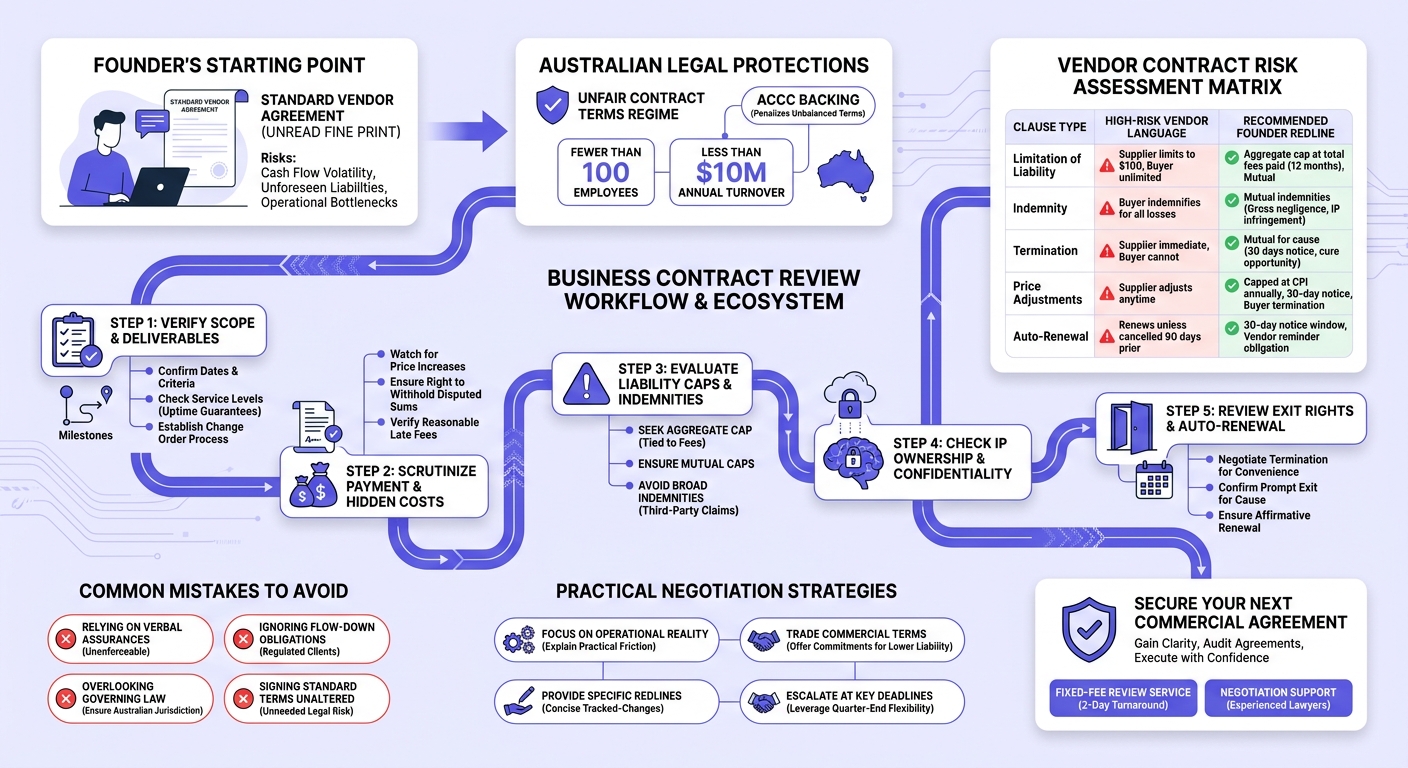
Under Australia's updated unfair contract terms regime, businesses with fewer than 100 employees or less than $10 million in annual turnover are protected against standard form contract abuses, but enforcement still starts with catching problematic clauses before signing. The Australian Competition and Consumer Commission (ACCC) actively penalizes businesses that impose unbalanced terms, giving small enterprises substantial legal backing during commercial discussions.
Whether procuring critical software, hiring a digital marketing agency, or engaging logistics providers, knowing how to evaluate vendor agreements gives you commercial leverage. This playbook outlines the step-by-step review workflow, high-risk clauses to redline, and practical strategies to negotiate balanced business terms.
Table of Contents
- Why Commercial Vendor Contract Reviews Matter
- A Step-by-Step Business Contract Review Workflow
- Navigating Australia's Unfair Contract Terms Regime
- Vendor Contract Risk Assessment Matrix
- Practical Negotiation Strategies for Founders
- Common Mistakes to Avoid in Australian Vendor Deals
- Secure Your Next Commercial Agreement
- Frequently Asked Questions
- Recommended
| Takeaway | Explanation |
|---|---|
| Core Objective | Prevent operational disputes and unexpected costs by auditing vendor agreements before signing. |
| Legal Protections | Australian law shields qualifying SMBs with fewer than 100 staff from unfair standard terms. |
| High-Risk Areas | Unlimited liability, one-sided indemnities, auto-renewals, and poorly defined service scopes. |
| Negotiation Leverage | Standard vendor agreements are rarely final; commercial redlines are routine in B2B transactions. |
| Review Turnaround | Professional legal document reviews typically take 2 to 3 business days with fixed pricing. |
Why Commercial Vendor Contract Reviews Matter
Vendor agreements often appear standard, but boilerplate language is rarely neutral. Suppliers draft contracts to shift maximum risk, cost, and legal responsibility onto the buyer.
When entering a new vendor relationship, founders often focus strictly on pricing and delivery dates while glossing over default terms, governing law, and dispute mechanisms. A single unbalanced clause can lock your company into recurring subscription fees for unused software, force you to defend third-party copyright claims, or prevent you from terminating underperforming suppliers.
A comprehensive review protects your balance sheet and aligns the legal documentation with your day-to-day operational reality. You can also read our guide on 7 hidden risks an Australian contract review lawyer can catch under the unfair contract terms regime to understand where unexpected exposure commonly arises.
A Step-by-Step Business Contract Review Workflow
Executing a structured review ensures that you examine both commercial fundamentals and legal safeguards before executing an agreement.

Step 1: Verify Commercial Scope and Deliverables
Ensure that the statement of work (SOW) or service schedule precisely describes what is being delivered. Vague phrases such as "best efforts" or "industry standard support" offer little recourse if delivery milestones slip.
- Milestones: Confirm specific dates, testing phases, and concrete delivery acceptance criteria.
- Service Levels: Check if uptime guarantees or response times carry fee credits or remediation rights.
- Change Orders: Establish a written sign-off process for any adjustments to project scope or cost.
Step 2: Scrutinize Payment and Hidden Cost Clauses
Review payment milestones, invoicing cycles, indexation, and penalty terms to protect working capital.
- Price Increases: Look out for clauses granting the vendor the unilateral right to increase prices annually without notice.
- Disputed Invoices: Ensure you have the right to withhold disputed sums while paying undisputed portions in good faith.
- Late Fees: Verify that interest rates on late payments are reasonable and comply with statutory limits.
Step 3: Evaluate Liability Caps and Indemnities
Liability and indemnity clauses represent the greatest legal exposure in any commercial contract.
- Liability Cap: Seek an aggregate cap tied to fees paid over a defined window (such as the preceding 12 months) rather than unlimited liability.
- Mutual Caps: Ensure that liability limits apply equally to both parties rather than capping only the supplier's liability.
- Indemnities: Avoid broad indemnities that require your business to defend the vendor against ordinary operational claims or third-party actions outside your direct control.
Step 4: Check IP Ownership and Confidentiality
Protect your pre-existing intellectual property and proprietary customer data.
- Background IP: State clearly that each party retains ownership of its pre-existing IP.
- Deliverables: Specify that bespoke work created specifically for your company transfers to you upon full payment.
- Data Protection: Ensure customer data remains confidential and subject to Australian privacy standards.
Step 5: Review Exit Rights and Auto-Renewal
Suppliers often use evergreen renewal clauses to retain accounts automatically unless cancelled within narrow windows.
- Termination for Convenience: Negotiate the right to exit the contract with 30 or 60 days of written notice.
- Termination for Cause: Confirm prompt exit rights with a 14-day or 30-day remedy period if the vendor breaches key obligations.
- Auto-Renewal: Ensure renewal requires affirmative written confirmation or includes clear, reasonable reminder notices.
Navigating Australia's Unfair Contract Terms Regime
Australia provides strong statutory protections under the Australian Consumer Law (ACL) regarding standard form contracts. According to business.gov.au, terms that create a significant imbalance in rights, cause financial detriment, and are not reasonably necessary to protect legitimate business interests may be deemed void.
The regime applies if:
- One party has fewer than 100 employees or an annual turnover of less than $10 million.
- The contract is presented on a standard form basis with little or no upfront negotiation.
Prohibited terms frequently include unilateral rights to alter pricing, unilateral termination clauses with no reciprocal rights, and unlimited indemnity obligations. Recognizing these clauses enables you to request adjustments with confidence during pre-signing discussions.
Vendor Contract Risk Assessment Matrix
| Clause Type | High-Risk Vendor Language | Recommended Founder Redline |
|---|---|---|
| Limitation of Liability | Supplier limits liability to $100 while buyer has unlimited liability. | Aggregate liability capped at total fees paid in the prior 12 months for both parties. |
| Indemnity | Buyer indemnifies supplier for all losses arising from use of services. | Mutual indemnities limited to gross negligence, willful misconduct, and IP infringement. |
| Termination | Supplier may terminate immediately; buyer cannot terminate early. | Mutual termination for cause upon 30 days of written notice with opportunity to cure. |
| Price Adjustments | Supplier may adjust fees at any time upon notice. | Price increases capped at CPI annually, with a 30-day notice and buyer termination right. |
| Auto-Renewal | Contract renews for 12 months unless cancelled 90 days before term ends. | 30-day non-renewal notice window with vendor obligated to send a prior renewal reminder. |
Practical Negotiation Strategies for Founders
Negotiating vendor contracts does not require aggressive confrontation. Clear, professional communication focused on mutual risk management yields the best commercial outcomes.
- Focus on Operational Reality: Explain why a clause creates practical friction rather than debating abstract legal theory.
- Trade Commercial Terms: If a vendor resists lowering their liability cap, offer a longer contract commitment or adjusted payment terms in exchange.
- Provide Specific Redlines: Send concise, tracked-change edits rather than general complaints so the vendor's legal team can easily accept your terms.
- Escalate at Key Deadlines: Vendors are often most flexible near quarter-end or when standard approval thresholds permit minor deviations.
Common Mistakes to Avoid in Australian Vendor Deals
Many early-stage teams make avoidable errors when processing incoming supplier documents.
- Relying on Verbal Assurances: Side conversations and email promises are unenforceable if the agreement contains an "entire agreement" clause excluding outside statements.
- Ignoring Flow-Down Obligations: If you provide services to regulated clients, ensure your underlying vendors meet matching data security and compliance requirements.
- Overlooking Governing Law: Verify that the contract is governed by the laws of an Australian state or territory rather than an overseas jurisdiction.
- Signing Standard Terms Unaltered: Assuming enterprise vendors never negotiate standard terms often leads to unneeded legal risk.
Secure Your Next Commercial Agreement
Navigating commercial contracts should accelerate your business, not slow it down. Gaining clarity on your risk profile, IP ownership, and exit options allows you to execute supplier deals with total confidence.
AirCounsel provides fixed-fee, fast-turnaround legal services designed for Australian founders and SMBs. If you are preparing to sign a high-value supplier agreement, explore our Review of your Contract or Legal Document service to receive structured redlines and risk ratings within 2 business days. For complex commercial arrangements requiring hands-on deal strategy, our Negotiation Support service connects you directly with experienced Australian lawyers.
Frequently Asked Questions
What should I look for first in a commercial vendor contract in Australia?
Start by verifying that the scope of work, deliverables, and payment milestones precisely reflect what was verbally agreed. Next, check the liability cap, indemnity obligations, intellectual property assignments, and exit rights to ensure your downside risk is clearly defined and capped.
Are unfair contract terms still a risk for small businesses in Australia?
Yes. Although Australian Consumer Law renders unfair terms illegal in standard form contracts, vendors still frequently include one-sided clauses in their default agreements. Identifying these clauses early saves you from entering disputes or relying on costly regulatory enforcement.
When should a founder get a lawyer to review a supplier or service agreement?
Engage a lawyer whenever an agreement represents significant recurring spend, involves mission-critical software or hardware, handles sensitive customer data, or includes unlimited liability and one-sided indemnity terms.
What contract terms are most worth negotiating in vendor deals?
Focus your negotiation bandwidth on liability caps, mutual indemnity carve-outs, clear deliverable acceptance criteria, intellectual property ownership, and reasonable termination notice periods.
Recommended
Need Legal Assistance?
Our expert legal team is ready to help you navigate complex legal matters with confidence.