5 Crucial Provisions in USA Asset Purchase Agreements Requiring Professional Contract Drafting Services in 2026

Acquiring or selling a business is one of the most significant financial milestones an entrepreneur will ever face. According to the U.S. Small Business Administration, business acquisition deals represent a major share of small-business lending, where tens of thousands of small businesses change hands annually across the US.
To protect capital and limit exposure, most small-business buyers and sellers prefer an Asset Purchase Agreement (APA) over a stock transfer. However, relying on generic templates creates severe legal and operational risks. Engaging specialized contract drafting services ensures that deal-critical terms reflect the actual intent of both parties, prevent unexpected tax liabilities, and keep operations running smoothly after closing.
This guide explores the five pivotal provisions in a US asset purchase agreement that demand meticulous drafting, how APAs differ from equity purchases, and how to structure an enforceable deal.
Table of Contents
- Quick Summary
- What Is an Asset Purchase Agreement in US Transactions?
- Asset Purchase vs. Stock Purchase: Core Differences
- 5 Critical APA Provisions Requiring Professional Drafting
- Common Mistakes in Small-Business Asset Drafting
- Step-by-Step Process for Drafting an Enforceable APA
- Secure Your Acquisition with AirCounsel
- Frequently Asked Questions
- Recommended
Quick Summary
| Takeaway | Explanation |
|---|---|
| Surgical Asset Transfer | APAs allow buyers to select specific tangible and intangible assets while leaving unwanted liabilities with the seller. |
| Mandatory Tax Alignment | Purchase price allocation must align with IRS Form 8594 rules to prevent conflicting tax returns between buyer and seller. |
| Liability Ring-Fencing | Unambiguous language is required to ensure pre-closing debts, claims, and regulatory penalties remain excluded. |
| Transition Safeguards | Enforceable non-compete clauses, IP assignments, and customer consent mechanics protect post-closing revenue. |
| Fixed-Cost Drafting | Professional legal drafting eliminates ambiguity upfront, saving thousands in avoidable post-closing litigation. |
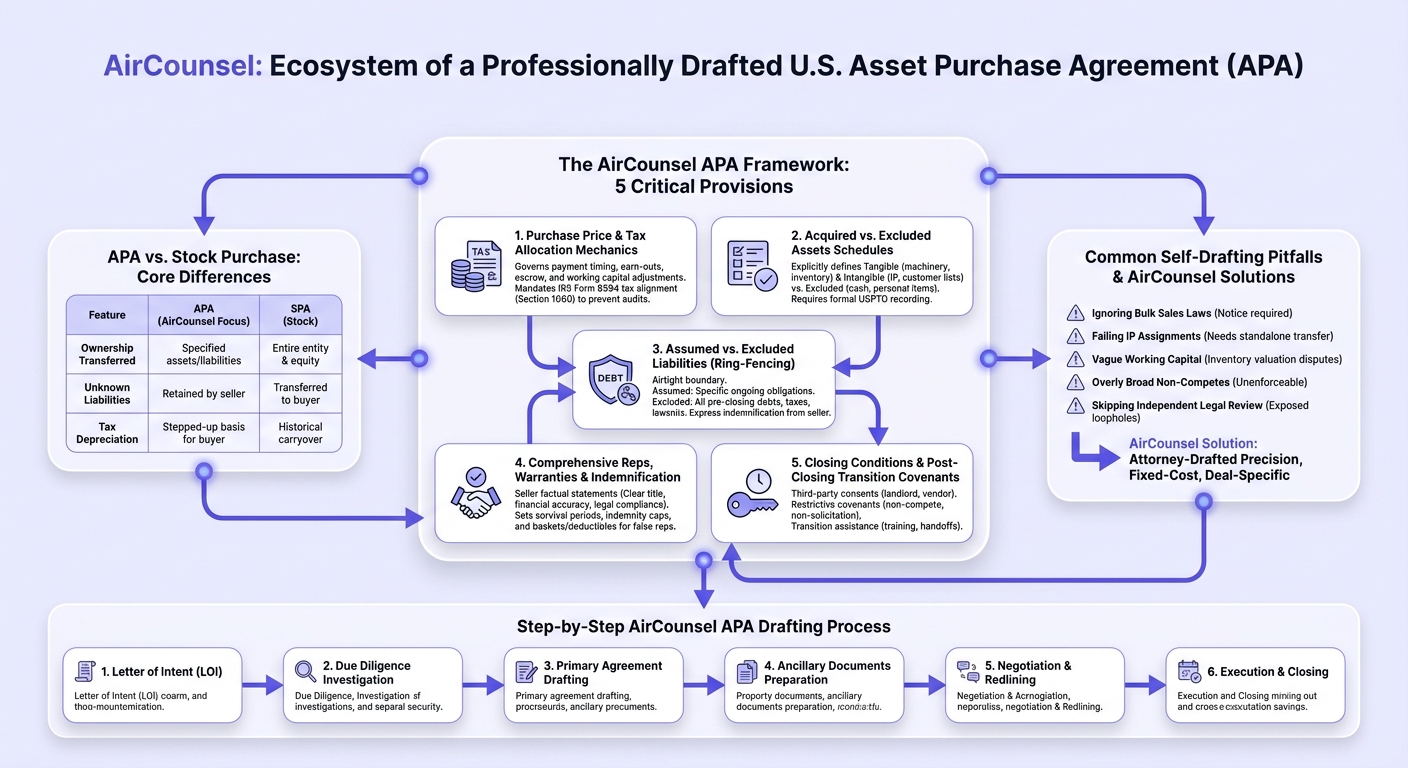
What Is an Asset Purchase Agreement in US Transactions?
An Asset Purchase Agreement (APA) is a legally binding contract where a buyer purchases designated business assets—such as equipment, customer lists, inventory, goodwill, and intellectual property—directly from a target company rather than buying the entity's equity.
In US commercial practice, small and mid-sized business (SMB) acquisitions lean heavily toward asset purchases because they allow buyers to "cherry-pick" productive assets and leave legacy risks behind. However, an APA does not automatically insulate a buyer from successor liability if the drafting is sloppy or asset schedules are vague.
Engaging professional contract drafting services ensures that every asset transfer is legally sound, state-specific assignment laws are respected, and all third-party consent requirements are addressed prior to closing.
Asset Purchase vs. Stock Purchase: Core Differences
Before drafting an acquisition document, founders must understand whether an asset purchase or a stock purchase agreement best serves their commercial goals.
In a stock purchase, the buyer acquires the target company's ownership shares or LLC membership units, stepping into the shoes of the existing business along with all past, present, and unknown liabilities. In an asset purchase, the corporate shell remains with the seller, and only agreed-upon items move to the buyer.
| Feature | Asset Purchase Agreement (APA) | Stock Purchase Agreement (SPA) |
|---|---|---|
| Ownership Transferred | Specified assets and selected liabilities | Entire legal entity including all equity |
| Unknown Liabilities | Generally retained by seller | Transferred automatically to buyer |
| Tax Depreciation | Buyer gains stepped-up basis in acquired assets | Historical tax basis generally carries over |
| Contract Assignments | Requires explicit assignment and counterparty consent | Contracts usually remain with company (unless change-of-control triggers) |
| Drafting Complexity | High (requires exhaustive asset/liability schedules) | Moderate (focuses on shares, capitalization, and entity history) |
If you are evaluating equity-based transactions instead of asset transfers, you can review our custom Sale of Stock Agreement service for tailored corporate transfer documents.
5 Critical APA Provisions Requiring Professional Drafting
To ensure enforceability and protect deal value, attorney drafting must focus heavily on five core provisions where transaction disputes most frequently arise.

1. Purchase Price and Tax Allocation Mechanics
The purchase price section must govern not just the top-line dollar amount, but also payment timing, earn-outs, escrow holdbacks, and working capital adjustments.
Crucially, under Section 1060 of the Internal Revenue Code, both parties must formally agree on how the purchase price is allocated across asset classes—such as equipment, inventory, and intangible goodwill. Inconsistent filings on IRS Form 8594 can trigger audits for both parties. Proper drafting ensures mutual agreement on tax reporting prior to closing.
2. Acquired Assets vs. Excluded Assets Schedules
An APA is only as strong as its disclosure schedules. The contract must explicitly define:
- Tangible Assets: Machinery, hardware, furniture, and physical inventory.
- Intangible Assets: Trademarks, proprietary code, customer lists, vendor agreements, and domain names. Formal recording with the U.S. Patent and Trademark Office is often required for registered brand assets.
- Excluded Assets: Seller's cash accounts, personal vehicles, corporate records, or specific receivables.
Ambiguous phrases like "all business assets" frequently result in post-closing disputes over who owns vital digital accounts, software licenses, or customer data.
3. Assumed Liabilities vs. Excluded Liabilities
The primary strategic reason buyers choose an APA is to avoid taking on past corporate debts. The contract must draw an airtight boundary between:
- Assumed Liabilities: Specific ongoing obligations, such as future lease payments or unfulfilled customer orders for which the buyer received credit.
- Excluded Liabilities: All pre-closing tax obligations, unpaid employee wages, pending lawsuits, accounts payable, and environmental or regulatory fines.
Drafting must also contain express indemnification language requiring the seller to defend and hold the buyer harmless if pre-closing creditors attempt to assert successor liability claims.
4. Comprehensive Representations, Warranties, and Indemnification
Representations and warranties ("reps and warranties") are factual statements made by the seller regarding the legal standing, financial health, and operational status of the assets. Key warranties cover:
- Clear title and ownership of all assets without undisclosed liens or encumbrances.
- Accuracy of historical financial statements provided to the buyer.
- Full compliance with federal, state, and local laws.
- Absence of pending litigation or intellectual property infringement claims.
The accompanying indemnification clause sets the financial remedy if a representation proves false. Attorneys draft survival periods (how long claims remain valid), indemnity caps (the maximum liability limit), and baskets or deductibles (the minimum threshold before claims can be brought).
5. Closing Conditions and Post-Closing Transition Covenants
A transaction rarely ends the moment signatures are exchanged. Key closing and post-closing mechanisms include:
- Third-Party Consents: Landlord approvals for commercial leases, software vendor assignments, and client contract transfers.
- Restrictive Covenants: Reasonable non-compete and non-solicitation clauses preventing the seller from opening a competing business next door or poaching transferred staff.
- Transition Assistance: Clear obligations outlining the seller's training period, consulting hours, and system handoffs.
If your transaction involves ongoing staff transitions, review our Custom Employment Agreement solutions to secure key talent alongside the asset purchase.
Common Mistakes in Small-Business Asset Drafting
When founders attempt self-drafting or modify recycled contracts, they consistently encounter predictable pitfalls:
- Ignoring Bulk Sales Laws: Certain states require specific notice to tax authorities and creditors when purchasing a substantial portion of inventory or business assets.
- Failing to Secure Intellectual Property Assignments: Simply stating that "software is included" does not satisfy federal assignment requirements without a standalone, signed transfer instrument.
- Vague Working Capital True-Ups: Failing to define standard inventory valuation methods leads to immediate day-one conflicts over stock value.
- Overly Broad or Unenforceable Non-Competes: Non-compete covenants that exceed reasonable geographic boundaries or duration limits risk being invalidated by courts.
- Skipping Independent Legal Review: Failing to have deal documents vetted by independent counsel leaves critical loopholes exposed.
For founders evaluating supplier-heavy acquisitions, you can read our guide on high-stakes supplier agreement reviews to understand how underlying commercial vendor contracts impact transaction risk.
Step-by-Step Process for Drafting an Enforceable APA
Executing an asset acquisition follows a structured legal workflow:
- Letter of Intent (LOI): Establish high-level pricing, deal structure, and exclusivity periods.
- Due Diligence Investigation: Inspect physical equipment, financial records, customer concentration, and public lien filings.
- Primary Agreement Drafting: Counsel drafts the core APA terms, indemnity limits, and payment mechanics.
- Ancillary Documents Preparation: Draft supporting instruments, including bills of sale, IP assignments, and disclosure schedules.
- Negotiation and Redlining: Parties exchange revisions to balance risk allocation and purchase price adjustments.
- Execution and Closing: Sign definitive documents, wire funds, deliver closing certificates, and execute operational handoffs.
Secure Your Acquisition with AirCounsel
Buying or selling small-business assets requires surgical precision. A single missing disclosure schedule or ambiguous liability clause can turn a profitable acquisition into an expensive legal battle. AirCounsel delivers attorney-drafted, deal-specific contracts designed to protect your investment with transparent, upfront pricing.
Whether you need a full acquisition document package from scratch or expert redlines on an existing agreement, our licensed US attorneys provide fast, thorough turnaround. Secure your deal today with our Custom Asset Purchase Agreement service, get comprehensive guidance with our Review of your Contract or Legal Document, or leverage dedicated Negotiation Support to finalize your transaction with total confidence.
Frequently Asked Questions
What is an asset purchase agreement in a U.S. business sale?
An asset purchase agreement is a definitive contract under US law where a buyer acquires specified assets and properties of a company—such as inventory, equipment, customer accounts, and intellectual property—without purchasing the entity itself or taking on unassumed liabilities.
Which provisions in an asset purchase agreement usually need the most lawyer attention?
The sections requiring the most legal precision are the purchase price allocation, the itemized schedules of acquired and excluded assets, the explicit exclusion of pre-closing liabilities, the representations and warranties with indemnification caps, and restrictive covenants like non-compete agreements.
How is an asset purchase agreement different from a stock purchase agreement?
An asset purchase agreement transfers individual assets and selected obligations, leaving the seller's legal entity behind. A stock purchase agreement transfers the equity of the entity itself, meaning the buyer automatically takes on all of the target company's historical debts, contracts, and unknown liabilities.
Why does professional contract drafting matter in an asset purchase transaction?
Professional drafting ensures that asset transfers comply with federal and state laws, that tax allocations meet IRS reporting standards, that intellectual property is legally assigned, and that the buyer is protected against inherited debts or post-closing seller competition.
Recommended
Need Legal Assistance?
Our expert legal team is ready to help you navigate complex legal matters with confidence.