Commercial Equipment Lease Agreements in 2026: The Startup Checklist for Contract Drafting Services

For industrial and hardware startups, securing heavy machinery, laboratory instruments, or specialized manufacturing tools is essential for scaling operations. However, purchasing high-value machinery outright can drain early-stage capital. As a result, founders frequently turn to commercial equipment leases to preserve cash flow while maintaining access to production technology.
According to data from the Small Business Administration, qualifying SBA equipment loans can reach up to $5.5 million with terms up to 10 years, highlighting the significant capital commitment required to equip modern industrial ventures. When outright financing is not the ideal fit, commercial leasing steps in as a flexible alternative.
Because lessor contracts are heavily weighted in favor of the financing entity, working with specialized contract drafting services or securing an attorney redline before signing is critical. Understanding the legal mechanics of equipment leasing protects your balance sheet from predatory terms, unexpected repair bills, and costly end-of-term obligations.
Table of Contents
- Quick Summary
- Understanding Equipment Leases vs. Real Property Leases
- Equipment Lease Structures: Operating vs. Finance Leases
- Key Clauses to Address in Commercial Equipment Leases
- Tax, Accounting, and Depreciation Considerations
- Startup Equipment Lease Checklist
- Protect Your Operations with Custom Contract Support
- Frequently Asked Questions
- Recommended
Quick Summary
| Takeaway | Explanation |
|---|---|
| Governing Law | Governed primarily by UCC Article 2A rather than state real estate statutes. |
| Lease Type Impact | Operating leases preserve balance sheet flexibility, while finance leases build equity. |
| Hidden Traps | Evergreen auto-renewal clauses and strict return shipping terms create unexpected costs. |
| Risk Allocation | Triple-net commercial lease clauses often shift all repair and insurance risk to the lessee. |
| Legal Review | Utilizing tailored contract drafting services prevents disputes and caps long-term liability. |
Understanding Equipment Leases vs. Real Property Leases
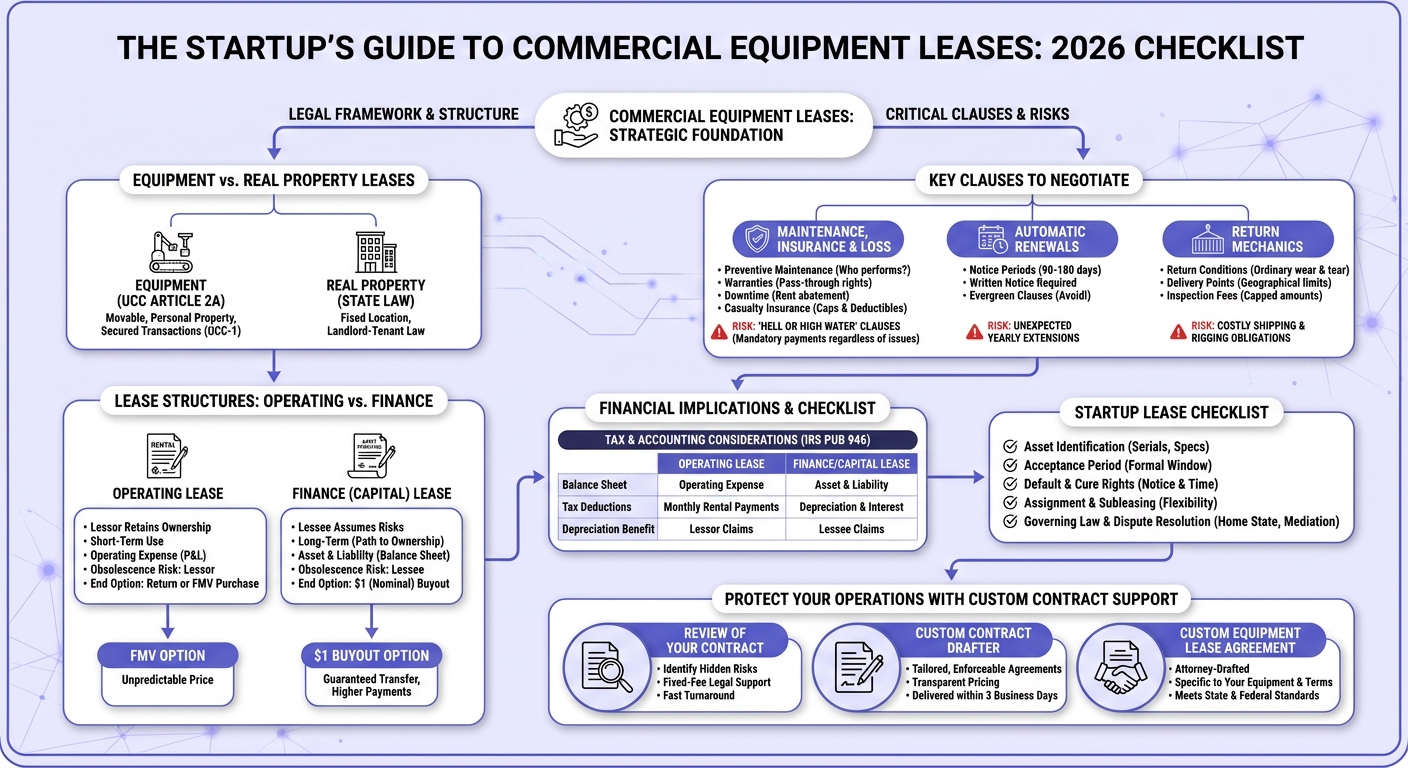
Commercial equipment leases differ fundamentally from commercial real estate leases. While real estate leases are governed by state-specific property law and landlord-tenant statutes, equipment leases fall under commercial personal property frameworks. In the United States, commercial personal property leases are governed by Article 2A of the Uniform Commercial Code (UCC), which has been adopted in almost every state.
Unlike real estate, where physical premises remain fixed, industrial machinery can be moved, upgraded, damaged during transit, or subjected to heavy physical wear. Furthermore, personal property leases frequently interact with secured transactions under UCC Article 9 if the lessor files a UCC-1 financing statement to secure its interest in the collateral.
Founders often mistake standard real estate concepts for equipment norms. If your business also rents physical warehouse or industrial space, you can read our guide on commercial lease contract review risks to understand how real property agreements differ in scope and legal liability.
Equipment Lease Structures: Operating vs. Finance Leases
Before entering into an equipment agreement, you must identify whether the contract is structured as an operating lease or a finance lease (often called a capital lease). The structure directly dictates your operational control, financial reporting, and end-of-term obligations.
- Operating Lease: A traditional rental arrangement where the lessor retains ownership of the asset. The startup uses the machinery for a portion of its useful life and returns it at the end of the term. These agreements suit equipment prone to rapid technological obsolescence.
- Finance Lease: A structured purchase mechanism where the lessee assumes most of the economic risks and rewards of ownership. The lease term often covers the majority of the equipment's useful lifespan, and the contract typically includes a path to full ownership.
Fair Market Value vs. Nominal Buyout Options
The buyout mechanism at the end of the term determines the true total cost of the lease:
- Fair Market Value (FMV) Option: The lessee can purchase the machinery at the end of the lease for its appraised market value. While this structure keeps monthly payments lower, the final purchase price can be unpredictable.
- $1 (Nominal) Buyout Option: The lessee pays a predetermined, nominal fee (such as $1 or $100) at term completion to transfer title. Monthly payments are higher, but ownership transfer is guaranteed without price negotiations.

Key Clauses to Address in Commercial Equipment Leases
Standard equipment vendor agreements are drafted to favor the lessor. Engaging an attorney or using dedicated contract drafting services ensures you identify and negotiate the following critical clauses.
Maintenance, Insurance, and Risk of Loss
Most industrial lessors utilize "hell or high water" clauses, requiring monthly payments regardless of whether the equipment breaks down or suffers factory defects. Contract negotiation must clarify:
- Preventive Maintenance: Specify whether the lessor provides routine servicing or if the lessee must contract third-party certified technicians.
- Warranties and Remedies: Ensure the lessor passes through manufacturer warranties to your business so you can enforce repair remedies directly against the builder.
- Downtime and Replacement: Negotiate rent abatements or temporary replacement machinery if mission-critical equipment experiences extended downtime due to manufacturing defects.
- Casualty Insurance: Define acceptable comprehensive insurance thresholds and deductible caps to prevent over-insuring older equipment.
Automatic Renewals and Return Mechanics
One of the most expensive pitfalls in equipment agreements is the evergreen renewal clause. Lessors often require written notice 90 to 180 days prior to lease expiration to prevent the agreement from automatically renewing for another full year.
Additionally, return shipping obligations can surprise early-stage businesses. High-precision manufacturing instruments and heavy industrial apparatus often require specialized rigging, professional de-installation, and insured freight. Ensure your contract specifies:
- Exact return-condition standards (e.g., "ordinary wear and tear excepted").
- Reasonable geographical delivery points for returned machinery.
- Capped inspection fees assessed by the lessor upon surrender.
Tax, Accounting, and Depreciation Considerations
The IRS enforces specific criteria to determine whether an agreement qualifies as a true lease for tax purposes or represents a conditional sales contract. Under IRS Publication 946, depreciation deductions are reserved for the legal and economic owner of the property.
| Metric | Operating Lease | Finance / Capital Lease |
|---|---|---|
| Balance Sheet Treatment | Operating expense on income statement | Asset and liability recorded on balance sheet |
| Tax Deductions | Monthly rental payments deducted as operating expenses | Depreciation and interest portion of payment deducted |
| Depreciation Benefit | Claimed by the lessor | Claimed by the startup (lessee) |
| Ownership Transfer | None (unless FMV purchase option exercised) | Expected at end of term via buyout |
| Obsolescence Risk | Borne primarily by lessor | Borne entirely by startup |
If an agreement is mischaracterized, your business risks unexpected tax liabilities or denied depreciation deductions. Precision in how contract terms, purchase rights, and title transfers are drafted prevents audit complications.
Startup Equipment Lease Checklist
Before executing a commercial equipment lease for your industrial startup, review the following operational checkpoints:
- Asset Identification: Confirm serial numbers, model specifications, software licenses, and included attachments are explicitly detailed.
- Acceptance Period: Establish a formal inspection window (e.g., 5 to 10 business days) after delivery to verify performance before the payment clock begins.
- Default and Cure Rights: Ensure the contract includes a written notice requirement and a minimum 10-to-15-day cure window for alleged non-monetary defaults.
- Assignment and Subleasing: Secure the right to assign the lease or transfer equipment use to affiliated entities or acquiring partners in the event of corporate restructuring.
- Governing Law and Dispute Resolution: Align jurisdiction with your company's home state and mandate mediation or arbitration before litigation.
If you are drafting an agreement from scratch for leased equipment that your company owns or provides to partners, obtaining a Custom Equipment Lease Agreement ensures your terms meet all state and federal standards.
Protect Your Operations with Custom Contract Support
Signing unvetted commercial contracts exposes industrial startups to hidden fees, unfavorable liability shifts, and restrictive operational covenants. Whether you are leasing proprietary fabrication units or renting heavy construction machinery, transparent legal guidance protects your runway and preserves business autonomy.
AirCounsel provides fast, fixed-fee legal support from licensed US attorneys. If you have been handed a standard lessor contract, order a thorough Review of your Contract or Legal Document to catch hidden risks before you sign. For proprietary transactions or custom vendor frameworks, explore our Custom Contract Drafter service to receive a tailored, enforceable agreement within three business days.
Frequently Asked Questions
What should be in a commercial equipment lease agreement for a startup?
A commercial equipment lease should clearly state the equipment description, lease term, payment schedules, maintenance responsibilities, insurance requirements, loss allocation, default conditions, and specific end-of-term purchase or renewal options.
How is an equipment lease different from an equipment loan or purchase?
An equipment purchase or loan transfers asset ownership immediately, with the buyer claiming depreciation and bearing all obsolescence risk. A lease allows a business to rent the asset over time, preserving working capital and often allowing monthly payments to be deducted as operating expenses.
What end-of-lease options should I check before signing?
Examine whether the lease provides a Fair Market Value (FMV) purchase option, a fixed-price buyout (such as a $1 nominal buyout), a renewal clause, or a requirement to return the equipment. Pay close attention to notification deadlines and return shipping obligations.
Who is responsible for maintenance, insurance, and repairs under the lease?
In most commercial finance leases, the lessee is responsible for ongoing maintenance, servicing, and property insurance under a "triple-net" structure. In operating leases, some maintenance may remain with the lessor, but this must be negotiated and explicitly drafted into the contract.
Recommended
- Custom Equipment Lease Agreement — Obtain an attorney-drafted, enforceable lease tailored to your specific commercial equipment and operational terms.
- Review of your Contract or Legal Document — Have licensed US attorneys redline third-party lease agreements and flag hidden financial traps within two business days.
- Custom Contract Drafter — Generate custom, compliant business agreements and commercial contracts with transparent, fixed pricing.
Need Legal Assistance?
Our expert legal team is ready to help you navigate complex legal matters with confidence.