A Comprehensive USA Startup Legal Checklist for Directing a Contract Review Attorney on High-Value Procurement Deals

Securing a high-value enterprise vendor contract or government procurement award is a transformative milestone for any growing startup. However, larger commercial deals carry hidden liabilities, aggressive indemnity triggers, and complex compliance flow-downs that standard boilerplate templates cannot safely manage.
Engaging a qualified contract review attorney ensures you identify structural legal exposure before signing away core proprietary rights or accepting unbounded financial risk. In federal and commercial supply chains, compliance requirements compound rapidly: federal prime contractors receiving awards of $950,000 or more must submit formal small-business subcontracting plans, demonstrating how enterprise rules frequently trickle down into vendor agreements according to Congressional Research Service analysis on small business contracting.
Directing legal counsel effectively—rather than handing over a 60-page agreement without instructions—saves substantial legal fees, accelerates deal execution, and preserves your operating margins.
Table of Contents
- Quick Summary
- Why High-Value Procurement Deals Require Specialized Legal Review
- Assembling Your Contract Review Packet
- Crucial Contract Clauses to Scrutinize
- Step-by-Step Workflow for Directing Your Contract Review Attorney
- Common Procurement Red Flags and Deal Breakers
- Cost Comparison: Traditional Hourly vs Fixed-Fee Review
- Secure Fast, Fixed-Fee Legal Review for Your High-Value Deals
- Frequently Asked Questions
- Recommended
Quick Summary
| Takeaway | Explanation |
|---|---|
| Procurement Complexity | High-value agreements contain enterprise risk allocations that standard commercial templates do not address. |
| Review Packet Preparation | Providing counsel with statements of work, service level agreements, and pricing schedules reduces turnaround time. |
| Key Risk Points | Limitation of liability caps, unilateral indemnities, and audit clauses create the highest financial exposure. |
| Direction Over Delegation | Defining your deal boundaries and risk tolerance yields practical redlines rather than theoretical legal objections. |
| Pricing Predictability | Fixed-fee contract reviews protect legal budgets while delivering comprehensive risk analysis within 2 business days. |
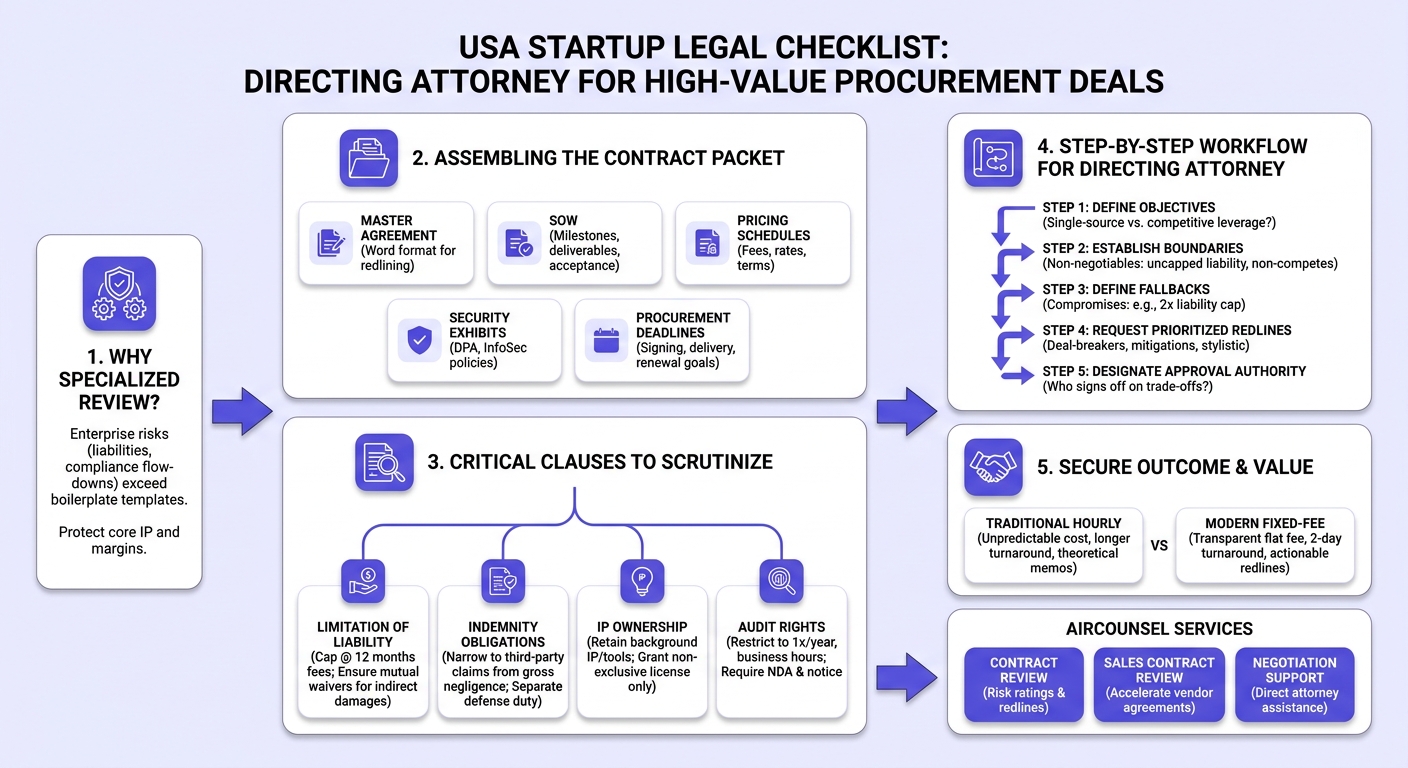
Why High-Value Procurement Deals Require Specialized Legal Review
Enterprise buyers and government prime contractors routinely utilize procurement agreements drafted by institutional legal teams to shift financial, operational, and regulatory risks onto suppliers. When a growing company signs an enterprise procurement contract, it is not merely selling a product or service; it is entering an integrated compliance ecosystem.
Standard commercial templates lack the nuanced protections required for high-stakes business-to-business transactions. For deeper insight into master agreements, read our guide on enterprise Master Services Agreements. Procurement contracts often feature strict performance warranties, stringent background check covenants, and mandatory insurance coverage minimums that can eliminate deal profitability if overlooked.
Working with an experienced contract review attorney allows you to balance legal protection against commercial momentum. Instead of allowing external counsel to block progress with academic legal debates, modern founders provide clear business parameters to secure practical redlines that close transactions safely.
Assembling Your Contract Review Packet
Before submitting documents for attorney analysis, you must organize a comprehensive contract packet. Handing an attorney an isolated master agreement without accompanying exhibits creates blind spots and increases legal review costs.
- Master Agreement Draft: The primary contract, Master Services Agreement (MSA), or Vendor Agreement in editable Microsoft Word format for redlining.
- Statements of Work (SOW): Clear project milestones, deliverable descriptions, acceptance testing timelines, and payment milestone schedules.
- Pricing and Fee Schedules: Detailed breakdown of software license fees, implementation costs, hourly rates, reimbursable expenses, and payment net terms.
- Security and Compliance Exhibits: Data Processing Addenda (DPA), Information Security Policies, and cybersecurity baseline obligations.
- Procurement Deadlines: Explicit target signing dates, delivery timelines, and renewal milestones to establish realistic attorney turnaround goals.
Organizing these documents beforehand ensures your attorney evaluates the agreement within the exact economic and technical realities of your business relationship.
Crucial Contract Clauses to Scrutinize
High-value procurement contracts contain several recurring operational traps. Knowing how these provisions function enables you to direct your attorney to the areas of greatest exposure.
Limitation of Liability and Consequential Damages
The limitation of liability clause sets the maximum financial cap a party must pay in damages. Enterprise buyers frequently propose caps equal to 3 to 5 times the annual contract value or attempt to exclude their own operational breaches while leaving vendor liability uncapped.
Ensure your attorney aligns the liability cap with 12 months of fees paid under the agreement, and verify that mutual waivers for indirect, consequential, and punitive damages remain intact without excessive carve-outs.
Indemnity and Defense Obligations
Indemnification clauses obligate one party to compensate and defend the other against third-party claims. High-value procurement contracts often contain one-sided provisions requiring vendors to indemnify buyers for ordinary breach of contract or broad negligence.
- Standard IP Indemnity: Vendors should generally indemnify customers for third-party intellectual property infringement claims arising directly from the vendor's proprietary technology.
- Defense vs Hold Harmless: Separate the duty to defend from open-ended indemnity obligations to avoid premature legal cost burdens.
- Mutual Gross Negligence: Narrow indemnity triggers to third-party claims resulting directly from gross negligence, willful misconduct, or material breach of confidentiality.
Intellectual Property Ownership and Work-for-Hire Rules
Procurement agreements frequently include broad "work-for-hire" language asserting that the buyer owns all deliverables, custom configurations, and underlying methodologies created during the engagement. To protect proprietary assets, explore our guide to protecting startup intellectual property.
Ensure that background intellectual property, pre-existing tools, core software code, and standard methodologies remain your exclusive property, granting the client only a non-exclusive license necessary to utilize the final deliverable.
Audit Rights and Compliance Flow-Downs
Enterprise procurement agreements frequently impose onerous audit rights, granting buyers broad access to your facilities, source code, financial ledgers, and employee records. In federal prime contractor relationships, these terms often flow down from mandatory government standards outlined in the SBA guidance on governing rules and responsibilities.
Your attorney must restrict audit rights to once per calendar year, require at least 14 business days of advance written notice, restrict inspections to standard business hours, and mandate that auditors sign strict non-disclosure agreements.

Step-by-Step Workflow for Directing Your Contract Review Attorney
Directing legal counsel requires active communication regarding your business goals, risk tolerance, and operational constraints. Follow this structured process to maximize review value:
- Step 1: Define Deal Objectives and Leverage: Inform your attorney of your commercial standing. Are you an indispensable single-source vendor, or are you competing against multiple bidders where excessive redlines might scuttle the deal?
- Step 2: Establish Non-Negotiable Boundaries: Specify terms you cannot accept, such as uncapped liability, non-compete restrictions, or assigning pre-existing patent rights.
- Step 3: Define Fallback Positions: Provide secondary compromises. For instance, if the buyer rejects a 1x contract value liability cap, instruct counsel that a 2x cap is acceptable as a compromise.
- Step 4: Request Prioritized Redlines: Ask counsel to categorize feedback into critical deal-breakers, recommended risk mitigations, and minor stylistic edits.
- Step 5: Designate Internal Approval Authority: Clarify who within your executive team has final sign-off authority for operational and financial trade-offs.
Common Procurement Red Flags and Deal Breakers
Recognizing commercial red flags early allows you to instruct your attorney to eliminate problematic language during the first redline round:
- Unilateral Termination for Convenience: Clauses allowing the buyer to cancel immediately without cause while requiring you to absorb all non-refundable operational costs.
- Vague Acceptance Criteria: Subjective milestone approval standards ("to buyer's sole satisfaction") that permit customers to withhold milestone payments indefinitely.
- Automatic Renewal Without Notice: Long multi-year auto-renewals with narrow 15-day cancellation windows that trap your business in outdated pricing models.
- Liquidated Damages and Penalty Fees: Arbitrary per-day fines for minor delivery delays, regardless of whether the customer caused or contributed to the delay.
- Broad Most-Favored-Nation (MFN) Clauses: Requirements forcing you to retroactively lower pricing if you offer discounts to any future client.
Cost Comparison: Traditional Hourly vs Fixed-Fee Review
Understanding legal billing structures helps founders manage operational expenses while securing high-caliber legal protection.
| Review Dimension | Traditional Law Firm Hourly Model | Modern Fixed-Fee Review Model |
|---|---|---|
| Pricing Predictability | Unpredictable ($450–$950+ per hour with open retainer) | 100% transparent flat fee starting from $250 |
| Turnaround Time | 5 to 10 business days depending on partner workload | 2 business days standard with express options |
| Output Clarity | Lengthy legal memos with theoretical risk analysis | Actionable contract redlines and executive summaries |
| Negotiation Focus | Over-lawyering minor phrasing points | Pragmatic risk mitigation aligned with deal velocity |
| Budget Control | Frequent billing surprises and hidden administrative fees | Clear upfront cost agreed upon before work begins |
Secure Fast, Fixed-Fee Legal Review for Your High-Value Deals
Do not let complicated procurement clauses, aggressive indemnities, or unbudgeted liabilities derail your enterprise revenue. Getting an attorney to examine your high-value agreements gives you the leverage to negotiate favorable terms, protect company assets, and close contracts with complete confidence.
AirCounsel provides rapid, transparent legal review from US-licensed attorneys without billable-hour surprises. Submit your contract today to receive expert redlines and strategic risk analysis:
- Get a comprehensive Review of your Contract or Legal Document with clear risk ratings and actionable redlines delivered within 2 business days.
- Accelerate enterprise vendor agreements with our fast-turnaround Sales Contract Review.
- Secure dedicated Negotiation Support to have an experienced US attorney assist directly with counterparties, deal strategy, and closing calls.
Frequently Asked Questions
What should a startup send a contract review attorney before a procurement deal review?
You should provide the complete editable agreement in Microsoft Word, all technical statements of work, pricing schedules, Service Level Agreements (SLAs), and Data Processing Addenda. Additionally, include a brief summary detailing deal value, key negotiation boundaries, and required completion deadlines.
Which clauses matter most in a high-value procurement contract?
The most critical clauses are the limitation of liability cap, consequential damage exclusions, defense and indemnity obligations, intellectual property ownership provisions, audit rights, payment terms, and termination rights.
When does a small business need a lawyer to review a contract before signing?
A small business should always engage counsel when a contract involves significant revenue, multi-year obligations, licensing of proprietary software or trademarks, strict data compliance mandates, or broad indemnity commitments.
What are the biggest red flags in vendor, supply, or procurement agreements?
Major red flags include uncapped liability, one-sided indemnity for ordinary breach of contract, subjective customer acceptance criteria, unilateral termination for convenience without expense reimbursement, and broad audit rights granting unrestricted access to proprietary source code or financial records.
Recommended
Need Legal Assistance?
Our expert legal team is ready to help you navigate complex legal matters with confidence.