7 Costly Traps in Standard Vendor Templates That Demand Custom Contract Drafting for US Businesses

Small business owners and founders frequently rely on off-the-shelf templates or vendor-supplied master agreements to accelerate purchasing. However, generic agreements rarely align with your business operations, exposing your company to operational failure, data exposure, and unrecoverable financial losses. Engaging in strategic custom contract drafting ensures your commercial agreements protect your interests, enforce vendor accountability, and eliminate hidden legal vulnerabilities.
According to the U.S. Small Business Administration, contracts valued between $10,000 and $250,000 are automatically set aside for small businesses in federal procurement, illustrating how critical even modest contract values are to emerging enterprises. In the commercial sector, signing standard forms without tailored terms can expose an enterprise to catastrophic operational and financial risks.
When managing third-party suppliers, SaaS providers, or independent contractors, generic language creates wide enforcement gaps. This guide outlines the seven most expensive traps in standard vendor contracts and shows how customized legal agreements safeguard your growing business.
Table of Contents
- The Real Cost of Off-the-Shelf Vendor Templates
- 7 Dangerous Traps in Standard Vendor Agreements
- Trap 1: Vague Scope of Work and Deliverables
- Trap 2: One-Sided Indemnification and Liability Caps
- Trap 3: Deficient Data Security and Privacy Terms
- Trap 4: Auto-Renewal and Termination Locks
- Trap 5: Missing Change-Order Controls and SLA Metrics
- Trap 6: Payment Ambiguities and Unchecked Fee Hikes
- Trap 7: IP Ownership and Confidentiality Loopholes
- Goods vs. Services: How UCC and State Laws Apply
- Checklist: When to Invest in Custom Contract Drafting
- Red Flags to Spot Before Signing Any Vendor Form
- Protect Your Operations with Tailored Legal Agreements
- Frequently Asked Questions
- Recommended
Quick Summary
| Takeaway | Explanation |
|---|---|
| Template Risks | Generic templates are drafted to benefit the original author, usually limiting vendor accountability while shifting liability to your business. |
| Operational Exposure | Ambiguous scopes of work and missing Service Level Agreements (SLAs) make performance failures difficult and expensive to remedy. |
| Legal Divergence | Contracts for physical goods follow Uniform Commercial Code (UCC) default rules, whereas services depend strictly on negotiated written terms. |
| Financial Traps | Evergreen clauses, hidden price escalators, and non-refundable retainers can lock small businesses into unwanted, recurring expenses. |
| Custom Value | Custom drafting establishes explicit acceptance criteria, clear IP ownership, balanced liability caps, and actionable dispute resolution paths. |
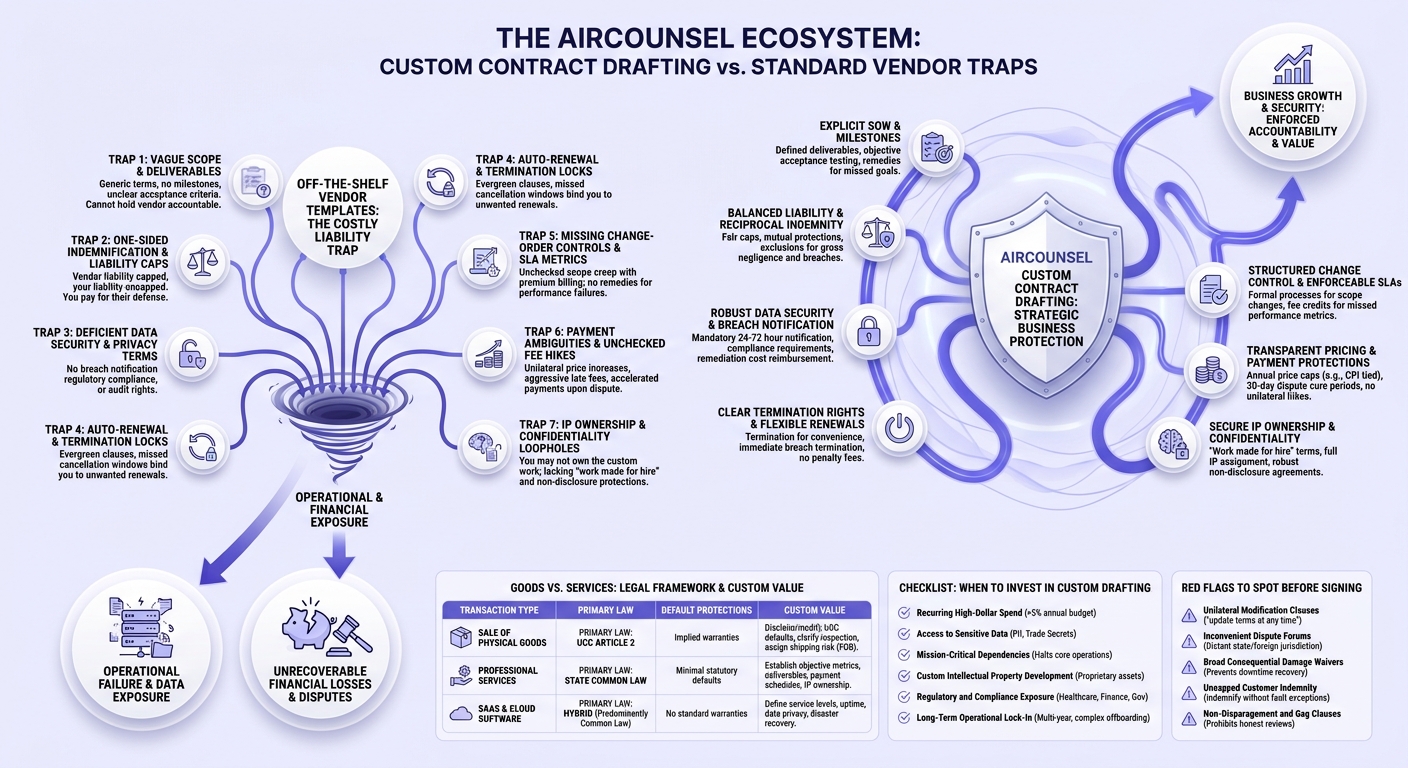
The Real Cost of Off-the-Shelf Vendor Templates
Generic contract templates promise convenience, but they often function as a liability transfer mechanism rather than a protective shield. Free internet templates are built around idealized scenarios that rarely match specific vendor deliverables, timelines, or compliance mandates.
When you use a boilerplate document, or worse, sign a vendor's pre-drafted standard service contract, the language typically contains structural biases. These include broad liability disclaimers for the vendor, strict payment conditions for you, and vague specifications regarding quality standards. If a dispute emerges, courts enforce the written language within the four corners of the document, regardless of verbal promises made during sales calls.
Using a Custom Services Agreement tailored to your exact operational workflow ensures that performance standards, milestone payouts, and legal protections are clearly enforceable under US law.
7 Dangerous Traps in Standard Vendor Agreements

Trap 1: Vague Scope of Work and Deliverables
Standard agreements often use generic descriptions such as "marketing support," "software maintenance," or "consulting services." Without detailed schedules, measurable milestones, and clear acceptance criteria, you cannot hold the vendor accountable for subpar output. Custom contract drafting replaces vague generalities with explicit Statements of Work (SOWs), defined deliverables, objective acceptance testing windows, and remedies for missed milestones.
Trap 2: One-Sided Indemnification and Liability Caps
Standard forms frequently cap vendor liability to the fees paid over the previous 30 days while leaving your liability completely uncapped. In addition, one-sided indemnity clauses may obligate you to pay for the vendor's legal defense if a third party brings a claim related to the project. A custom-drafted agreement balances these caps, creates reciprocal indemnity terms, and explicitly excludes gross negligence, confidentiality breaches, and data security incidents from the liability limit.
Trap 3: Deficient Data Security and Privacy Terms
The Federal Trade Commission Small Business Guidance emphasizes that security provisions in vendor contracts must be non-negotiable to protect customer data. Standard forms rarely contain explicit breach-notification timelines, regulatory compliance requirements (such as CCPA or HIPAA), or rights to audit security protocols. Custom terms ensure your vendor is legally bound to notify you within 24 to 72 hours of any security incident and reimburse remediation costs.
Trap 4: Auto-Renewal and Termination Locks
Boilerplate vendor forms often contain "evergreen" renewal clauses requiring written cancellation notices 60 or 90 days before the annual term ends. If missed, you are legally bound to pay for another full year. Custom drafting inserts clear termination rights, including termination for convenience with reasonable notice (e.g., 30 days) and immediate termination for material breach without penalty fees.
Trap 5: Missing Change-Order Controls and SLA Metrics
Projects evolve, but standard templates rarely articulate how scope expansions are priced and authorized. Without formal change-order mechanics, vendors can unilaterally bill you for "out-of-scope" work at premium hourly rates. Custom agreements implement structured change control procedures and include enforceable Service Level Agreements (SLAs) with fee credits if uptime or performance thresholds are missed.
Trap 6: Payment Ambiguities and Unchecked Fee Hikes
Standard templates often allow suppliers to adjust pricing upon renewal without notice, impose aggressive late fees (e.g., 1.5% to 2% monthly), and accelerate all remaining contract payments upon a disputed late invoice. Customized contracts establish annual price caps (e.g., tied to the Consumer Price Index), clear 30-day cure periods for invoice disputes, and prohibit unilateral rate adjustments.
Trap 7: IP Ownership and Confidentiality Loopholes
If you hire a contractor or agency using a generic template, you may not actually own the custom code, designs, or marketing assets they create. Under US copyright law, independent contractor work does not automatically belong to you unless there is an express written assignment. Using a tailored Custom Independent Contractor / Consulting Agreement establishes explicit "work made for hire" terms and guarantees full intellectual property assignment alongside robust non-disclosure protections.
Goods vs. Services: How UCC and State Laws Apply
The legal principles governing your vendor relationship vary significantly depending on whether the contract covers physical goods or intangible services.
Under the Uniform Commercial Code Section 2-204, contracts for the sale of goods adopt statutory default gap-fillers regarding warranties, delivery obligations, and acceptance. In contrast, service contracts are governed by state common law, where courts strictly interpret the written text without automatic statutory protections.
| Transaction Type | Primary Governing Law | Default Protections | Why Custom Drafting Is Essential |
|---|---|---|---|
| Sale of Physical Goods | Uniform Commercial Code (UCC) Article 2 | Implied warranties of merchantability and fitness for a particular purpose | To disclaim or modify default UCC gap-fillers, clarify inspection windows, and assign shipping risk (FOB terms). |
| Professional Services | State Common Law / Case Law | Minimal statutory defaults; strictly relies on contract language | To establish objective performance metrics, deliverables, milestone payment schedules, and IP ownership. |
| SaaS & Cloud Software | Hybrid (predominantly Common Law) | No standard statutory warranties unless explicitly stated | To define service levels, uptime guarantees, data privacy standards, and disaster recovery obligations. |
| Equipment Leasing | UCC Article 2A | Statutory default rules for lease terms and remedies | To clarify return conditions, maintenance responsibilities, risk of loss, and insurance obligations. |
Checklist: When to Invest in Custom Contract Drafting
Not every purchase requires a 20-page legal document. However, using custom contract drafting is critical when your business faces substantial financial, operational, or legal exposure:
- Recurring High-Dollar Spend: Any vendor engagement representing more than 5% of your annual operating budget.
- Access to Sensitive Data: Vendors that process, store, or transmit customer personally identifiable information (PII) or proprietary trade secrets.
- Mission-Critical Dependencies: Software, logistics, or operational vendors whose downtime immediately halts your core business operations.
- Custom Intellectual Property Development: Agencies, developers, or creators building proprietary brand assets, software, or marketing material.
- Regulatory and Compliance Exposure: Suppliers operating in healthcare, financial services, legal, or government contracting environments.
- Long-Term Operational Lock-In: Contracts with multi-year commitments or complex offboarding and data migration requirements.
Red Flags to Spot Before Signing Any Vendor Form
Before executing any third-party contract, review the agreement for these five critical warning signs:
- Unilateral Modification Clauses: Clauses stating the vendor may "update these terms at any time by posting notice on our website."
- Inconvenient Dispute Forums: Mandatory arbitration or court jurisdiction located in an unfavorable, distant state or foreign jurisdiction.
- Broad Consequential Damage Waivers: Provisions preventing you from recovering damages for operational downtime caused by the vendor's direct breach.
- Uncapped Customer Indemnity: Clauses requiring you to indemnify the vendor for third-party claims without fault or gross negligence exceptions.
- Non-Disparagement and Gag Clauses: Language prohibiting you from leaving honest reviews or disputing unfair billing practices publicly.
If you encounter these clauses in a supplier's contract, request a professional Review of your Contract or Legal Document to insert appropriate protective riders before signing.
Protect Your Operations with Tailored Legal Agreements
Using generic templates or unvetted vendor agreements exposes your growing company to avoidable disputes, financial losses, and operational disruptions. AirCounsel provides modern legal support designed for fast-moving founders and small business owners across the US.
Get transparent, fixed-fee legal drafting tailored to your exact transaction terms. Work directly with licensed US attorneys through our Custom Contract Drafter to produce ironclad vendor agreements, master service agreements, and commercial contracts delivered within 3 business days.
This article provides general information and is not legal advice.
Frequently Asked Questions
Why is a vendor template risky for a small business?
Generic vendor templates are typically drafted to protect the supplier by capping their financial liability, limiting their performance warranties, and locking customers into automatic renewal terms. For a small business, signing an unvetted template can leave you with no legal recourse if the vendor fails to deliver or suffers a major data breach.
Which contract clauses should be customized first in a vendor agreement?
The most critical clauses to tailor are the Scope of Work (SOW), liability caps, indemnification provisions, data security and breach notifications, intellectual property ownership, and termination rights. Customizing these clauses ensures clear performance accountability and limits unexpected financial exposure.
Does the UCC matter for vendor contracts involving goods in the US?
Yes. Contracts for the sale of physical goods in the US are governed by Article 2 of the Uniform Commercial Code (UCC), which provides default statutory rules for warranties, delivery, and acceptance. Service contracts are governed by state common law, meaning courts enforce only the terms explicitly written in the contract.
When should a business replace a template with custom contract drafting?
A business should replace generic templates whenever an engagement involves significant financial investment, access to proprietary data or trade secrets, mission-critical operations, or custom intellectual property creation. Tailored drafting prevents ambiguous terms from causing expensive disputes.
Recommended
Need Legal Assistance?
Our expert legal team is ready to help you navigate complex legal matters with confidence.