5 Dangerous Debt Covenants a Contract Review Lawyer Flags in Startup Venture Loans

Venture debt and structured commercial loans provide high-growth startups with valuable non-dilutive capital to extend cash runway between equity rounds. However, the initial term sheet rarely reveals the operational traps hidden deep within the final loan documents. Engaging an experienced contract review lawyer before signing helps founders identify restrictive clauses that could otherwise jeopardize business operations or transfer excessive control to a creditor.
According to the Federal Reserve Small Business Credit Survey, 59% of small businesses report experiencing financial challenges related to debt payments and operating costs, underscoring how volatile cash flow can collide with strict lender covenants. When market conditions shift or product milestones face delays, poorly structured debt covenants can quickly trigger technical defaults, fee penalties, or complete loss of company control.
Understanding the mechanics of loan covenants empowers founders to negotiate balanced terms, retain operational flexibility, and protect intellectual property. Below, we break down the five most dangerous debt covenants found in venture lending agreements and outline what you need to review before signing.
Table of Contents
- Understanding Debt Covenants: Affirmative, Negative, and Financial
- 1. Minimum Cash and Liquidity Covenants
- 2. Stringent Financial Ratios and Performance Milestones
- 3. Severe Restrictions on Additional Debt and Liens
- 4. Limits on Asset Sales, M&A, and Intellectual Property Transfers
- 5. Rigid Reporting Timelines and Subjective Default Triggers
- Red Flags to Catch During Contract Review
- Founder Checklist for Venture Loan Agreements
- Secure Professional Contract Review for Your Venture Loan
- Frequently Asked Questions
- Recommended
| Takeaway | Explanation |
|---|---|
| Financial Traps | Minimum liquidity floors can trap operational cash and restrict growth capital. |
| Operational Limits | Negative covenants often restrict future equity rounds, debt financing, or commercial licensing. |
| Technical Defaults | Missing a single reporting deadline can trigger default interest rates and penalty fees. |
| Remedy Mechanisms | Negotiating grace periods and cure notices prevents sudden cash sweeps and loan acceleration. |
| Legal Oversight | A dedicated contract review lawyer identifies subjective cross-default clauses prior to execution. |
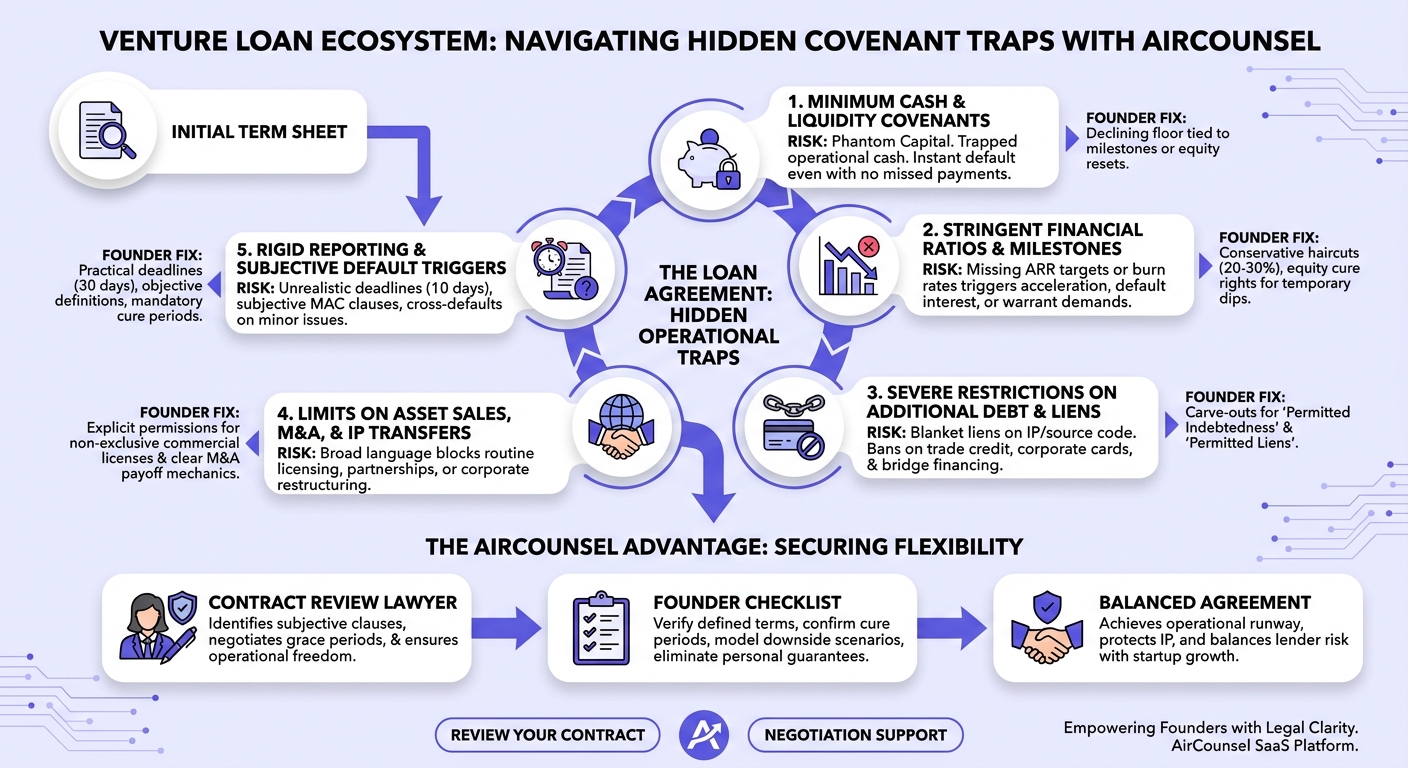
Understanding Debt Covenants: Affirmative, Negative, and Financial
A debt covenant is a legally binding commitment made by a borrower in a commercial loan agreement. Lenders insert covenants to mitigate risk, monitor borrower health, and ensure loan repayment. In venture lending, covenants fall into three primary categories:
- Affirmative Covenants: Obligations requiring the borrower to perform specific actions, such as maintaining corporate existence, paying taxes, securing commercial insurance, and providing periodic financial statements.
- Negative Covenants: Prohibitions that restrict the borrower from taking certain business actions without lender consent, such as incurring subordinated debt, changing the executive team, or selling assets.
- Financial Covenants: Mathematical hurdles that require the company to maintain specific financial metrics, such as minimum liquidity balances, recurring revenue targets, or debt-service coverage ratios.
While traditional commercial loans backed by programs like the SBA 7(a) Loan Program focus on historical profitability and hard collateral, venture debt often relies on future enterprise value and IP. Because early-stage startups operate with higher cash burn rates, venture loan covenants tend to be more restrictive and aggressive.
1. Minimum Cash and Liquidity Covenants
A minimum liquidity covenant requires a startup to maintain a specified amount of unencumbered cash in an approved deposit account at all times. For example, a credit agreement may mandate that the company maintain at least $1,000,000 or an amount equal to 3 months of trailing operating expenses.
The danger of an aggressive liquidity floor is the creation of "phantom capital." If a startup borrows $3,000,000 but must permanently maintain a $1,000,000 cash balance, the usable capital is only $2,000,000, yet the business pays interest on the entire principal balance. Breaching this floor instantly triggers a default, even if the startup has never missed a scheduled debt payment.
When reviewing this clause, an attorney will push for a declining liquidity floor tied to enterprise milestones, or allow the floor to reset based on incoming investor equity commitments.
2. Stringent Financial Ratios and Performance Milestones
Venture debt agreements often tie loan compliance to performance benchmarks, such as minimum Annual Recurring Revenue (ARR) growth, gross margin floors, or maximum net burn rates.
For young companies, growth is rarely linear. A single enterprise client delaying a contract signing by two weeks can cause a startup to miss an ARR target for a quarter, placing the entire credit facility into default. Once a financial covenant is breached, the lender gained the legal right to accelerate the full debt, impose default interest (often an additional 5% or more), or demand immediate equity warrants as consideration for a waiver.
To protect the business, founders should ensure performance targets reflect a conservative haircut (typically 20% to 30% below board-approved forecasts) and include explicit equity cure rights that allow incoming investment to remedy a temporary operational dip.
3. Severe Restrictions on Additional Debt and Liens
Negative covenants routinely prohibit the company from creating, incurring, or assuming any additional indebtedness or granting security interests over company assets. While protecting senior lender priority is standard, overly broad drafting can restrict ordinary business operations.
Dangerous restrictions in this category include:
- Blanket Lien Requirements: Demanding a first-priority security interest across all assets, including all source code, patents, and customer contracts.
- Prohibiting Trade Credit: Banning standard equipment leases, trade payable terms, or corporate credit cards.
- Blocking Subordinated Convertible Notes: Preventing the startup from issuing convertible debt or SAFEs to bridge subsequent venture rounds.
Founders should ensure the contract carves out generous "permitted indebtedness" and "permitted liens" baskets to accommodate everyday business activities and future equity financing.
4. Limits on Asset Sales, M&A, and Intellectual Property Transfers
Lenders want assurance that the assets generating value for the company remain in place until the loan is satisfied. However, venture debt contracts frequently use expansive language that inadvertently forbids normal product licensing, software distribution, or corporate restructuring.
If your startup engages in standard software licensing or strategic partnerships, an overly broad "no transfer of IP" clause could treat routine business contracts as an unapproved asset disposition. For detailed guidance on structuring commercial provisions alongside intellectual property protections, read our guide on protecting startup IP and agreements.
Make sure the loan agreement explicitly permits non-exclusive commercial licenses granted in the ordinary course of business and clearly outlines M&A payoff mechanics so the debt can be retired smoothly upon an acquisition.
5. Rigid Reporting Timelines and Subjective Default Triggers
The fifth covenant category involves operational compliance and reporting mechanisms that can trigger "technical defaults"—situations where the borrower is performing financially but breaches an administrative term.
Common traps include:
- Unrealistic Reporting Windows: Demanding monthly unaudited financial statements within 10 to 15 days of month-end, or audited annual statements within 60 days of fiscal year-end.
- Material Adverse Change (MAC) Clauses: Subjective language granting the lender default remedies if they deem a "material adverse change" has occurred in the startup's prospects or industry.
- Cross-Default Provisions: Provisions specifying that a minor dispute under an office lease or vendor agreement automatically defaults the venture debt facility.
A lawyer will negotiate objective standard definitions, eliminate subjective MAC default triggers, extend reporting deadlines to practical timeframes (such as 30 days post-month-end), and insert mandatory cure periods.
Red Flags to Catch During Contract Review

When reviewing a draft credit agreement, compare the proposed terms against standard commercial practices to identify potential points of friction.
| Covenant Category | Risky Clause Language | Standard Compromise / Founder Fix |
|---|---|---|
| Liquidity Requirement | Fixed cash balance equal to 6 months of trailing cash burn. | Stepped-down minimum cash floor tied to ARR milestones or cash-burn reduction. |
| Performance Tests | Strict adherence to financial model with zero variance permitted. | 25% cushion below board projections plus equity cure rights. |
| Negative Pledges | Total prohibition on granting intellectual property security interests. | Springing liens or negative pledge agreements without immediate IP title control. |
| Administrative Deadlines | 10 business days for monthly reporting; no grace period. | 30 calendar days for monthly reporting; 10 business-day notice and cure window. |
| Default Mechanics | Immediate loan acceleration and cash sweeps upon technical breach. | Written notice requirement with a 15-to-30 day formal cure period. |
Founder Checklist for Venture Loan Agreements
Before signing any definitive credit facility, founders and executive teams should verify each of the following legal safeguards:
- Review all defined terms carefully: Look up defined terms like "Permitted Liens," "Permitted Indebtedness," and "Material Adverse Effect" to understand how they restrict your business. For insights on managing complex commercial contract reviews, consult our legal checklist on directing contract review on high-value deals.
- Confirm adequate cure periods: Ensure that any technical, non-payment breach requires the lender to deliver formal written notice followed by at least a 15-day opportunity to cure.
- Verify deposit account control agreements (DACAs): Understand whether the lender requires "springing" control (activated only upon default) or "active" control (immediate oversight of bank disbursements).
- Model downside scenarios: Stress-test your financial model against the proposed revenue and liquidity covenants to confirm the business can remain compliant during a market downturn.
- Eliminate personal guarantees: Confirm that the venture loan remains strictly an obligation of the corporate entity without personal liability for founders or officers.
Secure Professional Contract Review for Your Venture Loan
Signing a venture loan agreement without rigorous legal review exposes your business to silent operational limits and aggressive default penalties. A skilled attorney helps you identify restrictive covenants, establish realistic reporting timelines, and preserve the flexibility you need to run your startup.
AirCounsel connects founders and growing businesses with top-tier US attorneys who provide transparent, fixed-price legal reviews. Whether you need an in-depth Review of your Contract or Legal Document, comprehensive Negotiation Support to push back on predatory terms, or a tailored Custom Loan Agreement, our team delivers fast, practical legal clarity to safeguard your runway.
Frequently Asked Questions
What are the most common debt covenants in startup venture loans?
The most common covenants include minimum cash balance requirements, minimum recurring revenue hurdles, negative pledges restricting secondary borrowing, and administrative reporting requirements for periodic financial statements.
Which covenants are most likely to trigger a default for a young company?
Minimum liquidity floors and monthly revenue performance covenants are the most common culprits. Because startup revenue growth is subject to market variability and sales cycle delays, missing a single financial hurdle can trigger an immediate covenant default.
Can a lender change covenant terms after the loan is signed?
No. Once the credit agreement is executed, a lender cannot unilaterally alter the covenant terms. Any change requires a formal written amendment or waiver signed by both the borrower and the lender.
What should a founder ask a contract review lawyer before signing a venture loan?
Founders should ask whether the agreement contains subjective default triggers, whether reporting deadlines are realistic, how cross-default provisions interact with other commercial contracts, and what cure periods exist if a technical breach occurs.
Recommended
Need Legal Assistance?
Our expert legal team is ready to help you navigate complex legal matters with confidence.