What Legal Liabilities Arise When USA Executives Sign 2026 Layoff Releases Without a Contract Review Attorney?

Corporate reorganizations and leadership restructurings across the USA move swiftly. When an enterprise undertakes workforce adjustments, departing C-suite members and senior managers routinely receive separation documents that condition severance packages, equity rights, and benefits continuation on a binding release of claims.
Under federal guidelines from the U.S. Department of Labor, the WARN Act generally requires at least 60 calendar days of advance written notice for covered plant closings and mass layoffs affecting 50 or more employees. When organizations fail to provide statutory notice or rush executive departures, departing leaders who sign unvetted paperwork risk relinquishing statutory damage claims, earned incentive pay, and post-employment mobility.
Before appending a signature to any separation package, engaging a dedicated contract review attorney ensures that every waiver, indemnity term, and restrictive covenant is rigorously analyzed. Taking this proactive step protects your financial interests, preserves professional reputation, and prevents the unintentional surrender of leverage during high-stakes corporate transitions.
Table of Contents
- Understanding Executive Layoff Releases in 2026
- Critical Legal and Financial Liability Buckets
- Federal Protections: WARN Act and OWBPA Compliance
- Executive Severance Review Checklist and Timelines
- Why Retaining a Contract Review Attorney Protects Your Exit
- Protect Your Executive Career and Compensation with AirCounsel
- Frequently Asked Questions
- Recommended
Quick Summary
| Takeaway | Explanation |
|---|---|
| Release Scope | General release clauses often extinguish accrued bonus rights, deferred compensation, and unvested stock options unless explicitly carved out. |
| Federal Statutory Rights | Layoff releases must comply with the WARN Act and the Older Workers Benefit Protection Act (OWBPA) to remain legally enforceable. |
| Restrictive Covenants | Overly broad non-competes, non-solicitation clauses, and non-disparagement covenants can freeze your ability to work within your industry. |
| Indemnification Gaps | Signing without explicit survival of Directors and Officers (D&O) coverage exposes departing executives to personal legal liability for corporate acts. |
| Attorney Review | Having a dedicated legal professional redline your agreement typically secures better financial terms and removes dangerous post-employment traps. |
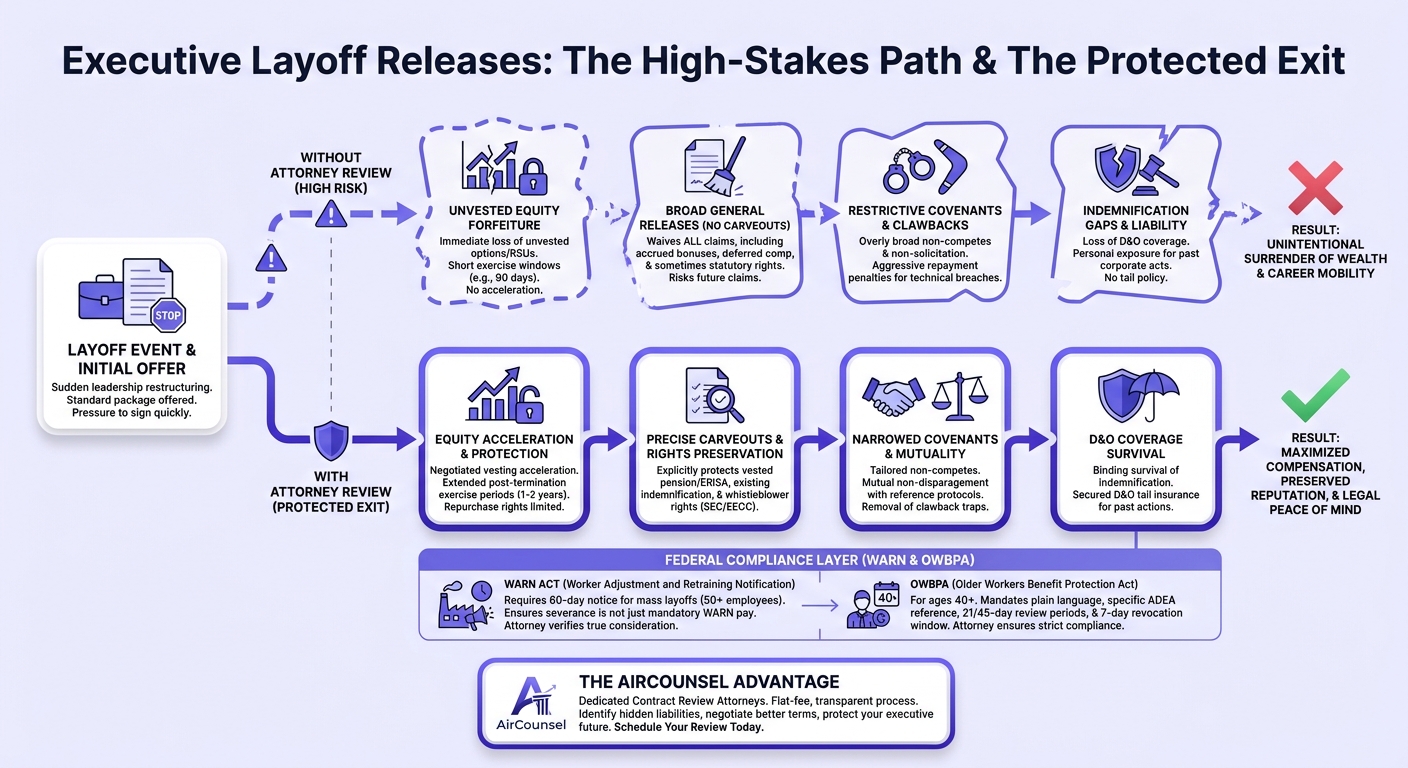
Understanding Executive Layoff Releases in 2026
A layoff release is a legally binding contract in which an employee agrees to waive claims against an employer in exchange for consideration—typically severance pay, extended health benefits, or accelerated equity vesting. In the executive suite, these agreements carry significantly higher legal and financial complexity than standard rank-and-file releases.
Departing executives regularly handle corporate intellectual property, sensitive strategic plans, and major vendor relationships. Consequently, employers design separation documents that aggressively protect corporate assets while limiting long-term liabilities. If you are also managing commercial or operational transitions, you can read our guide on protecting startup IP and contracts to see how early-stage agreements influence executive liability.
How Layoff Agreements Differ for Leadership
Standard workforce releases typically offer a basic formula, such as 2 weeks of base salary per year of service, tied to a standard boilerplate liability release. In contrast, executive exit documents encompass complex compensation structures that require board-level approval and specialized drafting.
Key structural differences in executive packages include:
- Multi-tiered compensation: Combining base pay continuation, pro-rated annual incentives, and target bonus payouts.
- Equity governance: Detailed treatment of stock options, restricted stock units (RSUs), profits interests, and change-in-control vesting triggers.
- D&O indemnification: Maintaining corporate defense coverage and insurance tail policies for past management actions.
- Public disclosures: Structuring agreed-upon internal announcements and external press releases, especially in public or venture-backed firms.

Critical Legal and Financial Liability Buckets
Signing a layoff release without line-by-line legal oversight introduces substantial exposure across multiple areas of personal finance and legal standing.
Equity Acceleration and Unvested Stock Forfeiture
One of the largest financial traps in executive departures concerns stock options, incentive units, and restricted equity. Boilerplate separation releases often state that the executive relinquishes any rights to equity awards not fully vested on the separation date.
A thorough review evaluates:
- Post-termination exercise windows: Extending standard 90-day exercise periods to 1 or 2 years to prevent forced forfeitures.
- Accelerated vesting clauses: Enforcing single-trigger or double-trigger acceleration rights established in initial employment agreements.
- Repurchase rights: Preventing the company from repurchasing vested equity at unfair, historical book valuations.
Broad General Releases and Non-Waivable Rights
Companies frequently draft general releases to cover every imaginable claim from the beginning of time through the signature date. While employers seek total finality, departing leaders must maintain explicit carveouts to protect their interests.
Standard carveouts that must remain protected include:
- Vested pension and retirement benefits under ERISA.
- Existing indemnification rights under corporate bylaws, operating agreements, and D&O insurance policies.
- Statutory whistleblower protections permitting communication with regulatory bodies like the SEC or EEOC.
- Claims arising after the execution date of the release document.
Restrictive Covenants and Clawback Provisions
Employers routinely embed restrictive covenants into separation packages. These include non-competition clauses, client non-solicitation restrictions, and strict non-disparagement provisions backed by aggressive repayment penalties. If an agreement includes a broad clawback clause, a technical breach of a confidentiality term could require you to repay your entire gross severance package plus the company's attorney fees.
Federal Protections: WARN Act and OWBPA Compliance
Executive layoffs often occur during broader company reductions in force (RIFs). When restructurings cross statutory thresholds, specific federal and state laws govern how releases must be presented and executed.
Worker Adjustment and Retraining Notification (WARN) Act
The federal WARN Act protects workers and communities by requiring covered employers to give advance notice of significant employment losses. When employers orchestrate sudden reductions, they sometimes offer severance pay in lieu of the statutory 60-day notice period.
Departing executives must verify whether the severance consideration being offered represents an actual bonus exit package or merely the payment the employer is already legally obligated to make under federal WARN rules. If an employer uses mandatory WARN pay as the sole consideration for a sweeping liability release, the agreement may lack legal consideration under US contract law principles.
Older Workers Benefit Protection Act (OWBPA) Rules
Under the OWBPA (an amendment to the Age Discrimination in Employment Act), federal law imposes strict criteria on releases signed by employees who are age 40 or older.
To create an enforceable waiver of age discrimination claims, the agreement must satisfy statutory prerequisites:
- Plain language drafting: Written in a clear manner calculated to be understood by the individual.
- Explicit ADEA reference: Specific mention of rights and claims arising under the Age Discrimination in Employment Act.
- No waiver of future claims: The release cannot cover rights arising after the date of signing.
- Consideration requirement: Compensation provided in exchange for the waiver must exceed anything to which the individual is already entitled.
- Attorney advisory notice: Clear written advice encouraging the individual to consult an independent legal advisor before signing.
- Statutory review periods: At least 21 calendar days to consider individual terminations, or 45 calendar days for group exit programs, accompanied by a mandatory 7-day post-signature revocation window.
Executive Severance Review Checklist and Timelines
Evaluating a separation agreement requires comparing standard corporate severance terms against executive-grade protective provisions.
| Agreement Component | Standard Workforce Release | Executive Separation Package |
|---|---|---|
| Review Window | Standard statutory minimums (7 to 21 days) | 21 to 45 days, plus custom negotiation windows |
| Severance Pay | 1 to 2 weeks per year of service | 6 to 24 months base salary plus target bonuses |
| Health Benefits | Standard COBRA notifications | Company-subsidized COBRA premiums for 6 to 18 months |
| Equity Rights | Unvested shares forfeit immediately | Negotiated accelerated vesting and extended exercise periods |
| D&O Coverage | Rarely applicable | Binding survival of indemnification and D&O tail insurance |
| Non-Disparagement | Unilateral (protects employer only) | Mutual non-disparagement with agreed reference protocols |
Why Retaining a Contract Review Attorney Protects Your Exit
Negotiating an executive exit is rarely an all-or-nothing dispute; it is a transactional adjustment of business terms. Retaining an independent contract review attorney allows you to preserve valuable professional relationships while having seasoned counsel advocate for essential modifications.
Legal counsel identifies hidden liabilities, such as tax non-compliance under Internal Revenue Code Section 409A regarding deferred compensation timing. Moreover, an attorney ensures that restrictive covenants do not unduly hinder your next executive appointment or consulting engagement. For business owners and executives reviewing broader service frameworks, our analysis on structuring independent contractor agreements outlines how post-exit advisory roles should be structured cleanly.
By securing targeted legal review, you replace ambiguity with clarity, ensure that all consideration formulas are fully calculated, and enter your next career chapter with complete legal peace of mind.
Protect Your Executive Career and Compensation with AirCounsel
Navigating an executive departure requires fast, decisive legal analysis. AirCounsel provides transparent, fixed-price legal solutions led by licensed US attorneys who specialize in identifying hidden contractual risks, negotiating higher exit terms, and protecting your earned compensation.
If you have received a separation agreement or are preparing an executive exit, schedule our Severance Agreement Review to receive comprehensive feedback within 2 business days. For broader corporate documents or general employment matters, you can also access our Review of your Contract or Legal Document or dedicated Employment Contract Review to safeguard your professional future.
Frequently Asked Questions
What claims can an executive still preserve after signing a layoff release?
An executive can typically preserve vested retirement benefits under ERISA, rights to defense and indemnification under corporate bylaws or D&O insurance, workers' compensation claims, and the statutory right to file reports or cooperate with federal agencies such as the SEC, EEOC, and NLRB.
Does signing a severance release waive WARN Act rights?
A severance agreement can waive federal or state WARN Act claims only if the waiver is knowing and voluntary, supported by additional legal consideration beyond payments the employer is already legally obligated to deliver under the WARN Act.
How long do executives have to review and revoke a release?
Executives age 40 and older must receive at least 21 days to review individual separation agreements (or 45 days in group layoffs) under the OWBPA, followed by a non-waivable 7-day revocation window after signing. Executives under 40 are governed by standard contract principles and any reasonable time limits specified in the contract.
What terms in a layoff release should a contract review attorney flag first?
An attorney will first flag general release carveouts, equity forfeiture clauses, short stock option exercise windows, Section 409A tax compliance issues, broad non-compete covenants, unilateral non-disparagement terms, and the absence of continuous D&O indemnification protection.
Recommended
Need Legal Assistance?
Our expert legal team is ready to help you navigate complex legal matters with confidence.