How to Safeguard Proprietary Code and Training Data with Custom Contracts by an Attorney

Building proprietary software, custom algorithms, and specialized training datasets represents the primary enterprise value for modern technology companies. However, many business owners incorrectly assume that paying an external software developer, agency, or contractor automatically transfers full legal ownership of the resulting intellectual property (IP). Under US copyright law, independent developers retain ownership of the deliverables unless explicit, statutory transfer language is executed.
According to data published by the U.S. Small Business Administration, small businesses account for 99.9% of all US enterprises, making IP asset protection essential for the vast majority of founders scaling tech-driven operations. Without airtight contractual terms, a vendor or departing contractor can legally license your underlying software logic to a direct competitor or reuse your proprietary training datasets for other commercial projects.
Securing your core assets requires precision drafting tailored to software architectures, data pipelines, and machine learning workflows. Utilizing custom contracts by an attorney guarantees that your business retains exclusive IP ownership, prevents unauthorized model training, and protects critical trade secrets across all commercial relationships.
Table of Contents
- Quick Summary
- Defining Core Assets in Software and AI Workflows
- Intellectual Property Ownership: Work Made for Hire vs. Present Assignment
- Trade Secrets, Confidentiality, and Permitted-Use Restrictions
- Managing Contractor, Vendor, and AI Model Risks
- Post-Termination Rights, Deletion, and Audit Protocols
- Custom Contracts vs. Generic Templates
- Protect Your Code and Data Assets with AirCounsel
- Frequently Asked Questions
- Recommended
Quick Summary
| Takeaway | Explanation |
|---|---|
| Default IP Ownership | Independent contractors own copyrightable deliverables by default under US law unless assigned in writing. |
| Assignment Language | Contracts must include present-tense assignment ("hereby assigns") rather than future promises ("agrees to assign"). |
| Data Usage Boundaries | Agreements must expressly forbid vendors from using your data to train internal or third-party AI models. |
| Trade Secret Safeguards | Maintaining trade secret status requires demonstrating reasonable contractual and technical security measures. |
| Post-Termination Protocols | Enforceable provisions must govern code repositories, data deletion, and post-engagement audit verifications. |
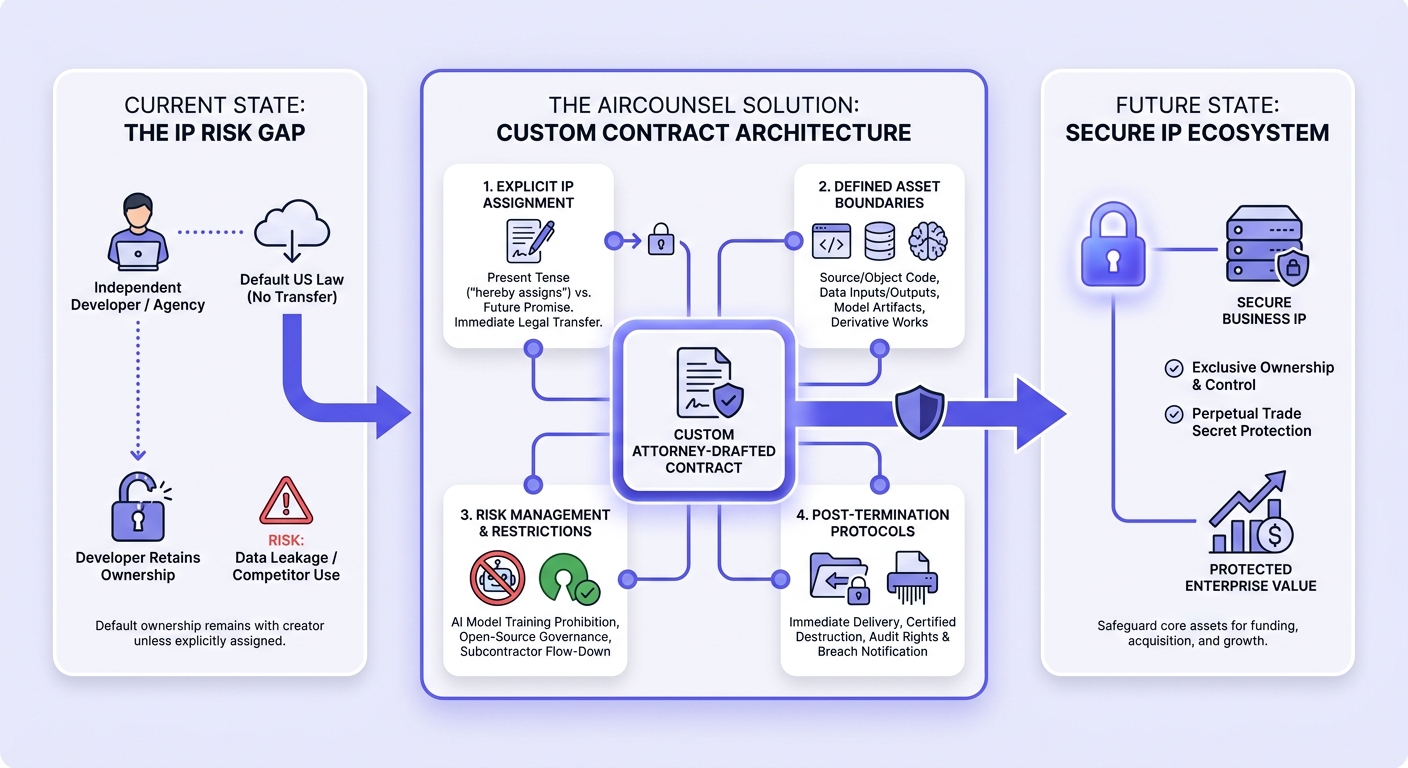
Defining Core Assets in Software and AI Workflows
Modern commercial contracts often use outdated definitions of intellectual property that fail to protect digital assets. Standard language referring broadly to "work product" frequently overlooks the technical components that drive enterprise software and data platforms.
A robust agreement must define and delineate every asset category involved in development, deployment, and maintenance:
- Source Code and Object Code: The human-readable programming instructions, compiled binary files, scripts, database schemas, and microservices architecture.
- Data Inputs and Outputs: Raw customer records, proprietary data pipelines, processed outputs, structured labels, and curated synthetic data.
- Model Training Artifacts: Prompt templates, vector embeddings, fine-tuning datasets, model weights, and hyperparameter configurations.
- Derivative Works: Updates, modifications, enhancements, and adaptations based on the underlying technology, as defined under US copyright principles.
- Documentation and Technical Specs: Internal architecture diagrams, API documentation, data dictionaries, and deployment runbooks.
Failing to explicitly name these individual elements creates ambiguity. If a contract only mentions "deliverable software," a contractor might argue that the custom training pipelines or data labeling frameworks remain their personal property.
Intellectual Property Ownership: Work Made for Hire vs. Present Assignment
A widespread legal misunderstanding among founders is relying solely on "work made for hire" clauses. Under the U.S. Copyright Office statutory framework, the work-made-for-hire doctrine applies automatically to formal employees acting within the scope of their employment. For independent contractors, however, work made for hire only applies to nine narrow statutory categories, and software is generally not among them unless it qualifies as a supplementary work or compilation.
       WORK CREATED BY THIRD PARTY
                   |
     +-------------+-------------+
     |                           |
Employee (Scope of Job)    Independent Contractor
     |                           |
Automatically Owned        Must Have Express Written
by Employer                Present Assignment ("hereby assigns")
To secure undisputed ownership from contractors, agencies, and vendors, an agreement must feature an explicit, comprehensive IP assignment clause.
The Importance of Present-Tense Assignment
US courts strictly distinguish between an agreement to assign IP in the future and an immediate assignment.
- Ineffective Language: "The Contractor agrees to assign all rights in the deliverables upon completion." (Creates an executory promise, requiring a separate transfer document later).
- Enforceable Language: "The Contractor hereby unconditionally and irrevocably assigns, transfers, and conveys all right, title, and interest in and to the Work Product." (Executes an immediate legal transfer the moment the code is created).
A properly executed Custom IP Assignment Agreement ensures that title passes instantly, preventing disputes if a contractor demands additional compensation before handing over repository access.
Trade Secrets, Confidentiality, and Permitted-Use Restrictions
Copyright protects original expression, but it does not protect underlying concepts, mathematical formulas, or business logic. To protect proprietary algorithms, data architectures, and customer metrics, businesses must rely on trade secret law.
Under guidance from the U.S. Patent and Trademark Office, information qualifies for trade secret protection only if it derives independent economic value from not being generally known and the owner takes reasonable measures under the circumstances to maintain its secrecy.

To establish reasonable measures in commercial relationships, agreements must incorporate:
- Strict Access Limitations: Restricting code and data access to contractor personnel on a verified need-to-know basis.
- Express Negative Covenants: Prohibiting the reverse engineering, decompilation, scraping, or benchmarking of the software and data infrastructure.
- Prohibition of Model Training: Barring vendors from ingesting your code, prompts, or proprietary data into public or multi-tenant machine learning models.
- Perpetual Trade Secret Survival: Ensuring that confidentiality obligations for source code and datasets survive contract termination indefinitely, rather than expiring after standard two- or three-year periods.
Managing Contractor, Vendor, and AI Model Risks
Engaging outside agencies and freelance engineers introduces structural risks that standard vendor templates often ignore. When negotiating development contracts, businesses must address open-source software (OSS), subcontracting, and generative AI toolchains.
Open-Source Software Governance
Contractors frequently incorporate open-source libraries to accelerate development. However, "copyleft" licenses (such as GPL v3) can legally obligate a company to release its entire proprietary source code to the public if integrated incorrectly. Custom contracts must require vendors to disclose all third-party and open-source components and warrant that no copyleft code infects your proprietary software.
Subcontractor Flow-Down Obligations
Agencies often outsource tasks to third-party subcontractors or offshore entities. If the agency agreement lacks flow-down provisions, the actual individuals writing your code may never have signed an IP assignment, leaving your title clouded. Your contract must mandate written assignments from all downstream contributors.
Generative AI Restrictions
Software teams increasingly utilize AI coding assistants. If a contractor feeds your proprietary logic into commercial AI models without enterprise privacy safeguards, your trade secrets may become part of a public training dataset. Agreements should require prior written consent before using generative AI tools on your codebase.
Post-Termination Rights, Deletion, and Audit Protocols
The termination of a commercial engagement is the most vulnerable phase for software and data leakage. A contract must outline precise operational steps for offboarding developers and vendors:
- Immediate Delivery: Mandatory transfer of all repository administrative credentials, local branches, build artifacts, and encryption keys within 24 to 48 hours.
- Certified Destruction: A formal written certification signed by an authorized officer confirming the permanent deletion of all proprietary datasets, source code clones, and backups from non-company devices.
- Breach Notification Timelines: Strict covenants requiring the vendor to notify your company within 24 to 72 hours of any suspected data breach, credential compromise, or unauthorized repository access.
- Audit Rights: The legal right to inspect vendor systems or review access logs to verify compliance with confidentiality and deletion covenants.
Custom Contracts vs. Generic Templates
Using free online contract templates for technical deliverables creates substantial legal exposure. Standard templates typically lack the specialized clauses necessary to protect modern software, model weights, and proprietary data flows.
| Risk Dimension | Generic Online Template | Custom Attorney-Drafted Contract |
|---|---|---|
| IP Ownership Mechanics | Relies on generic "work-for-hire" labels that often fail under US copyright law for contractors. | Contains explicit present assignment ("hereby assigns") covering code, data, and derivative works. |
| AI Model Training | Completely silent on generative AI, prompt extraction, embeddings, and dataset ingestion. | Explicitly restricts the use of your data or code to train or fine-tune internal or third-party AI models. |
| Open-Source Risks | No warranties regarding copyleft contamination or license compliance. | Clear warranties and indemnities protecting your business from copyleft licensing exposure. |
| Confidentiality Duration | Imposes standard 2-to-3-year expiration dates on all confidential information. | Ensures trade secret protections for code and datasets survive in perpetuity. |
| Dispute Resolution | Often defaults to unfavorable forums or lacks fast-track injunctive relief mechanisms. | Establishes your local jurisdiction and enables immediate injunctive relief for trade secret breaches. |
Whether you are engaging an external agency through a Website Design/Software Development and/or Maintenance Agreement or hiring specialist consultants via a Custom Independent Contractor / Consulting Agreement, attorney-drafted contracts ensure your core IP remains fully protected.
Protect Your Code and Data Assets with AirCounsel
Uncertainty around intellectual property ownership can derail venture funding, complicate acquisitions, and lead to expensive litigation. Protecting your business requires robust, enforceable agreements tailored to your exact tech stack, data pipelines, and vendor relationships.
AirCounsel provides fast, transparent legal solutions drafted by licensed US attorneys. Whether you need a comprehensive Custom Contract Drafter solution for bespoke technical deals or a tailored Custom Services Agreement to define scope and ownership, our team delivers enforceable legal contracts with upfront fixed pricing and rapid turnaround times.
This article provides general information and is not legal advice.
Frequently Asked Questions
Who owns code and training data created under a software agreement?
Under US copyright law, the individual author or independent vendor owns the deliverables by default unless the contract contains a written present assignment transferring all right, title, and interest to the hiring party.
What clauses best protect proprietary code and training data?
The most effective clauses include present-tense IP assignments ("hereby assigns"), explicit carve-outs prohibiting vendors from training machine learning models on your data, perpetual trade secret confidentiality terms, and open-source non-contamination warranties.
How do trade secret clauses help if a vendor misuses my data?
Trade secret clauses allow you to seek immediate court injunctions to stop the unauthorized use or distribution of your proprietary algorithms, code, or datasets, alongside financial damages for commercial harm.
When is a custom contract better than a template for tech assets?
Custom contracts are essential whenever you engage third parties to build software, process proprietary datasets, or access internal infrastructure, as generic templates rarely account for AI data ingestion, copyleft license risks, or present assignment mechanics.
Recommended
Need Legal Assistance?
Our expert legal team is ready to help you navigate complex legal matters with confidence.