Safeguarding Your Trade Secrets: Beyond a Basic Nondisclosure Agreement

As a founder or modern business leader, your proprietary data, customer lists, and software algorithms are the lifeblood of your company. Simply having a nondisclosure agreement (NDA) in place is a critical first step to protecting these assets. However, many business operators mistakenly believe that a signed contract is a magic shield that automatically cures all security threats.
In reality, protecting your company's intellectual property requires more than just paper. Trade secret theft costs US companies between $180 billion and $540 billion annually, according to estimates by the US Chamber Institute for Legal Reform. To truly safeguard your assets in the USA, you must combine a legally robust contract with active operational controls.
This guide breaks down what an NDA can actually protect, why your business needs operational security measures to make it enforceable, and how to structure your agreements to survive court challenges.
Table of Contents
- Quick Summary
- What an NDA Can and Cannot Protect
- Why an NDA Is Not Enough on Its Own
- How to Draft an Enforceable Nondisclosure Agreement
- Operational Safeguards to Enforce Secrecy
- Managing Employees and Contractors
- What to Do After a Suspected Leak
- Common Pitfalls for Small Businesses
- Protect Your Intellectual Property Today
- Frequently Asked Questions
- Recommended
Quick Summary
| Takeaway | Explanation |
|---|---|
| Contract vs Security | A nondisclosure agreement establishes a legal duty of confidentiality, but it requires operational enforcement to demonstrate you took reasonable measures to protect it. |
| Reasonable Secrecy | Federal and state laws require businesses to take active digital and physical steps to keep secrets private; you cannot rely entirely on a signed paper. |
| Tailored Clauses | Avoid generic templates that fail to specifically define what is confidential or lack indefinite survival terms for genuine trade secrets. |
| Entry and Exit Controls | Protect your assets during onboarding through IP assignment agreements, and conduct strict offboarding exit interviews. |
| Rapid Response | If a leak occurs, you must preserve logs instantly, block digital access, and move quickly to seek court injunctions to stop further sharing. |
What an NDA Can and Cannot Protect
A contractually binding nondisclosure agreement defines a relationship where one or both parties agree not to share specified proprietary materials. But to use this tool effectively, you must understand what falls under its protection.
An NDA is designed to protect three categories of business assets:
- Trade secrets: Proprietary formulas, patterns, compilations, program devices, methods, techniques, or processes that provide competitive economic value.
- Confidential information: Data that is not publicly known but may not meet the strict statutory definition of a trade secret, such as pending marketing plans or vendor pricing.
- Proprietary business information: Internal software iterations, customer data, and financial projections.
Under the guidance shared in the USPTO Trade Secret Policy, an NDA can actually cover a wider range of information than trade secret law alone. This is because contract law allows parties to agree on what they consider private. However, an NDA cannot protect information that is already public, independently developed by a third party, or acquired housing no duty of confidentiality.
Trade Secrets vs Confidential Information
It is crucial to differentiate between general confidential information and a true trade secret. General confidential information—such as a list of current office supply providers—often has an expiration date on its commercial sensitivity. Trade secrets can theoretically remain protected forever if they are kept hidden from the public eye.
Why an NDA Is Not Enough on Its Own
In the USA, trade secret protection is governed by both state laws (under the Uniform Trade Secrets Act in most states) and federal law under the Defend Trade Secrets Act of 2016 (DTSA).
Both frameworks establish a clear requirement: to claim trade secret protection, the owner must take "reasonable measures" to maintain its secrecy.
Simply getting a signature on a nondisclosure agreement does not satisfy the "reasonable measures" test. If a business files a lawsuit for trade secret misappropriation but has left its source code sitting on an unprotected, public GitHub repository, a court may rule that the company did not take reasonable steps to secure the asset. In this scenario, your NDA becomes practically unenforceable because you failed to protect the underlying asset in the real world.
As highlighted in the SBA Intellectual Property Guide, legal agreements must go hand-in-hand with internal security habits and access controls to build an airtight defense.
How to Draft an Enforceable Nondisclosure Agreement
To stand up in a US court, your contract must be drafted with precision. Generic internet templates often contain structural flaws that can make them completely useless during a business dispute.

When drafting or refining your agreement, pay close attention to these key provisions:
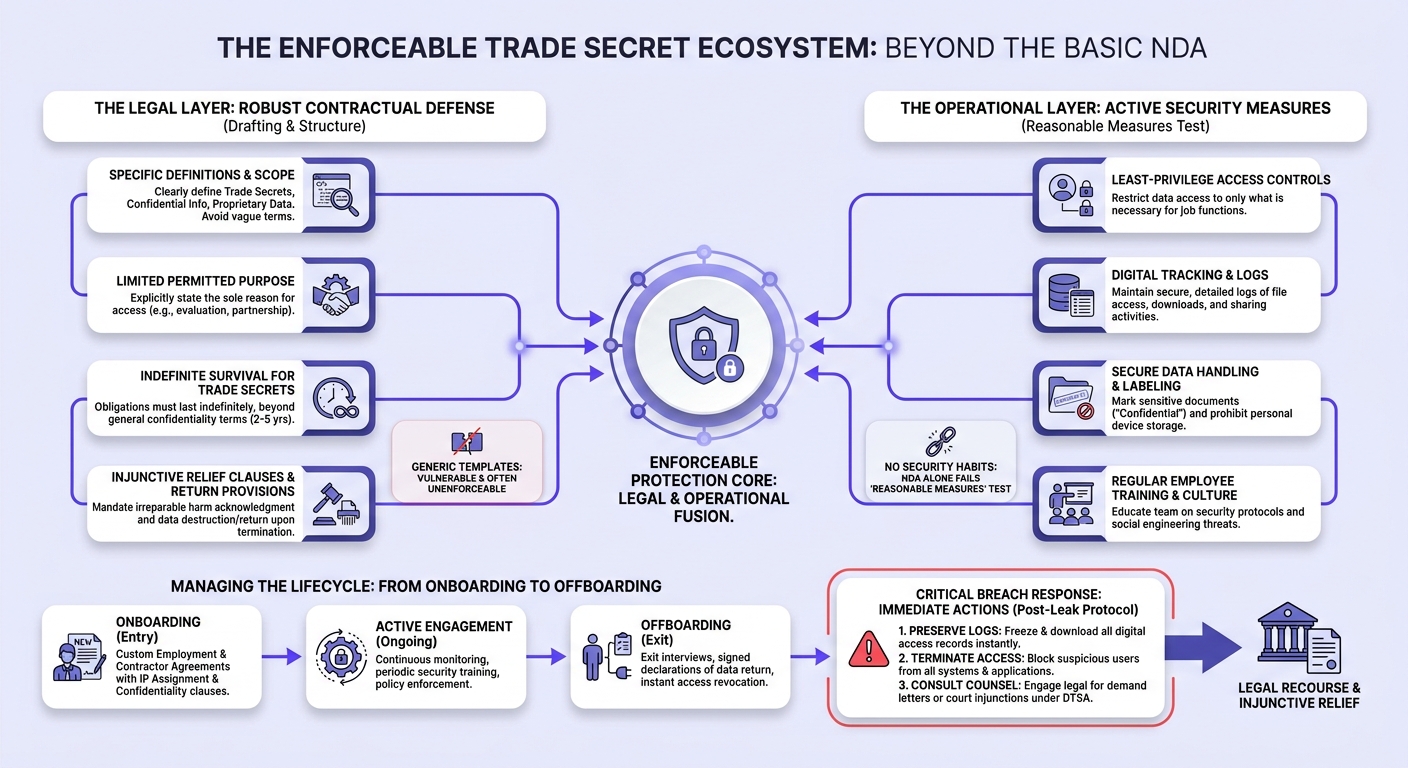
- Specific definitions: Do not just say "all information shared is confidential." Clearly specify the scope, such as technical blueprints, customer databases, or financial models.
- Limited permitted purpose: Explicitly outline why the recipient is receiving the information (e.g., "solely to evaluate a potential joint venture") and prohibit any other use.
- Indefinite survival for trade secrets: While general confidentiality obligations might expire after 2 to 5 years, trade secrets must remain confidential indefinitely, or for as long as they remain secret under statutory definitions.
- Return and destruction provisions: Mandate that once the relationship ends, the recipient must destroy or return all confidential data and provide a written certificate of compliance.
- Injunctive relief clauses: Include a clause stating that a breach will cause irreparable harm, allowing you to seek an immediate court order (injunction) to stop any further leaks.
If you are currently sharing sensitive data using legacy contracts, we highly recommend purchasing a fast Review of your Contract or Legal Document to catch weaknesses before a vendor or partner relationship turns sour.
Operational Safeguards to Enforce Secrecy
To back up your nondisclosure agreement and prove to a court that you have exercised "reasonable measures" of secrecy, you must establish clear operational protocols:
- Implementation of least-privilege access: Restrict information access so employees and contractors can only view the files necessary to complete their specific job functions.
- Digital tracking and logs: Use platforms that maintain secure access logs, showing precisely who opened, downloaded, or shared proprietary files.
- Clear labeling and classification: Mark sensitive documents with headers such as "Confidential - Internal Use Only."
- Secure data handling policies: Prohibit the storage of company files on personal devices or unauthorized cloud accounts.
- Regular employee training: Train your team on security protocols and how to spot social engineering attempts that could lead to accidental leaks.
| Action | Practical Implementation | Legal Benefit |
|---|---|---|
| Digital Access Control | Role-based permissions in Google Drive, AWS, or local networks. | Proves intentional access restriction in court. |
| Confidential Watermarks | Dynamic watermarks on PDFs indicating the viewer's email address. | deters leaks and quickly identifies the source of a breach. |
| Security Training Logs | Annual cybersecurity training sessions with signed attendance lists. | Demonstrates a corporate culture of active trade secret defense. |
Managing Employees and Contractors
Your internal team is your greatest asset—and your largest potential vulnerability. Standard employment arrangements do not always guarantee that the work your team creates belongs exclusively to your company, or that they are legally bound to absolute secrecy.
When onboarding new hires, make sure they sign a comprehensive Custom Employment Agreement. This document should explicitly combine strong confidentiality protections with an intellectual property (IP) assignment clause.
For outside help, ensure you secure identical protections. Before developers or consultants write a single line of code, put a Custom Independent Contractor / Consulting Agreement in place containing robust work-for-hire terms and explicit restrictions on sharing your operational secrets.
When employees or contractors depart, run through a structured exit procedure:
- Conduct an exit interview: Walk through the signed agreements and remind them of their ongoing duty of confidentiality.
- Obtain a signed declaration: Require departing personnel to sign a formal statement confirming they have returned all company property and deleted any local copies of company files.
- Revoke all access keys: Instantly terminate access to emails, dashboards, cloud tools, repositories, and physical servers.
What to Do After a Suspected Leak
If you suspect an employee, contractor, or business partner has breached their nondisclosure agreement and shared proprietary secrets, you must act rapidly. Delays in response can weaken your argument that the stolen data is a true, valuable secret requiring emergency protection.
Take these immediate actions:
- Step 1: Secure digital logs: Instantly freeze and download admin access logs, email history, and file download registries associated with the suspected individual.
- Step 2: Terminate access permissions: Block the suspicious user from all servers and company applications to halt ongoing data removal.
- Step 3: Consult qualified legal counsel: Reach out to an attorney to evaluate the breach and draft an immediate demand letter or prepare for court-ordered injunctive relief under the DTSA.
If you need fast advice on how to legally handle the early hours of a suspected data leak, you can Ask a U.S. Attorney a Question online to receive a confidential, expert response in just a few business hours.
Common Pitfalls for Small Businesses
Avoid these common mistakes to keep your business records, algorithms, and designs safe:
- Relying on generic internet templates: Standard online contracts frequently fail to specify state-specific laws, enforceability standards, or indefinite survival clauses for trade secrets.
- Failing to classify confidential data: If your team does not know what is considered a secret, they cannot protect it. Make sure you clearly identify and classify sensitive databases.
- Leaving agreements unsigned: Ensure all parties have executed contracts before you share critical designs, APIs, or business metrics during preliminary meetings.
- Treating NDAs as non-compete agreements: Courts consistently strike down NDAs that are drafted so broadly they effectively prevent a departing worker from earning a living in their industry. Keep your nondisclosure protections focused squarely on data protection.
If you want to ensure your agreements are accurate, compliant, and legally binding without paying bloated hourly rates, work with a professional Custom Contract Drafter to tailor-make documents that fit your unique workflows.
Protect Your Intellectual Property Today
A signed contract is only as strong as the legal precision put into its drafting and the daily security habits used to back it up. Do not leave your core trade secrets, client data, and custom code exposed to generic forms or unprotected operational workflows.
At AirCounsel, we help entrepreneurs and scaling small businesses secure their intellectual property through fast, transparent, and fixed-price legal services. Whether you need a brand-new agreement drafted from scratch or an old template reviewed for modern state compliance, our licensed attorneys are ready to deliver.
Secure your company’s assets today by starting a Custom Contract Drafter order, or get the comprehensive protection you need with our All-Access Legal Membership (USA).
This article provides general information and is not legal advice.
Frequently Asked Questions
What is the difference between an NDA and a trade secret?
An NDA is a signed, private contract between parties defining what they must keep secret and the penalties for unauthorized disclosures. A trade secret is a specialized type of intellectual property defined by federal and state statutes. While your NDA can contractually protect general private business details, trade secrets enjoy unique, statutory court protections even in the absence of a contract, provided the owner takes active, reasonable steps to maintain security.
Does an NDA automatically make information a trade secret?
No. Signing a contract does not instantly turn average business information into a trade secret under US law. To establish trade secret status under the DTSA, the information must hold actual independent economic value because it is not public knowledge, and you must prove you actively utilized reasonable physical or digital controls to keep it hidden.
How long should an NDA last for trade secrets?
While general business information protections under an NDA typically expire after 2 to 5 years, obligations regarding genuine trade secrets should remain in place indefinitely. Your agreement should feature specialized survival language stating that the duty of confidentiality for trade secrets will persist for as long as the information continues to meet statutory definitions of a trade secret.
What should I do if an employee or contractor leaks confidential information?
First, instantly preserve all security, cloud, and email access records to assemble concrete digital proof. Second, immediately revoke all of the user's systems credentials to prevent further data loss. Finally, contact legal counsel immediately to evaluate your situation and issue a formal cease-and-desist letter or prepare to petition a court for an immediate injunction.
Recommended
- Custom Contract Drafter - Get legally secure, attorney-drafted NDAs and confidentiality contracts customized for your precise operations.
- Review of your Contract or Legal Document - Ensure your legacy agreements are fully compliant under the latest state and federal laws.
- All-Access Legal Membership - Secure ongoing legal safety, unlimited consultations, and flat discounts on all contract reviews.
Need Legal Assistance?
Our expert legal team is ready to help you navigate complex legal matters with confidence.