The USA Tech Founder’s Legal Checklist for Series A Term Sheets

According to the U.S. Small Business Administration, small businesses make up 99.9% of U.S. businesses and employ about 45.9% of private-sector workers. For the high-growth technology startups among them, transitioning from early-stage bootstrapping or seed funding to an institutional Series A round is a pivotal milestone. To secure this growth capital, founders must navigate the complex landscape of venture capital term sheets, where minor phrasing issues can dramatically impact equity and governance.
When scaling a business, relying on templated agreements or generic drafts can introduce hidden liabilities that scare away institutional investors. Engaging professional contract drafting services during the early stages of a fundraise ensures that your term sheet—and the subsequent definitive agreements—are structurally sound, compliant, and optimized to protect your hard-earned equity.
By understanding how these documents are structured and knowing when to transition from basic templates to professional drafting, founders can navigate investor negotiations with confidence and speed.
Table of Contents
- Quick Summary
- What is a Series A Term Sheet?
- Core Economic Terms Founders Must Review
- Governance and Control Rights
- The Legal Document Flow After the Term Sheet
- Common Red Flags in Venture Financing
- Why Leverage Contract Drafting Services for Series A?
- A Checklist for Closing the Deal
- Protect Your Equity and Control Your Future
- Frequently Asked Questions
- Recommended
Quick Summary
| Takeaway | Explanation |
|---|---|
| Focus on Economics | Watch valuation, option pool expansion, and liquidation preferences closely. |
| Guard Board Seats | Board composition determines future control of your company; protect founder seats. |
| Understand Binding Terms | Confidentiality and exclusivity (no-shop) terms are typically binding upon signing. |
| Exemptions and Compliance | Ensure private placement compliance under SEC Regulation D to avoid regulatory issues. |
| Professional Support | Use customized legal support over generic templates to reduce closing delays. |
What is a Series A Term Sheet?
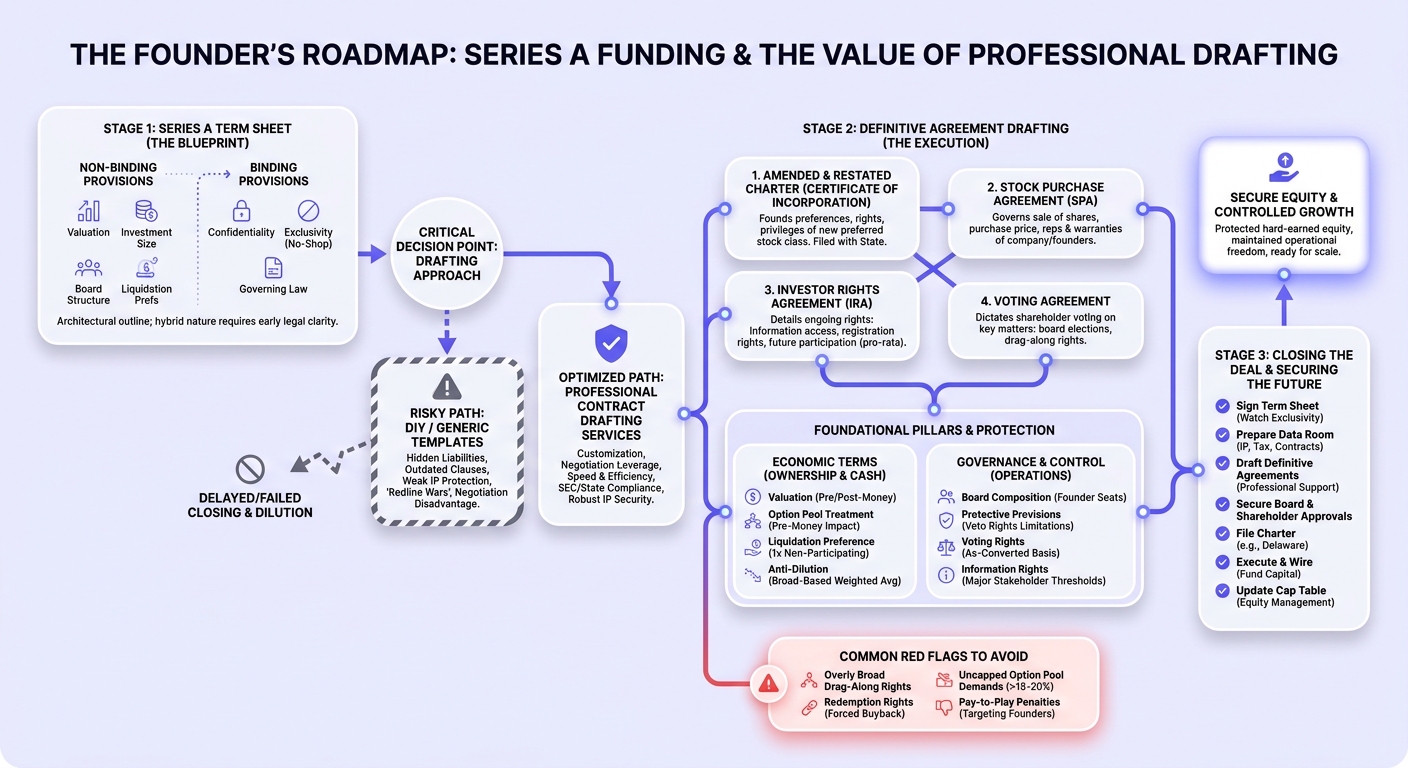
A Series A term sheet is a non-binding expression of interest from a venture capital firm or lead investor. It outlines the valuation, investment amount, and structural parameters of a proposed equity financing round. Think of it as the architectural blueprint for the final, binding legal agreements that will govern your startup's relationship with its new investors.
Binding vs. Non-Binding Clauses
While the majority of a term sheet is non-binding, certain provisions are immediately enforceable upon signing. This hybrid nature makes early-stage legal clarity critical.
- Non-Binding Provisions: These include valuation, the size of the investment, the board of directors structure, and future liquidation preferences. They serve as a framework for the definitive agreements but do not legally compel either party to close the deal.
- Binding Provisions: These typically include confidentiality agreements, the governing law clause, and an exclusivity (or "no-shop") period. The exclusivity clause prevents founders from shopping the deal to other investors for a set period (usually 30 to 45 days) while the lead investor conducts due diligence.
Understanding this division is critical. Signing a term sheet binds your startup to exclusivity, meaning you cannot walk away easily if a better offer arises. Proper planning under private placement safe harbors like SEC Regulation D ensures your equity offering remains compliant throughout this process.
Core Economic Terms Founders Must Review
The economic terms of a Series A round dictate how much of the company you own after the investment and how cash is distributed during a sale.
- Valuation: Pre-money valuation is the value of your company before receiving the investment, while post-money valuation includes the investment capital. Ensure you understand how these figures affect your overall dilution.
- Option Pool Treatment: Investors often require the creation or expansion of an employee option pool. If this expansion is required to happen pre-money, the dilution falls entirely on the existing founders, lowering the effective pre-money valuation.
- Liquidation Preference: This term dictates who gets paid first during a sale or liquidation. A 1x non-participating preference is the standard for fair venture deals. Avoid participating preferences, which allow investors to double-dip by taking their initial investment back and then sharing the remaining proceeds.
- Anti-Dilution Provisions: These protect investors if the company issues shares at a lower valuation in the future (a "down round"). A broad-based weighted average anti-dilution clause is standard and fair, whereas a "full-ratchet" clause is highly dilutive to founders and should be avoided.
Governance and Control Rights
Economic terms dictate the money, but governance terms dictate who runs the company. As a founder, maintaining operational control is crucial for executing your long-term vision.
- Board Composition: A standard Series A board is often structured as a 3-member or 5-member board. For example, a 5-member board might consist of 2 founders, 1 representative appointed by the Series A investors, and 2 independent members chosen mutually by the founders and investors.
- Protective Provisions (Veto Rights): Investors will request veto rights over major corporate decisions, such as selling the company, changing the articles of incorporation, or issuing new debt. Ensure these vetoes are limited to high-impact corporate actions and do not interfere with daily operations.
- Voting Rights: Series A preferred stock generally votes together with common stock on an as-converted basis, rather than as a separate class, except on matters directly affecting their preferred status.
- Information Rights: Major investors will demand regular access to financial statements, annual budgets, and operational updates. Establish a reasonable threshold (such as owning at least 5% of preferred stock) to limit this burden to major stakeholders.
The Legal Document Flow After the Term Sheet
Once the term sheet is signed, the transaction moves into the drafting phase. The non-binding terms must be converted into comprehensive, binding definitive agreements.

This phase requires drafting four core documents:
- Amended and Restated Certificate of Incorporation (Charter): This document is filed with your state of incorporation (typically Delaware for venture-backed startups) and legally establishes the rights, preferences, and privileges of the new class of preferred stock.
- Stock Purchase Agreement (SPA): This is the primary agreement governing the sale of the shares. It outlines the purchase price, the number of shares sold, and the representations and warranties made by both the company and the founders.
- Investor Rights Agreement (IRA): This document details the ongoing rights of the investors, including information rights, registration rights, and the right of first refusal to participate in future funding rounds.
- Voting Agreement: This governs how shareholders vote on key matters, particularly the election of board members and drag-along rights during a sale.
To prevent issues during due diligence, founders should ensure that all intellectual property is fully owned by the company. Using a Custom IP Assignment Agreement ensures that all historical and future code, patents, and designs are legally secured. This minimizes diligence delays flagged by the U.S. Patent and Trademark Office.
Common Red Flags in Venture Financing
Founders must watch out for terms that stray from market standards, as they can severely limit operational freedom or lead to unexpected dilution.
- Overly Broad Drag-Along Rights: Drag-along provisions force minority shareholders to approve a sale of the company if a majority approves it. Ensure the threshold for a "majority" requires the consent of both the board and the common shareholders, not just the preferred investors.
- Redemption Rights: These rights allow investors to force the company to buy back their shares after a set period (e.g., 5 years) if the company has not yet gone public or been acquired. This can bankrupt a growing startup.
- Uncapped Option Pool Demands: Investors may request an excessively large option pool (e.g., 20%) to be carved out pre-money. Negotiate this down to what is actually needed for the next 12 to 18 months of hiring to minimize founder dilution.
- Pay-to-Play Clauses: These penalize existing investors if they do not participate in future funding rounds. While sometimes used to motivate co-investors, ensure they do not unfairly target early angels or founders.
Why Leverage Contract Drafting Services for Series A?
Many founders attempt to save capital during early financing rounds by using free online templates or automated generators. While templates are helpful for learning the basics, they lack the specificity required to protect a growing enterprise.
Professional contract drafting services bridge the gap between expensive enterprise law firms and risky self-drafting.
- Customization Over Templates: Every venture round is unique. A template cannot account for your specific cap table, state-level employment rules, or existing investor agreements.
- Negotiation Leverage: Providing the first draft of an agreement gives you structural leverage. When your legal team drafts the definitive documents, you set the default terms, placing the burden of negotiation on the investor.
- Speed and Efficiency: Clear, legally sound drafts minimize the "redline war"—the lengthy, expensive process of sending conflicting document versions back and forth.
| Feature | Generic Templates | Professional Contract Drafting Services |
|---|---|---|
| Accuracy | High risk of outdated clauses | Tailored to current SEC and state standards |
| IP Protection | Often fails to comprehensively secure IP | Includes robust assignment mechanisms |
| Turnaround | Instant, but requires heavy editing | Fast 3-day delivery of investor-ready files |
| Legal Recourse | None (self-drafted risk) | Supported by experienced, licensed US attorneys |
A Checklist for Closing the Deal
Closing a Series A round requires coordination across multiple legal and operational fronts. Use this checklist to stay organized during the final push:
- Step 1: Sign the Term Sheet: Execute the non-binding term sheet, paying close attention to the binding exclusivity window.
- Step 2: Prepare the Data Room: Gather all corporate records, material contracts, tax returns, and IP assignments. Address tax questions early with the IRS Small Business Center.
- Step 3: Draft Definitive Agreements: Instruct your legal team to prepare the Charter, SPA, IRA, and Voting Agreement.
- Step 4: Secure Board and Shareholder Approvals: Pass formal board resolutions and obtain shareholder consent for the new share class.
- Step 5: File the Charter: File the Amended and Restated Certificate of Incorporation with Delaware (or your state of incorporation).
- Step 6: Execute and Wire: Sign all definitive agreements, collect investor signatures, and receive the wired capital.
- Step 7: Update the Cap Table: Record the new shares in your equity management software.
Protect Your Equity and Control Your Future
Securing Series A funding is a monumental step, but a poorly drafted agreement can jeopardize your company's control and dilute your stake. Protect your hard work with precise, professional drafting. At AirCounsel, we offer rapid, transparently priced Custom Contract Drafter services tailored specifically to founders.
Whether you need a rapid review of an incoming investor term sheet or customized ancillary documents, we have you covered. Get expert support by leveraging our Review of your Contract or Legal Document or connect directly with our team for strategic Negotiation Support.
This article provides general information and is not legal advice.
Frequently Asked Questions
What parts of a Series A term sheet are usually most negotiable for founders?
Valuation, the size and timing of the employee option pool expansion, and the specific composition of the board of directors are highly negotiable. Founders should push to minimize pre-money option pool allocations and ensure they retain balanced board control.
Which term sheet clauses can create hidden dilution or loss of control?
Pre-money option pool requirements can significantly lower your effective pre-money valuation, causing unexpected founder dilution. Additionally, broad protective provisions (veto rights) can grant minority preferred investors outsized control over standard operational decisions.
Do founders need a lawyer to review a Series A term sheet before signing?
Yes. Even though most terms are non-binding, signing a term sheet commits you to a binding exclusivity period. This prevents you from talking to other investors while the lead VC conducts diligence. Having a lawyer review the sheet ensures you do not agree to unfavorable baselines that will carry over to the final contracts.
How is a term sheet different from the final financing documents?
A term sheet is a short, conceptual outline of the transaction's primary economics and governance. The final financing documents (the SPA, IRA, Voting Agreement, and Charter) are long, highly detailed, and legally binding agreements that execute the exact parameters established in the term sheet.
Recommended
- Custom Services Agreement – Build solid commercial foundations alongside your fundraise.
- LLC Operating Agreement – Understand structural governance before converting to a C-Corp for Series A.
- Ask a U.S Attorney a Question – Get rapid answers to specific fundraising or drafting questions.
Need Legal Assistance?
Our expert legal team is ready to help you navigate complex legal matters with confidence.