7 Essential Clauses for Your Software Licensing Agreements

For modern founders and growing companies, software is often the most valuable asset. Whether you are licensing proprietary code to enterprise clients or integrating third-party systems into your workflow, getting the paperwork right is critical. If your licensing terms are weak, you risk intellectual property theft, revenue loss, and devastating liability. This is why working with a professional contract lawyer is essential to secure your commercial interests from day one.
According to the Pew Research Center, small businesses make up 99.9% of U.S. firms, demonstrating how vital small enterprises are to the national economy (Pew Research Center). As these businesses scale and adopt cloud infrastructure, protecting digital assets becomes a primary driver of long-term business valuation.
Traditional legal firms often overcomplicate this process with dense legalese and unpredictable hourly billing. At AirCounsel, we believe contract protection should be fast, transparent, and highly accessible. Below, we break down the seven vital clauses you must include in any software licensing agreement to shield your business from unnecessary risks.
Table of Contents
- Why You Need a Contract Lawyer for Software Licensing
- 1. Clear License Grant and Scope
- 2. IP Ownership and Protection
- 3. Commercial Terms and Payment Audits
- 4. Limitation of Liability and Risk Shifting
- 5. Termination and Post-Termination Rules
- 6. Confidentiality and Data Security
- 7. Governing Law and Dispute Resolution
- Common Mistakes to Avoid in Software Licensing
- Licensing Costs and Timelines
- Protect Your Code with AirCounsel
- Frequently Asked Questions
- Recommended
Quick Summary
| Key Focus Area | Why It Matters |
|---|---|
| License Scope | Defines exactly how, where, and by whom the software can be used, preventing unauthorized distribution. |
| IP Ownership | Explicitly retains all copyrights and patents with the licensor, ensuring you only "rent" your code rather than sell it. |
| Liability Caps | Restricts potential damages to a set amount (usually a multiple of fees paid), shielding your company from financial ruin. |
| Data Security | Mitigates data-breach risk by aligning responsibilities with FTC and industry cybersecurity frameworks. |
| Termination Terms | Outlines how a contract ends and ensures code is deleted or data returned smoothly without legal friction. |
Why You Need a Contract Lawyer for Software Licensing
A generic template downloaded from the internet cannot protect your unique software architecture or business model. Software licenses are unique because they straddle copyright law, trade secrets, and ongoing cloud services. A dedicated contract attorney ensures that your rights are preserved while maximizing commercialization.
According to the U.S. Copyright Office, computer software programs are protected under copyright law as literary works. Distinguishing between a limited "right to use" and an actual transfer of ownership is a core task of contract drafting.
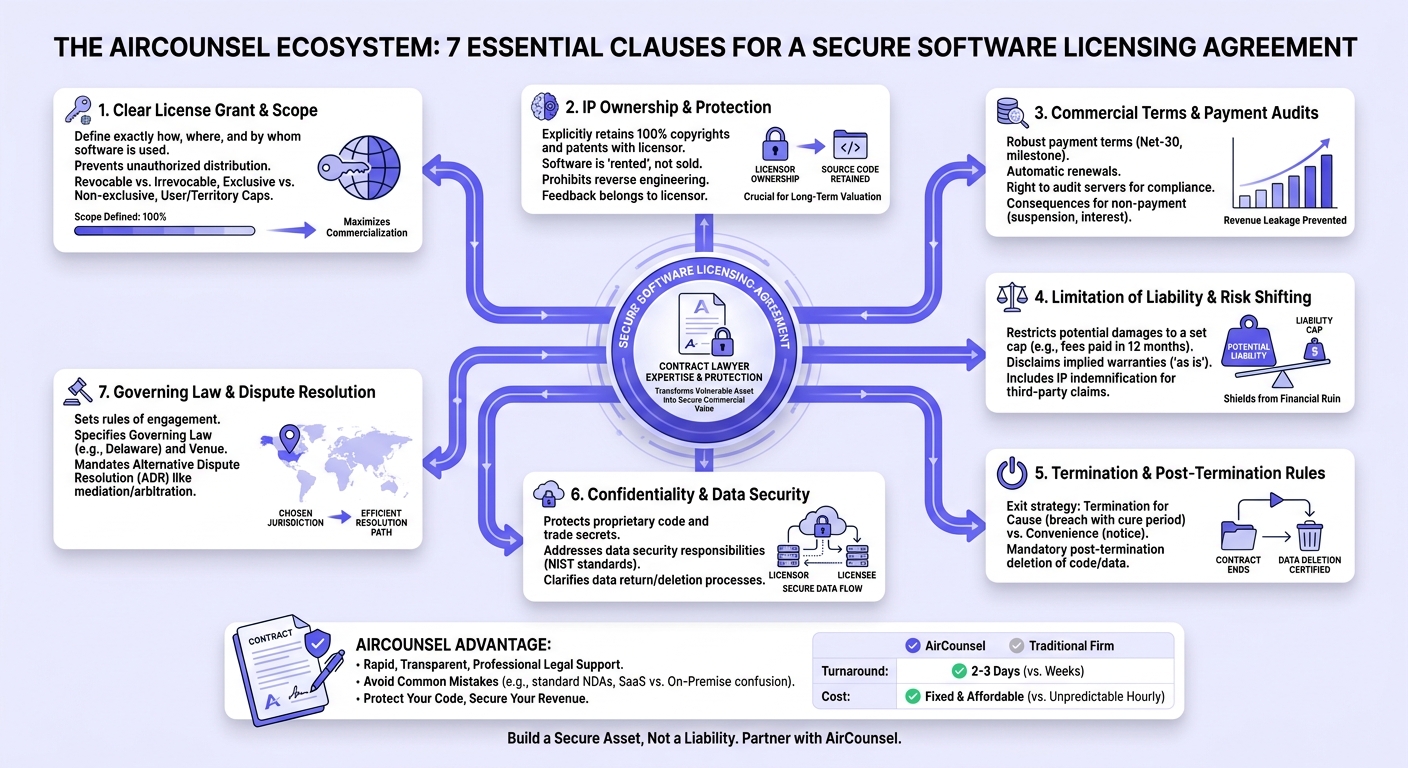
1. Clear License Grant and Scope
The core of any software licensing deal is the license grant itself. This clause defines the exact boundaries of what the buyer (licensee) can do with your software. A vague grant can lead to your software being deployed on thousands of machines when you only intended to license it for ten.
Your contract should explicitly state whether the license is:
- Revocable vs. Irrevocable: Can you pull the license back if they break rules?
- Exclusive vs. Non-exclusive: Can you license the same software to their competitors?
- Territory and Users: Is the license limited to the USA or specific geographic regions? Are there seat, user, or device caps?
- Sublicensing: Is the buyer allowed to rent, lease, or distribute your software to third parties?
2. IP Ownership and Protection
Never leave intellectual property (IP) up to interpretation. Under federal copyright standards, a transfer of copyright ownership is invalid unless it is in writing. A software licensing agreement must state that the licensor (you) retains 100% ownership of the underlying source code, documentation, and any derivative works.
The clause should clarify that:
- The software is licensed, not sold.
- Reverse engineering, decompiling, or attempting to discover the source code is strictly prohibited.
- Any feedback, feature requests, or improvements suggested by the licensee automatically belong to the licensor.

3. Commercial Terms and Payment Audits
A licensing contract is a commercial tool. Without robust payment and audit provisions, you face revenue leakage and payment defaults. Your licensing agreement must lay out clear payment terms under commercial guidelines like the Uniform Commercial Code (UCC).
Ensure your agreement covers:
- Billing and Timing: Net-30, up-front, or milestone-based payments.
- Automatic Renewals: If they do not cancel within 30 or 60 days before the term ends, the license automatically renews.
- Right to Audit: For enterprise software, your attorney should include a clause that gives you the right (with reasonable notice) to inspect their servers or user logs to verify compliance with license limits.
- Consequences of Nonpayment: Immediate suspension of software access and interest penalties on overdue balances.
4. Limitation of Liability and Risk Shifting
What happens if your software goes down during a critical business day for your client, costing them millions of dollars? Without a limitation of liability clause, your business could be sued for consequential damages far exceeding the value of the software.
A robust risk-mitigation section includes:
- Warranties and Disclaimers: Explicitly stating the software is provided "as is" and disclaiming any implied warranties of merchantability or fitness for a particular purpose.
- Liability Caps: Limiting total potential damages to the exact amount the client paid you over the previous 12 months.
- IP Indemnification: Protecting the licensee if a third party sues them claiming your software infringes on their IP, provided they used your software correctly.
5. Termination and Post-Termination Rules
Every contract needs an exit strategy. The termination clause dictates how parties can leave the agreement and what happens to the software once they do. According to U.S. Bankruptcy Basics, the insolvency or bankruptcy of a business client can freeze assets and contracts; your termination clause must anticipate these risks.
Make sure you define:
- Termination for Cause: Material breach of terms (like non-payment or IP infringement) with a set cure period (e.g., 10 business days) before termination occurs.
- Termination for Convenience: Allowing either party to terminate with a 30-day or 60-day written notice.
- Post-Termination Deletion: Forcing the licensee to certify in writing that they have completely uninstalled and deleted all copies of the software.
6. Confidentiality and Data Security
Software applications today rarely operate in isolation; they ingest, store, and process sensitive business and personal data. This is particularly critical under FTC guidelines for data privacy and security.
Your agreement must:
- Define Confidential Information: Protect proprietary code, technical specifications, and client trade secrets.
- Address Data Security: Specify which security controls are maintained, referencing standards like the NIST Cybersecurity Framework.
- Clarify Data Return: Detail how user data is extracted, deleted, or handed back to the licensee after contract termination.
7. Governing Law and Dispute Resolution
If a dispute arises, you do not want to be forced to travel across the country to defend yourself in an unfamiliar court. This clause sets the rules of engagement for any legal fights.
A standard dispute clause covers:
- Governing Law: Usually the home state of the software provider (e.g., Delaware or California).
- Venue: The specific county or federal court district where any lawsuit must be filed.
- Alternative Dispute Resolution (ADR): Mandating mediation or binding arbitration before either party can file a formal lawsuit in court, which saves considerable time and money.
Common Mistakes to Avoid in Software Licensing
Many business operators attempt to bypass professional legal advice by relying on templates. This often leads to critical, costly mistakes:
- Assuming a standard NDA is enough: An NDA protects secrets, but it does not license software or handle IP allocation.
- Failing to distinguish SaaS from On-Premise licenses: If you provide software-as-a-service, you do not need to "license" a copy of the code; you are providing "access" to a service. Using an on-premise license for a SaaS product can create severe compliance and tax liabilities.
- Allowing unlimited indemnification: Agreeing to cover all damages caused by your software without a cap is a massive risk that can bankrupt a startup.
Licensing Costs and Timelines
Drafting or reviewing a software licensing agreement does not have to be slow or expensive. Below is an overview of how these legal projects compare in cost and timeline:
| Service Type | Average Cost (Traditional Firm) | AirCounsel Cost | Typical Turnaround |
|---|---|---|---|
| Contract Review & Redline | $1,500 - $3,500 | $250 - $400 | 2 Business Days |
| Custom SaaS Terms of Service | $3,000 - $6,000 | $900 | 3 Business Days |
| Custom Licensing Agreement | $4,000 - $7,000 | $900 | 3 Business Days |
Protect Your Code with AirCounsel
Securing your software licensing agreement is not just about avoiding lawsuits; it is about building a secure asset that increases the valuation of your business. Standard templates leave massive loopholes that can jeopardize your code and your revenue.
With AirCounsel, you get professional legal support without the traditional law firm stress. Our experienced US-licensed attorneys deliver rapid, affordable, and expert contract drafts and reviews at transparent, upfront fixed rates.
Protect your software today with our targeted legal services:
- Review of your Contract or Legal Document (Starting at $250)
- Custom Licensing Agreement ($900)
- SAAS Application Terms of Service ($900)
This article provides general information and is not legal advice.
Frequently Asked Questions
What should a software license agreement always include?
At a minimum, it must contain a clear scope of the license grant, explicit statements retaining IP ownership with the creator, liability caps to limit financial risk, payment terms, and rules for how the agreement terminates and how the software is deleted.
What is the difference between a software license and a software assignment?
A software license grants a temporary, limited right to use the software while you retain full ownership of the intellectual property. A software assignment is a complete, permanent transfer of IP ownership, meaning you sell the rights to the code entirely to another party. For custom ownership transfers, companies typically use a Custom IP Assignment Agreement.
Can a software license limit liability for data breaches or downtime?
Yes. Most robust licensing agreements feature limitation of liability clauses that explicitly exclude consequential damages (such as lost profits or business disruption) and cap total direct damages to a reasonable amount, such as the total fees paid by the client over the preceding 12-month period.
Should a small business use a lawyer for every software licensing agreement?
While you might not need a lawyer to review every tiny standard subscription, you absolutely need a contract lawyer for custom enterprise deals, partner integrations, or unique distributions. One bad clause in an enterprise deal can lock you into unfavorable terms or risk your proprietary intellectual property.
Recommended
Need Legal Assistance?
Our expert legal team is ready to help you navigate complex legal matters with confidence.