Why USA Startups Must Implement Specific Data Processing Addendums (DPAs)

As a scaling startup, safeguarding user data is no longer just an ethical choice—it is a critical commercial requirement. In the modern business landscape, 99.9% of US businesses are small businesses, according to the SBA Office of Advocacy, and these agile companies face the heaviest burden when navigating evolving state privacy laws. Whenever you share personal data with external vendors, you need robust legal agreements to protect your business from catastrophic liability and regulatory fines.
This is where professional contract drafting services become essential. Startups frequently sign up for SaaS tools, analytics platforms, and payment processors without realizing that they are transferring customer and employee data to third parties. Under the current US data privacy framework, failing to execute a proper Data Processing Addendum (DPA) with these vendors can expose your company to massive penalties and ruin your chances of securing venture capital.
By utilizing specialized contract drafting services, founders can secure their vendor agreements, ensure compliance with state laws like California's CPRA, and build institutional trust that accelerates enterprise sales.
Table of Contents
- Quick Summary
- What is a Data Processing Addendum and Why Startups Need One
- Contracts That Typically Require a DPA
- How US State Privacy Laws Impact Your Contracts
- Key Clauses to Include in Your DPA
- Common Startup Mistakes in Vendor Contracting
- Why Professional Contract Drafting Services Outperform Templates
- How a Robust DPA Drives Business Growth
- Protect Your Startup with Expert Contract Drafting
- Frequently Asked Questions
- Recommended
Quick Summary
| Takeaway | Explanation |
|---|---|
| What is a DPA? | A legally binding agreement added to a vendor contract that dictates how personal data is handled and protected. |
| Why it Matters | Protects your startup from liability and complies with US state laws like California's CPRA. |
| Target Contracts | SaaS tools, payment processors, HR systems, and marketing analytics that touch user data. |
| Critical Clauses | Must define roles, processing rules, data breach notification times, and data deletion rights. |
| The Solution | Professional contract drafting services ensure your DPAs are legally compliant and protect your liability. |
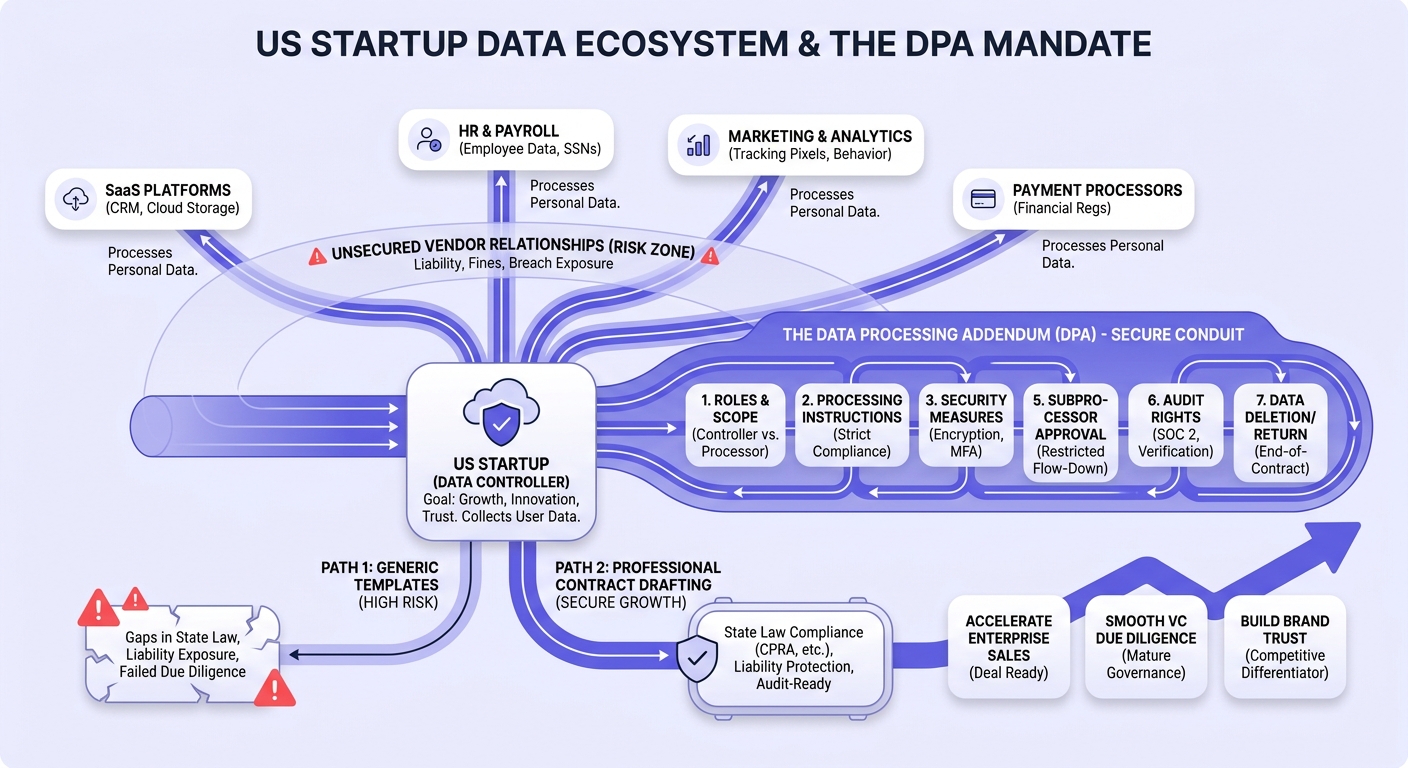
What is a Data Processing Addendum and Why Startups Need One
A Data Processing Addendum (DPA) is a specialized legal document that acts as an extension to a master service agreement (MSA). It specifically regulates how a third-party vendor (a "processor" or "service provider") manages, secures, and processes any personal data received from your startup (the "controller" or "business").
The FTC Data Security Guidelines highlight that businesses are responsible for verifying that their vendors maintain reasonable security practices. Without a DPA, you have no contractual guarantee that your vendor will protect your users' data or notify you if they suffer a breach. If a breach occurs on their watch, your startup could face the primary legal fallout, destroying your brand reputation overnight.
Contracts That Typically Require a DPA
Many founders mistakenly believe DPAs are only necessary for complex enterprise deals. In reality, almost any vendor contract that touches personal data requires one.
Here are the most common agreements that demand a DPA:
- SaaS Platforms: Customer relationship management (CRM) software, cloud storage providers, and email delivery platforms.
- HR and Payroll Systems: Any external platform that processes employee Social Security numbers, bank details, or health information.
- Marketing and Analytics Tools: Websites tracking user behavior, pixel tracking, and email marketing software.
- Payment Processors: Gateways that handle customer financial transactions, which must align with regulations like Regulation P.
How US State Privacy Laws Impact Your Contracts
The US does not have a single federal privacy law. Instead, startups must navigate a patchwork of state-level regulations. The California Privacy Protection Agency enforces some of the strictest rules under the California Consumer Privacy Act (CCPA), as amended by the CPRA.
To comply, your vendor contracts must explicitly forbid "service providers" from selling or sharing personal data, or retaining it outside the direct business relationship. Other states, including Virginia, Colorado, and Utah, enforce similar flow-down obligations. If your contracts do not reflect these state-specific statutory terms, your business is technically out of compliance, even if your internal systems are perfectly secure.
Key Clauses to Include in Your DPA
When utilizing contract drafting services to build a compliant DPA, several core clauses must be customized for your operational model:
- Roles and Scope: Define exactly who is the controller (your startup) and who is the processor (the vendor).
- Processing Instructions: Explicitly state that the vendor may only process data in accordance with your written instructions.
- Security Measures: Require the vendor to implement robust technical and organizational security controls (such as encryption and multi-factor authentication).
- Breach Notification: Establish a strict timeline (often 24 to 72 hours) for the vendor to notify you of any suspected data breach.
- Subprocessor Approval: Limit the vendor's ability to hire other subcontractors to process your data without your prior written consent.
- Audit Rights: Give your startup the right to audit the vendor's security practices or demand proof of independent security certifications (like SOC 2).
- Data Deletion and Return: Mandate that the vendor must securely delete or return all personal data upon the termination of the agreement.
To make these agreements flow seamlessly, you should integrate these clauses into your standard vendor onboarding process. Here is a typical timeline for setting up compliant vendor relations:
| Step | Action Item | Timeline |
|---|---|---|
| Step 1 | Map out all third-party vendors and categorize the data they process. | 1-2 Days |
| Step 2 | Have an attorney draft your standard Master DPA using specialized contract drafting services. | 3 Business Days |
| Step 3 | Send the DPA to existing vendors for signature and mandate it for all new vendor onboarding. | Ongoing |
Common Startup Mistakes in Vendor Contracting
Avoid these costly pitfalls when managing vendor contracts:
- Using Generic Online Templates: Free templates rarely account for the specific state laws relevant to your customers or the precise nature of the data you collect.
- Failing to Align with the Main Agreement: Sometimes, the liability limits in your main services agreement nullify the data breach protections in your DPA. Professional contract review is required to ensure these documents do not conflict.
- Ignoring Subprocessor Flow-Downs: If your vendor hires a subcontractor who loses your data, and your DPA didn't restrict or regulate subprocessors, you are left holding the liability.
Why Professional Contract Drafting Services Outperform Templates
While self-serve templates are cheap, they leave your business exposed to regulatory fines, intellectual property disputes, and unlimited liability. Professional contract drafting services give you the speed of modern technology combined with the absolute security of licensed legal counsel.
If you use a template, you are guessing. When you work with a professional legal partner, they align your DPA with your Custom Application, Software or Website Privacy & Cookies Policy and ensure that your Custom Independent Contractor / Consulting Agreement also respects your data flows. This holistic protection keeps your business audit-ready.

How a Robust DPA Drives Business Growth
Investing in high-quality legal drafting is not just a defensive play—it is an offensive strategy.
- Accelerating Enterprise Procurement: Large enterprise clients will not buy your software unless you have a standard, compliant DPA ready to sign. Having one prepared shows you are enterprise-ready and cuts down deal friction.
- Smoothing Venture Capital Due Diligence: During fundraising, sophisticated investors inspect your vendor contracts. Clean, lawyer-drafted agreements are proof of mature governance, boosting your valuation.
- Building Brand Trust: Demonstrating that you take privacy seriously turns data protection into a competitive differentiator that attracts privacy-conscious consumers.
Protect Your Startup with Expert Contract Drafting
Protecting your startup from data liabilities does not have to be slow, confusing, or prohibitively expensive. At AirCounsel, we offer rapid, fixed-price legal services designed specifically for fast-growing startups and small businesses. Our licensed US attorneys can draft your Custom Data Processing Addendum or review your vendor agreements within days, giving you elite-level asset protection without the typical hourly law firm rates.
Ready to secure your business and accelerate your enterprise sales? Explore our tailored services today:
- Get custom-made legal agreements with our Custom Contract Drafter service.
- Ensure your vendor contracts are safe and balanced with a professional Review of your Contract or Legal Document.
- Align your digital platforms with our Custom Application, Software or Website Privacy & Cookies Policy builder.
This article provides general information and is not legal advice.
Frequently Asked Questions
What is a data processing addendum in a vendor contract?
A data processing addendum (DPA) is a legal document added to a primary contract (like an MSA) that regulates how personal data is handled, stored, and protected by a vendor on behalf of your business.
Do U.S. startups need a DPA for every service provider?
No, only for service providers that access, host, or process personal data (such as emails, names, IP addresses, or payment details) belonging to your customers or employees.
What clauses should be included in a startup DPA?
A robust DPA must include clearly defined controller/processor roles, processing instructions, security measures, mandatory data breach notification timelines, subprocessor restrictions, audit rights, and data deletion obligations.
When should a startup use contract drafting services instead of a template?
A startup should use contract drafting services when dealing with high-risk personal data, integrating multiple US state laws, negotiating enterprise-tier vendor agreements, or preparing for venture capital due diligence where standardized templates fail to protect against liability.
Recommended
- Learn how to secure your brand with our attorney-led Trademark Filing guide.
- Structure your company governance correctly using a customized LLC Operating Agreement.
- Understand employment law essentials with a professionally crafted Custom Employment Agreement.
Need Legal Assistance?
Our expert legal team is ready to help you navigate complex legal matters with confidence.