What Happens When Australian Tech Companies Skip a Business Contract Review on Enterprise MSAs?

Landing a major enterprise client is a defining milestone for any growing Australian software or technology company. However, enterprise procurement teams rarely sign your standard click-wrap agreement; instead, they issue their own 40-page Master Service Agreement (MSA) on a take-it-or-leave-it basis.
Rushing to sign these standard contracts without conducting a detailed business contract review puts your company at immediate operational and legal risk. In Australia, small business unfair contract term protections apply where at least one party employs fewer than 100 people or has an annual turnover of under $10 million, yet relying on statutory safety nets after a dispute arises is both expensive and disruptive.
A structured business contract review allows tech founders and operators to pinpoint aggressive liabilities, preserve intellectual property rights, and negotiate balanced commercial terms before signing.
Table of Contents
- The Enterprise MSA Trap for Australian Tech Companies
- Key Risks Hidden in Standard Form Enterprise MSAs
- How Australian Unfair Contract Term Laws Protect B2B Deals
- A 5-Step Business Contract Review Workflow for Tech Founders
- Comparison: Standard Enterprise Clause vs. Balanced Position
- Secure Your Enterprise Deals with AirCounsel
- Frequently Asked Questions
- Recommended
| Takeaway | Explanation |
|---|---|
| Enterprise MSAs Shift Risk | Enterprise-drafted contracts routinely assign disproportionate legal and financial liabilities onto suppliers. |
| UCT Protections Exist | Australian Consumer Law guards qualifying small businesses against unfair terms, but proactive negotiation remains essential. |
| Schedules Carry Danger | Security addenda, data processing terms, and SLAs often contain stricter liabilities than the main contract body. |
| IP Protection Is Critical | Vague clauses can accidentally assign your proprietary codebase or background IP to the enterprise client. |
| Fixed Reviews Save Margin | Professional, flat-fee legal reviews protect your profit margins and speed up your enterprise sales cycle. |
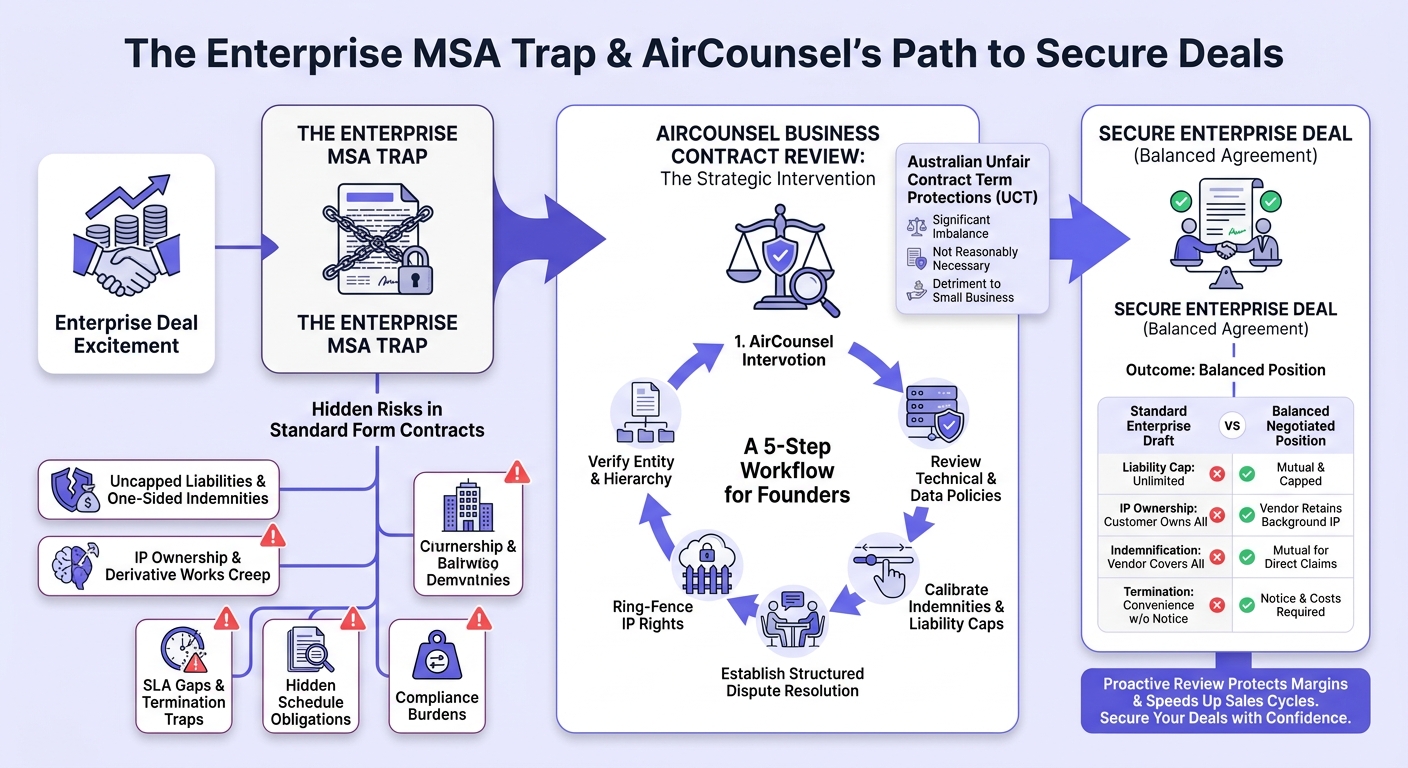
The Enterprise MSA Trap for Australian Tech Companies
When enterprise customers agree to purchase your software or consulting services, their procurement department typically issues a generic, buyer-friendly Master Service Agreement. An enterprise MSA serves as the overarching legal umbrella governing work orders, statements of work (SOWs), and software subscriptions.
Because enterprise legal teams draft these agreements to protect large corporations, they frequently function as standard form contracts. If presented on a take-it-or-leave-it basis, these contracts shift third-party risks, regulatory compliance burdens, and system downtime penalties entirely onto your business.
Skipping a business contract review to accelerate signing often leads to commitments your insurance will not cover, or delivery requirements your engineering team cannot fulfill. For deeper insights into statutory traps, read our guide on 7 hidden risks an Australian contract review lawyer can catch under the unfair contract terms regime.
Key Risks Hidden in Standard Form Enterprise MSAs
Enterprise contracts are intentionally complex, burying substantial obligations inside schedules, technical definitions, and referenced policies.

One-Sided Indemnities and Uncapped Liabilities
A standard enterprise contract often includes broad indemnities requiring the vendor to cover any third-party claims, legal fees, or losses incurred by the client. At the same time, the enterprise buyer may cap their own liability to nominal fees while leaving your liability completely uncapped for breaches of confidentiality, security incidents, or IP infringement.
IP Ownership and Derivative Works Creep
Many enterprise MSAs state that the customer owns all "deliverables, work product, and developments" created during the engagement. If this clause lacks clear carve-outs for your pre-existing code, proprietary algorithms, and core platform features, you risk inadvertently assigning your underlying technology to your client. To avoid forfeiting assets, tech teams should read our guide on how to work with an Australian contract review lawyer to protect your tech IP.
SLA Gaps and Unilateral Termination Traps
Service Level Agreements (SLAs) frequently set 99.99% uptime guarantees backed by severe financial penalties and immediate termination rights for minor performance lapses. Enterprise contracts may also grant the client convenience termination with zero notice while locking your company into continuous support without price indexation.
How Australian Unfair Contract Term Laws Protect B2B Deals
Australia maintains robust legislation regarding standard form business contracts. Under guidance provided by the ACCC and enforcement frameworks overseen by business.gov.au, unfair contract terms (UCT) in standard form business-to-business agreements are illegal and subject to severe civil penalties.
A contract term is deemed unfair under Australian Consumer Law if it meets three statutory criteria:
- Significant Imbalance: It creates a substantial imbalance in the rights and obligations of the parties.
- Not Reasonably Necessary: It is not reasonably necessary to protect the legitimate interests of the advantaged party.
- Detriment: It would cause financial or operational detriment to the small business if applied or relied upon.
While this regulatory framework offers vital legal recourse, proving a clause is unfair in court requires considerable time and capital. Completing a business contract review before signing ensures one-sided terms are struck out or adjusted before problems occur.
A 5-Step Business Contract Review Workflow for Tech Founders
- Verify Corporate Entities and Cross-Document Hierarchy: Confirm that all contracting entities, ABNs, and order-of-precedence clauses are clear so that SOW terms override standard MSA boilerplate where negotiated.
- Review Technical Schedules and Data Policies: Inspect cybersecurity exhibits and data handling schedules against your current operational capabilities to ensure you can comply with data residency and breach reporting rules.
- Calibrate Indemnities and Liability Caps: Restrict vendor indemnities to direct, proven third-party IP claims, and tie aggregate liability to a reasonable multiple of fees paid (e.g., 12 months' contract value).
- Ring-Fence Intellectual Property Rights: Explicitly define and reserve ownership of your pre-existing IP, open-source software, and underlying platform architecture, granting the client only a non-exclusive license.
- Establish Structured Dispute Resolution: Ensure the contract includes mandatory dispute escalation, good-faith executive conferences, and mediation prior to formal litigation.
Comparison: Standard Enterprise Clause vs. Balanced Position
| Clause Type | Typical Enterprise Draft | Balanced Negotiated Position |
|---|---|---|
| Liability Cap | Unlimited vendor liability; customer liability capped at 1 month of fees. | Mutual liability cap set at 100% of fees paid over the prior 12 months. |
| IP Ownership | Customer owns all work product, modifications, and created items. | Vendor retains background IP and software; customer owns bespoke deliverables only. |
| Indemnification | Vendor indemnifies customer for all losses, claims, and data incidents. | Mutual indemnities limited to direct claims for gross negligence and willful misconduct. |
| Termination | Customer may terminate for convenience on 7 days' notice without penalty. | Termination for convenience requires 60 days' notice and payment of incurred costs. |
| Warranty Periods | 12-month defect-free warranty with automatic refund rights. | 30-day warranty with sole remedy limited to re-performance or system patching. |
Secure Your Enterprise Deals with AirCounsel
Closing high-value enterprise sales should not mean accepting unmanageable legal exposure. AirCounsel delivers comprehensive, fixed-fee legal contract reviews performed by qualified Australian solicitors, giving tech founders the confidence to negotiate and close deals fast.
Get an expert Review of your Contract or Legal Document within 2 business days to identify red flags, or engage our lawyers for direct Negotiation Support to handle counterparty revisions smoothly.
Frequently Asked Questions
What is a business contract review for an enterprise master service agreement?
A business contract review is a comprehensive legal evaluation of an MSA and its associated schedules. It identifies high-risk terms, liability imbalances, intellectual property traps, and regulatory compliance gaps before execution.
Are enterprise master service agreements usually standard form contracts in Australia?
Yes. Enterprise buyers routinely supply their standard MSA template with limited willingness to alter their core boilerplate, creating a strong presumption under Australian Consumer Law that the agreement is standard form.
What risks should tech companies look for before signing an MSA?
Tech companies should evaluate uncapped indemnities, IP transfer provisions, onerous SLA credit penalties, overly restrictive non-compete clauses, and unlimited data breach liability in incorporated schedules.
Can unfair contract terms in Australian business contracts be challenged after signing?
Yes. If the contract qualifies as a standard form small business contract, unfair terms can be declared void by a court, and statutory penalties may apply under Australian Consumer Law. However, challenging terms post-signature is costly compared to pre-signing negotiation.
How quickly can a lawyer complete a business contract review?
A standard contract review is typically completed within 2 business days, with express same-day or 24-hour turnaround options available for urgent deal cycles.
Recommended
Need Legal Assistance?
Our expert legal team is ready to help you navigate complex legal matters with confidence.