IP Protection in Australia: A Practical Guide for Founders

Australian founders move fast—but your competitors move just as fast, and often quietly. Australian SMEs that actively protect their IP are significantly more likely to achieve high growth compared to those that don’t, according to analysis of the Australian IP Report 2025.
If you’re building a brand, product, or platform, you already own intellectual property (IP). The real question is whether you’ve locked it down. This guide walks through practical, founder-friendly IP protection in Australia: what to protect, when to register, how to avoid common traps, and where legal help adds real value.
Use it as a roadmap to turn your ideas, brand, and code into defensible, investor-ready assets.
Table of Contents
- Quick Summary
- Understanding IP Protection in Australia
- Why IP Protection Matters for Australian Startups
- Key Types of IP for Australian Businesses
- Step-By-Step: How To Protect Your IP in Australia
- Costs, Timelines, and Budgeting
- Common IP Mistakes Founders Make
- Practical IP Strategies To Impress Investors
- When To Get Legal Help On IP
- Protect Your IP With AirCounsel
- Frequently Asked Questions
- Recommended
Quick Summary
| Takeaway | Explanation |
|---|---|
| Treat IP as a core asset | Your brand, code, content, designs, and product features are often more valuable than physical assets. Plan for IP early. |
| Not all IP is automatic | Copyright arises automatically, but trade marks, patents, and designs generally need registration through IP Australia. |
| Registration is a business decision | You can’t and shouldn’t register everything; focus on what drives revenue and competitive advantage. |
| Contracts are as important as filings | Employment, contractor, and development agreements should clearly assign IP to the company. |
| Timing matters | File trade marks and patents early to avoid conflicts, but don’t file patents before you’re ready to disclose. |
| Get expert help for complex IP | DIY is risky for patents and high-value trade marks; targeted legal advice often saves money and pain later. |
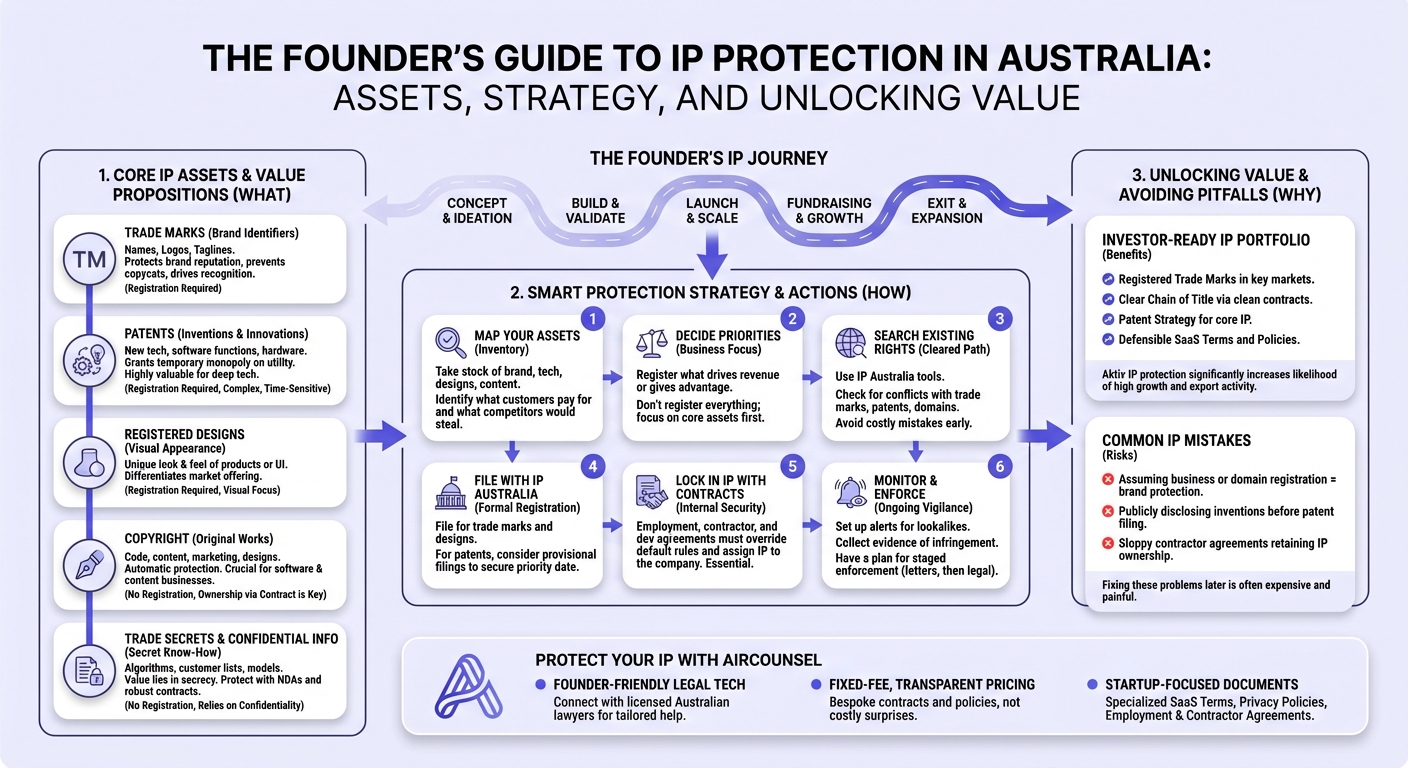
Infographic: IP protection in Australia overview
Understanding IP Protection in Australia
IP protection in Australia is governed mainly by federal law and administered by IP Australia, the government agency that handles trade marks, patents, designs, and plant breeder’s rights.
For founders, “IP protection” usually covers four fronts:
- Registering formal rights (trade marks, patents, designs).
- Relying on automatic rights (copyright, confidential information).
- Using contracts (employment, contractor, terms of service) to confirm ownership.
- Enforcing rights against copycats and infringers.
The right mix depends on your business model—software/SaaS, e‑commerce, hardware, deep tech, brand-led consumer product, etc. The goal is simple: make it hard and expensive for others to copy what makes you different.
Why IP Protection Matters for Australian Startups
IP isn’t just a legal topic—it’s a commercial strategy.
- Protects your name and reputation: A registered trade mark helps stop others from riding on your brand.
- Locks in product advantage: Patents and designs can block competitors from copying your tech or look-and-feel.
- Boosts valuation and exit potential: Investors and acquirers routinely ask what IP you own, not just what you’ve built.
- Supports international expansion: Clear IP rights at home make it easier to extend protection offshore.
- De-risks partnerships: Joint ventures, resellers, and licensing deals are smoother when your IP position is clear.
Analysis of the Australian IP Report 2025 shows that SMEs who actively manage and protect their IP are materially more likely to experience high growth and export activity than those who don’t, underlining that IP strategy and growth are tightly linked.
Key Types of IP for Australian Businesses

At a high level, here’s what different IP rights typically cover in Australia:
| IP Type | What It Protects | Registration Needed? | Typical Use Cases |
|---|---|---|---|
| Trade mark | Brand identifiers (name, logo, tagline, packaging) | Yes, for strongest protection | Brand names, app names, logos, product lines |
| Patent | New inventions (how something works) | Yes | Novel tech, hardware, chemical or biotech inventions |
| Registered design | Visual appearance of a product | Yes | Product shapes, user interface layouts, packaging design |
| Copyright | Original works (code, text, images, music, videos) | No – automatic on creation | Software, website content, marketing assets |
| Confidential info / trade secrets | Valuable non-public information | No, but must be kept secret | Algorithms, recipes, customer lists, pricing models |
Trade Marks
Trade marks protect your brand identifiers—the signs consumers use to recognize your business.
- Examples: business name, product name, logo, tagline, distinctive packaging.
- Australia uses a class system (Group similar goods/services under numbered classes).
- Registration gives you an exclusive right to use the mark in those classes in Australia.
Key points:
- A registered trade mark is generally much stronger than relying on “common law” rights.
- Registering your company name or domain does not equal having a registered trade mark.
- A conflict discovered late (after brand launch) can force a painful rebrand.
Patents
Patents protect inventions—how things work or are made.
- Must generally be new, inventive, and useful.
- You get a time-limited monopoly (up to 20 years for standard patents) in exchange for public disclosure.
- Usually critical for deep tech, hardware, biotech, and some software innovations.
Key points:
- Publicly disclosing your invention before filing can destroy patentability.
- Patent drafting is complex; professional help is strongly recommended.
- Often part of a broader strategy (trade secrets, copyright, contracts).
Registered Designs
Design protection covers the visual appearance of a product, not how it works.
- Think shape, configuration, pattern, or ornamentation.
- Common for consumer products, devices, and sometimes UI/UX elements (e.g., icons, layouts).
Key points:
- Design must be new and distinctive at the priority date.
- Useful for physical products where look and feel is a major differentiator.
Copyright
Copyright automatically protects original creative works, including:
- Software source code
- Website and app content
- Graphics, logos (as artworks), photos, videos, audio
- Written materials (blogs, whitepapers, manuals)
Key points:
- No registration system for copyright in Australia—protection exists from creation.
- Ownership can be tricky: by default, creators (or their employer in some cases) own copyright.
- For startups, clear contracts are essential to ensure the company owns the IP, not individual founders, contractors, or agencies.
Confidential Information and Trade Secrets
These protect valuable information that is kept secret, such as:
- Algorithms and models
- Customer lists and CRM data
- Manufacturing processes
- Growth strategies and financial models
Key points:
- Protection comes from keeping the information confidential, not from registration.
- NDAs and confidentiality clauses in contracts are critical.
- Once information is made public, trade secret protection is usually lost.
Step-By-Step: How To Protect Your IP in Australia
This is a practical roadmap you can follow to strengthen IP protection in Australia without over-spending or over-engineering too early.
Step 1: Map Your IP Assets
Start with an “IP inventory”:
- Brand elements (names, logos, taglines, product names).
- Tech and product features (code, algorithms, hardware, unique processes).
- Designs and visuals (UI/UX, packaging, product shapes).
- Content and data (blogs, educational content, datasets, playbooks).
- Contracts, manuals, and internal know-how.
Ask:
- What would hurt most if a competitor copied it tomorrow?
- What do customers actually pay us for?
- What will investors expect us to have locked down?
These answers guide what to protect first.
Step 2: Decide What To Register
You don’t need to register everything. Focus on:
- Trade marks for your main brand and flagship products.
- Patents for inventions that are:
- Technically novel.
- Likely to underpin long-term revenue.
- Hard for competitors to design around.
- Designs for products where appearance is a key selling point.
Prioritise:
- Revenue drivers (current and near-term).
- Assets you plan to license or franchise.
- Markets where you’re most exposed to copycats.
Step 3: Search Existing Rights
Before committing to a name or filing:
- Use the IP Australia search tools to check for similar trade marks, patents, and designs.
- Search domains, app stores, and social platforms for similar brands.
- Look at competitors’ branding and product features in your space.
You’re looking for:
- Conflicts that could block your registration.
- Red flags that your chosen brand is too descriptive or generic.
- Opportunities—gaps where no one is protecting a space that matters to you.
A targeted legal search is often worthwhile for your core brand, as conflicts here can be very expensive to fix.
Step 4: File With IP Australia
For most registrations, you deal directly with IP Australia.
-
Trade marks:
- Choose your classes and description of goods/services.
- File online with IP Australia.
- Application is examined, published, and if not opposed, proceeds to registration.
- The process commonly takes several months.
-
Patents:
- Start with a patentability assessment if you’re unsure your invention qualifies.
- File a provisional application first if you’re still refining the invention.
- Follow with a standard patent application within required timeframes.
- Expect a multi-year process for full grant.
-
Designs:
- File representations (images) showing the design.
- After formalities, the design can be registered and later certified.
For detailed process steps and official forms, the IP Australia online services portal is the authoritative starting point.
Step 5: Lock In IP In Your Contracts
Registrations are only part of IP protection in Australia. Contracts close many of the biggest gaps.
Focus on:
- Employment agreements: Should assign IP created in the course of employment to the company, cover confidentiality, and include reasonable post-employment restrictions.
- Contractor and consultant agreements: Must clearly assign all IP to your company (default rules often favor the creator).
- Development and agency agreements (software, design, branding, marketing): Should specify who owns source code, designs, content, and underlying IP.
- Terms of service and privacy documents: Clarify who owns what content, how users can use your product, and how you handle data.
AirCounsel can help with founder-friendly templates such as a Custom Employment Agreement and bespoke Application, Software or Website Terms of Service that bake in IP ownership and usage rules from day one.
Step 6: Monitor and Enforce Your Rights
IP is not “set and forget”.
- Set up alerts on marketplaces, app stores, and social platforms for lookalike brands or products.
- Periodically re-run trade mark searches in your core classes.
- Keep a simple log of infringements and how you responded.
If you spot a potential infringement:
- Collect evidence (screenshots, dates, URLs, product samples).
- Assess risk and commercial impact.
- Consider a staged response—informal outreach, then a formal lawyer’s letter, then litigation if necessary.
A tailored Letter Prepared by Lawyer is often enough to stop early-stage infringement before it escalates.
Costs, Timelines, and Budgeting
Every business is different, but you can think of IP costs and timing roughly like this:
| Item | Typical Timing | Budget Guide (Government + Professional) |
|---|---|---|
| Trade mark (1 brand, 1–2 classes) | 6–8+ months to registration if unopposed | Government fees in the low hundreds of dollars per class, plus any legal fees for strategy and filing |
| Provisional patent application | As soon as invention is defined; before public disclosure | Government fees plus professional drafting that can run to thousands of dollars, depending on complexity |
| Standard patent (to grant) | Often 2–4+ years from filing | Significant long-term investment; plan for staged costs over several years |
| Registered design | Months from filing to registration, certification can take longer | Government fees typically in the hundreds of dollars, plus any representation and drafting costs |
| Contracts and policies | 1–3 days for custom agreements | Fixed-fee legal drafting or review; often cheaper than the cost of one serious dispute |
Practical budgeting tips:
- Prioritise 1–2 core trade marks early (e.g., company name and flagship product).
- For patents, validate commercial potential before committing major spend.
- Use targeted legal help rather than trying to DIY your entire portfolio.
- Revisit your IP strategy at key milestones: funding rounds, major product releases, or international expansion.
Common IP Mistakes Founders Make
Some pitfalls we see repeatedly with Australian startups:
- Assuming registration equals safety: A registered business or domain name does not give you trade mark rights.
- Branding too late: Falling in love with a name then discovering a conflicting trade mark just before launch.
- Publicly disclosing inventions: Pitch decks, conferences, or GitHub repos that go live before any patent filing.
- Sloppy contractor arrangements: Freelancers or agencies retaining IP in branding, code, or designs.
- Copy-paste terms and policies: Borrowed terms of service or privacy policies that misstate your IP position or breach Australian law.
- Not planning for overseas: Expanding into new markets with no trade mark or patent strategy there.
Each of these can usually be avoided with simple, early interventions—often a fraction of the cost of fixing them later.
Practical IP Strategies To Impress Investors
Investors and acquirers rarely anticipate a perfect IP portfolio, but they do expect intentionality.
You’ll stand out when you can say:
- “We own the registered trade mark for our brand in classes X and Y.”
- “All code and content is owned by the company through signed employment and contractor agreements.”
- “We’ve filed a provisional patent covering our core algorithm and have an international strategy.”
- “We have clear SaaS terms and a privacy policy that lock in our IP and comply with Australian Consumer Law and privacy requirements.”
Concrete steps that look good in a data room:
- A simple IP register listing your brands, domains, registrations, and key agreements.
- Copies of IP assignments from founders, employees, and contractors.
- Evidence of trade mark and patent filings with IP Australia.
- Clear, professional customer-facing documents (e.g., tailored SaaS terms, privacy and cookies policy).
AirCounsel’s fixed-fee services, such as SAAS Application Terms of Service and Privacy & Cookies Policy, make it straightforward to bring your public-facing IP posture up to investor grade.
When To Get Legal Help On IP
You don’t need a lawyer for every small step—but there are moments when professional advice creates outsized value:
- Before committing to a core brand name: Assess registrability and risk of conflict.
- Before disclosing a potential invention publicly: Decide between patenting, trade secrets, or a hybrid.
- When entering key development or licensing deals: Ensure IP ownership and licensing terms align with your growth strategy.
- When you spot a serious infringer: Calibrate your response and avoid missteps (e.g., groundless threats).
If you just need a quick steer—“Is this name safe?” or “Should we patent this?”—a concise, fixed-price consultation such as Ask a Australian Solicitor a Question can be the fastest path to clarity.
Protect Your IP With AirCounsel

You don’t have time to become an IP lawyer. But you can put a clear, defensible IP framework around your business in days, not months—with predictable pricing and documents built for how startups actually operate.
AirCounsel connects you with licensed Australian lawyers who specialize in founder-focused documents: trade mark strategy, airtight employment and contractor agreements, and robust terms for your SaaS or app. You get transparent fixed fees, fast turnarounds, and documents you can actually understand and use.
If you’re ready to lock down your IP protection in Australia:
- Get bespoke contracts and policies through our Custom Contract Drafter.
- Protect your platform with tailored Application, Software or Website Terms of Service.
- Clarify who owns what in your team with a Custom Independent Contractor / Consulting Agreement.
Frequently Asked Questions
What are the main types of IP protection available in Australia?
The main types are trade marks (for brands), patents (for inventions), registered designs (for product appearance), copyright (for creative works like code and content), and protection for confidential information or trade secrets. Trade marks, patents, and designs require registration with IP Australia; copyright and confidentiality arise automatically but need to be managed carefully through contracts and security practices.
How do I register a trade mark in Australia?
You file an application with IP Australia specifying the trade mark (word, logo, etc.) and the goods/services it covers, grouped into “classes.” IP Australia examines the application, then publishes it for opposition. If there are no issues or oppositions, it proceeds to registration. The process typically takes several months. A lawyer can help you choose the right classes, avoid common objections, and assess conflict risks before filing.
When should a startup file for a patent?
File before you publicly disclose the invention (e.g., before demos, conferences, or open-source releases). Many startups start with a provisional patent application once the invention is clearly defined but still evolving, then move to a standard patent later. Because patents are expensive and long-term, it’s wise to get legal advice to check patentability and commercial value before committing.
How can protecting my IP help attract investors?
Investors want to see that your competitive advantage is defensible. Registered trade marks, well-managed copyrights, patents (where relevant), and clean IP assignments from team members and contractors all signal that your business can scale and be acquired without messy ownership disputes. Strong IP can also support higher valuations, better licensing opportunities, and smoother cross-border expansion.
Do I need to register copyright in Australia?
No. Copyright protection arises automatically when an original work is created (code, text, designs, images, etc.). There is no official copyright register. However, you do need to ensure your company owns the copyright—typically via employment contracts, contractor agreements, and IP assignment deeds—otherwise the individual creator may own it.
What if someone is infringing my IP?
Gather evidence (dates, screenshots, product samples, website copies) and assess the impact on your business. In many cases, a well-drafted lawyer’s letter demanding they stop, rebrand, or compensate is an effective first step. If the matter is significant or complex, get targeted advice on your options and risks before taking public action, especially around trade marks and patents where “groundless threats” rules can apply.
Recommended
- Strengthen your contracts and ownership chain with the Custom Contract Drafter.
- Protect your core brand and platform with tailored SAAS Application Terms of Service.
- Get fast, focused guidance on a specific IP issue through Ask a Australian Solicitor a Question.
Need Legal Assistance?
Our expert legal team is ready to help you navigate complex legal matters with confidence.