4 Red Flags in Software Development Agreements That Demand a Business Contract Review

Engaging an external developer or software agency to build your digital product is one of the most critical investments a company can make. However, signing a vendor-drafted software development agreement without a rigorous business contract review leaves business owners vulnerable to budget overruns, missed launch targets, and severe disputes over who actually owns the underlying codebase.
Under Australian commercial law, agency agreements and master services agreements (MSAs) are typically weighted heavily in favor of the developer. According to regulatory guidance published by ASIC, a contract qualifies as a small-business contract under Australian law if at least one party employs fewer than 100 people or reports an annual turnover under $10 million. While statutory protections exist, relying on post-dispute litigation is far more costly than eliminating predatory terms before work commences.
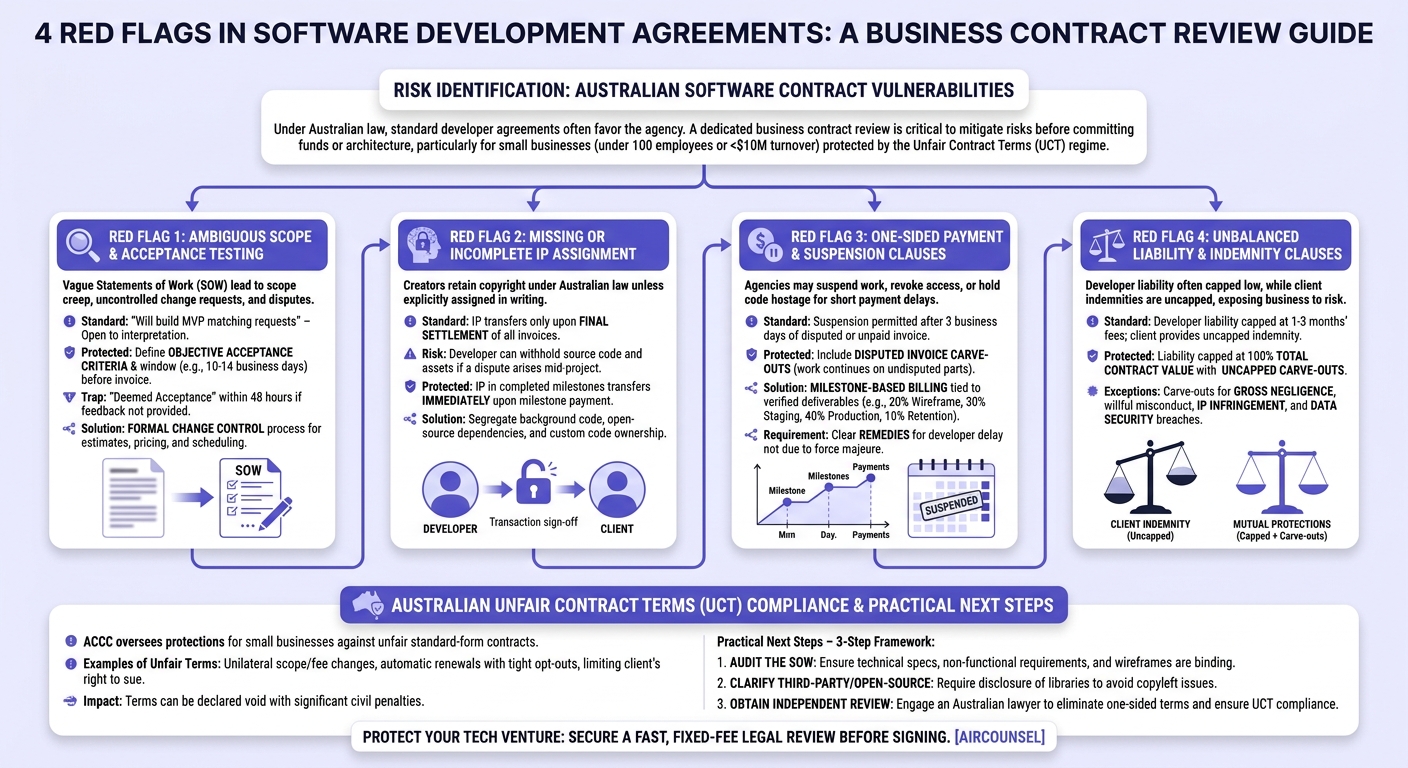
Before committing funds or sharing proprietary architecture, founders must identify four critical red flags across scope definition, intellectual property, payment schedules, and liability caps.
Table of Contents
- Why Software Development Contracts Demand a Dedicated Review
- Red Flag 1: Ambiguous Scope and Acceptance Testing
- Red Flag 2: Missing or Incomplete IP Assignment
- Red Flag 3: One-Sided Payment Milestones and Suspension Clauses
- Red Flag 4: Unbalanced Liability and Indemnity Clauses
- Australian Unfair Contract Terms (UCT) Compliance
- Key Clauses Comparison: Standard vs Protected
- Practical Next Steps for Australian Founders
- Protect Your Tech Venture with a Fast Fixed-Fee Review
- Frequently Asked Questions
- Recommended
Quick Summary
| Takeaway | Explanation |
|---|---|
| Scope Clarity | Vague statements of work (SOW) trigger uncontrolled change requests and cost overruns. |
| IP Retention Risks | Independent contractor laws dictate that creators retain copyright unless assigned in writing. |
| Milestone Control | Milestone-based payment releases protect cash flow compared to rigid calendar invoicing. |
| Liability Symmetry | Caps on liability must exclude developer breaches of confidentiality, IP infringement, and data security. |
| Statutory Protections | Australian small businesses are shielded from one-sided standard-form contracts by the UCT regime. |
Why Software Development Contracts Demand a Dedicated Review
A generic commercial contract review is insufficient for technical agreements. Software development contracts combine service delivery with intellectual property licensing, data handling, and ongoing support mechanics.
When a standard template is used, critical technical definitions—such as source code escrow, third-party library dependencies, APIs, and acceptance testing periods—are often omitted or vaguely drafted. A dedicated business contract review ensures that your commercial expectations match the legal realities of software development in Australia.
Red Flag 1: Ambiguous Scope and Acceptance Testing
The single largest source of software litigation stems from poorly defined Statements of Work (SOW) and the absence of clear acceptance criteria. Vendor contracts frequently use broad language like "will build an MVP matching customer requests," which leaves deliverables open to interpretation.
To prevent scope creep and disputes:
- Objective Acceptance Criteria: The contract must provide a defined window (such as 10 to 14 business days) for your team to test deliverables against agreed functional specifications before an invoice becomes payable.
- Deemed Acceptance Traps: Watch out for clauses stating that deliverables are "deemed accepted" if you fail to provide written feedback within an unrealistically short window (e.g., 48 hours).
- Formal Change Control: Ensure the agreement outlines a transparent change-request process detailing how new feature requests will be estimated, priced, and scheduled.
Red Flag 2: Missing or Incomplete IP Assignment
Under the Australian Copyright Act 1968, the author of software source code or design assets is the initial owner of the copyright, unless an explicit, written legal assignment transfers that ownership to the client.
Many developer agreements include language stating that intellectual property transfers "only upon final settlement of all invoices across the entire project lifecycle." If a dispute arises halfway through the project, the developer may legally withhold the source code, repositories, and documentation, leaving you with zero usable assets despite having paid significant milestone fees.
You can read our guide on how to work with an Australian contract review lawyer to protect your tech IP to understand how background code, open-source dependencies, and custom code should be segregated.

Red Flag 3: One-Sided Payment Milestones and Suspension Clauses
Software agencies routinely include terms that permit them to suspend all development, revoke access to test environments, or hold repositories hostage if an invoice is disputed or unpaid for as little as 3 business days.
A robust contract must incorporate:
- Disputed Invoice Carve-Outs: The developer should be required to continue work on undisputed deliverables while both parties resolve billing questions in good faith.
- Milestone-Based Billing: Tie payments directly to verified, tested deliverables (e.g., 20% on wireframe signoff, 30% on staging delivery, 40% on production release, 10% post-warranty retention) rather than arbitrary monthly time-and-materials billing.
- Delay Consequences: Include clear remedies if the vendor misses core milestones without justifiable force majeure events.
Red Flag 4: Unbalanced Liability and Indemnity Clauses
Agency contracts often cap the developer's maximum liability at the amount paid by the client in the preceding 1 to 3 months, while simultaneously requiring the client to provide uncapped indemnities.
This dynamic exposes your business to unmitigated risk. Ensure that liability caps feature standard Australian commercial carve-outs for:
- Gross negligence or willful misconduct
- Breaches of confidentiality and data security obligations
- Third-party intellectual property infringement claims arising from the developer's custom code
Australian Unfair Contract Terms (UCT) Compliance
Australian Consumer Law, overseen by the ACCC, strictly prohibits unfair terms in standard-form contracts involving small businesses. Terms that create significant imbalances in rights, are not reasonably necessary to protect legitimate business interests, and cause financial detriment can be declared void and attract substantial civil penalties.
Common unfair terms in standard software development contracts include:
- Unilateral rights for the developer to vary project scope, fees, or delivery timelines without client consent
- Automatic contract renewal clauses paired with tight, hidden opt-out notice windows
- Clauses limiting the client's right to sue while preserving full litigation rights for the agency
You can read our guide on 7 hidden risks an Australian contract review lawyer can catch under the unfair contract terms regime to identify additional clauses that violate Australian statutory standards.
Key Clauses Comparison: Standard vs Protected
| Clause Type | Typical Agency Draft (High Risk) | Protected Australian Position (Negotiated) |
|---|---|---|
| IP Transfer | IP passes only upon full payment of all future project fees. | IP in completed milestones transfers immediately upon payment for that specific milestone. |
| Code Repositories | Developer retains exclusive control of git repositories until final launch. | Continuous client access to development branches, documentation, and raw code assets. |
| Warranty Period | "As-is" with 7-day bug-fixing support. | 30 to 90-day defect warranty requiring remediation of non-conformances at no extra cost. |
| Liability Cap | Capped at 50% of the last month's fees; no carve-outs. | Capped at 100% of total contract value, with mutual uncapped carve-outs for IP and confidentiality breaches. |
| Termination | Client must pay full anticipated contract value upon early termination. | Client pays only for approved work completed up to the date of termination for convenience. |
Practical Next Steps for Australian Founders
Before signing any software development agreement, implement this 3-step validation framework:
- Audit the Statement of Work: Ensure technical specifications, non-functional requirements (security, browser compatibility, response times), and wireframes are attached as binding schedules.
- Clarify Third-Party and Open-Source Code: Require the developer to disclose all open-source libraries (e.g., GPL, MIT, Apache) to ensure no copyleft licenses compromise your proprietary ownership.
- Obtain an Independent Business Contract Review: Have an Australian legal practitioner review the draft to eliminate one-sided indemnity clauses, insert IP warranty protections, and align the agreement with Australian Consumer Law.
Protect Your Tech Venture with a Fast Fixed-Fee Review
Safeguarding your software investments requires commercial precision, clear intellectual property assignment, and balanced risk terms. Rather than risking code ownership disputes or unexpected development costs down the track, get legal certainty before signing on the dotted line.
AirCounsel connects Australian founders and operators with experienced Australian lawyers who deliver fixed-price, rapid contract turnarounds. Protect your business today with an expert Review of your Contract or Legal Document or have our team prepare a customized Website Design/Software Development and/or Maintenance Agreement.
Frequently Asked Questions
What should a software development agreement include in Australia?
A comprehensive software development agreement in Australia should outline detailed project specifications, milestone delivery dates, objective acceptance testing procedures, clear intellectual property assignments, warranty defect-repair windows, data privacy terms, and dispute resolution mechanisms.
Who owns the code and intellectual property in a software development agreement?
Under Australian copyright law, the author or development agency owns the code unless the contract expressly includes a written assignment transferring ownership to the client. The contract should confirm that custom IP transfers to the client upon milestone payment.
Can unfair contract terms apply to Australian software development contracts?
Yes. If the contract is standard-form and at least one party employs fewer than 100 people or has an annual turnover below $10 million, the contract is governed by the Australian Unfair Contract Terms (UCT) regime under the Australian Consumer Law.
What contract clauses should small businesses watch most closely before signing a developer agreement?
Small businesses must scrutinize acceptance testing timelines, pre-existing vs custom IP ownership provisions, unilateral termination or price modification terms, and one-sided liability caps that fail to protect against developer IP infringement or data breaches.
Recommended
Need Legal Assistance?
Our expert legal team is ready to help you navigate complex legal matters with confidence.