Why Do Emerging USA AI Companies Need Specialized Contract Drafting Services for Technology Licensing Agreements?

Artificial intelligence ventures are scaling faster than traditional software companies, but their underlying transactions carry unprecedented commercial and legal risks. According to research from Stanford University's Institute for Human-Centered AI, private US investment in artificial intelligence reached $67.2 billion in 2023, driving a rapid surge in commercial partnerships, enterprise vendor integrations, and proprietary model licensing.
Standard software-as-a-service (SaaS) templates and off-the-shelf boilerplate contracts cannot properly govern the unique operational realities of generative engines, machine learning pipelines, and proprietary training datasets. When early-stage founders rely on generic agreements, they frequently jeopardize their intellectual property, forfeit valuable downstream data rights, or take on catastrophic indemnity liabilities for automated outputs.
Engaging specialized contract drafting services allows emerging AI companies to convert complex technical arrangements into clear, enforceable technology licensing agreements. Tailored drafting protects underlying IP, establishes boundaries for model usage, satisfies venture capital due diligence requirements, and accelerates deal cycles with enterprise customers.
Table of Contents
- Quick Summary
- The Unique Legal Challenges of AI Technology Licensing
- Core Elements of an AI Technology Licensing Agreement
- Key Risk-Allocation Clauses for AI Startups
- AI Contract Architecture: Standard SaaS vs. Specialized AI Licensing
- Common AI Contract Pitfalls and How to Avoid Them
- Streamline Your AI Licensing Deals with AirCounsel
- Frequently Asked Questions
- Recommended
Quick Summary
| Takeaway | Explanation |
|---|---|
| Distinct IP Boundaries | Clear drafting separates pre-existing models, fine-tuned weights, customer inputs, and AI-generated outputs. |
| Training Data Rights | Express contractual provisions define whether customer prompts and telemetry can be used for model retraining. |
| Output Liability Protection | Specialized clauses shield startups from indemnifying unpredictable hallucinations or third-party copyright claims. |
| Investor Diligence Alignment | Clean, professionally drafted licensing terms prevent chain-of-title defects during venture financing or M&A. |
| Enterprise Deal Speed | Balanced risk allocations shorten negotiation cycles with corporate procurement departments. |
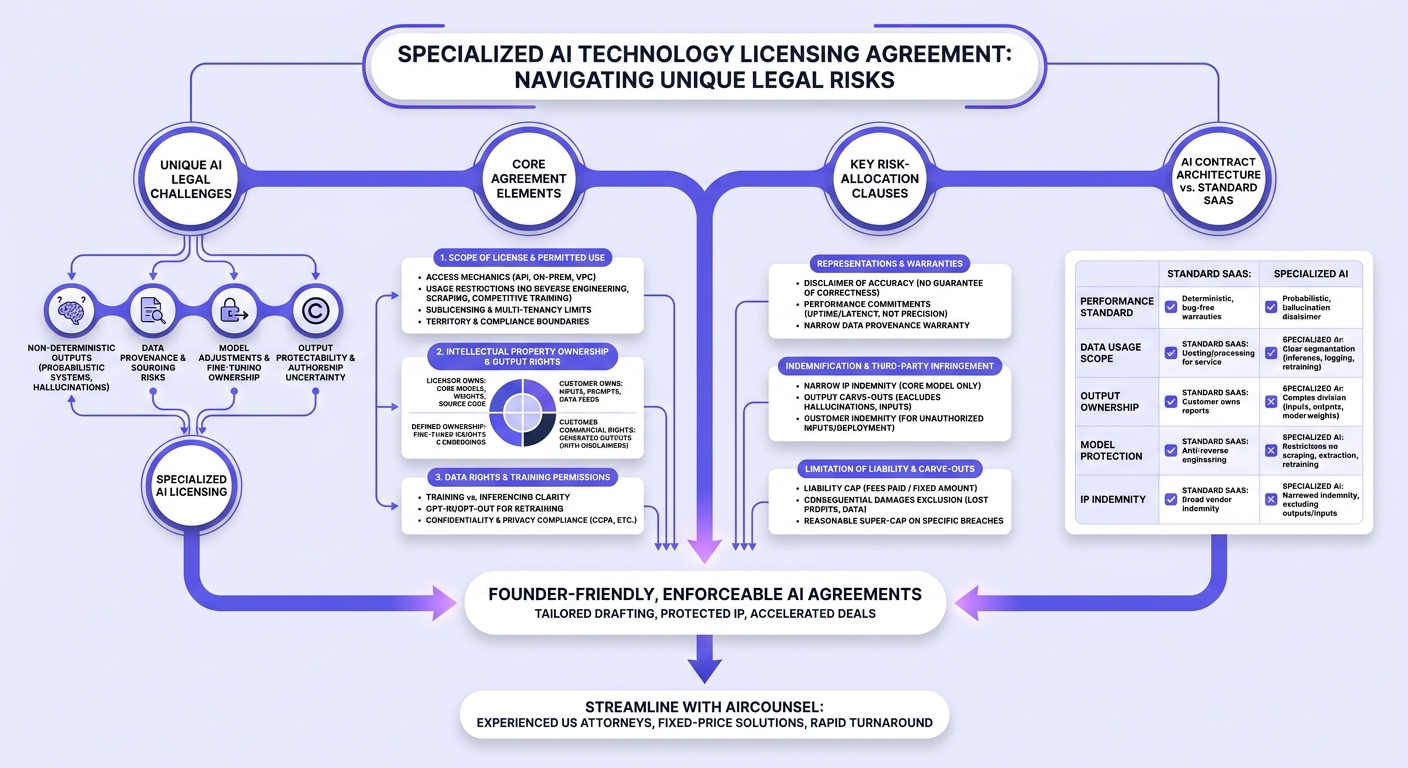
The Unique Legal Challenges of AI Technology Licensing
Traditional commercial software contracts assume deterministic performance: code executes a predetermined command, producing a predictable result. Artificial intelligence models, in contrast, are non-deterministic, probabilistic systems that consume vast datasets, generate novel outputs, and continually adapt through fine-tuning.
This fundamental technical distinction creates legal friction under US contract and intellectual property law. Regulators and standards bodies, including the National Institute of Standards and Technology, emphasize that AI systems introduce novel risks surrounding governance, data provenance, and reliability. When licensing an AI product—whether delivering an API endpoint, an on-premises model deployment, or a customized enterprise tool—a standard software agreement leaves critical questions unanswered:
- Provenance and Sourcing: Who warrants that the training data does not infringe third-party copyrights or violate privacy rights?
- Model Adjustments: Who owns customer-specific fine-tuning weights and algorithmic embeddings?
- Output Protectability: How are outputs handled given current guidance from the U.S. Copyright Office regarding human authorship requirements?
- System Hallucinations: Who bears the legal and financial liability when a model produces factual inaccuracies, offensive content, or defamatory statements?
Without tailored drafting, early-stage AI founders risk inadvertently giving enterprise clients ownership over core model improvements or assuming unbounded liability for unpredictable generative behavior.
Core Elements of an AI Technology Licensing Agreement
A robust AI technology license requires precise drafting across three main technical layers: access rights, intellectual property boundaries, and data pipelines.
Scope of License and Permitted Use
The grant clause defines exactly how a licensee can interact with your AI system. In AI transactions, a vague grant of "use" creates significant vulnerability.
- Access Mechanics: Clarify whether the license permits API access, direct software deployment within the licensee's virtual private cloud (VPC), or on-premises model weights transfer.
- Usage Restrictions: Expressly prohibit reverse engineering, extraction of model parameters, model scraping, and using outputs to train, benchmark, or develop competing machine learning models.
- Sublicensing and Multi-Tenancy: State whether the licensee can expose the functionality to downstream third parties or internal affiliates only.
- Territory and Compliance: Define jurisdictional boundaries and restrict deployment in jurisdictions subject to US export controls or specialized regulatory restrictions.
When structuring these terms, using a deal-specific custom licensing agreement ensures that your usage limits reflect your technical infrastructure and monetization tiers.
Intellectual Property Ownership and Output Rights
AI licensing deals require a four-part ownership breakdown to prevent co-ownership disputes and maintain a clean cap table:
- Background IP: The licensor retains exclusive ownership of all core models, source code, base weights, system prompts, architecture designs, and pre-existing training pipelines.
- Customer Inputs: The licensee retains full ownership of their proprietary prompts, uploaded documents, database feeds, and confidential business data.
- Fine-Tuned Weights and Embeddings: Contracts must explicitly determine whether customer-specific fine-tuning becomes the property of the customer or remains licensor IP licensed back to the user.
- Generated Outputs: Most enterprise buyers demand full ownership or an exclusive license to downstream outputs. Drafting must grant this commercial benefit while clarifying that similar or identical outputs independently generated for other users do not constitute infringement.
Startups frequently pair licensing terms with an assignment agreement to guarantee that any external contractors or developers contributing to model improvements assign all title back to the company.
Data Rights and Training Permissions
Data fuels artificial intelligence, making data clauses the most heavily negotiated provisions in modern enterprise transactions. Licensing agreements must address data ingestion, retention, and model learning in explicit terms:
- Training vs. Inferencing: State clearly whether customer prompts and output logs can be utilized to retrain, refine, or evaluate the startup's global foundational models.
- Opt-In and Opt-Out Mechanics: For enterprise tiers, offer dedicated zero-retention or zero-training environments, supported by distinct pricing structures.
- Confidentiality and Privacy: Ensure data processing clauses comply with state-level data privacy statutes (such as the California Consumer Privacy Act) and prevent customer trade secrets from leaking across multi-tenant vector databases.

Key Risk-Allocation Clauses for AI Startups
Enterprise procurement teams often attempt to push traditional technology warranty and indemnification terms onto early-stage AI vendors. Startups must implement protective contract guardrails to avoid existential liability.
Representations and Warranties
Standard software agreements routinely warrant that the software will perform without error and will not infringe third-party rights. In AI licensing, warranties must be tailored:
- Disclaimer of Accuracy: Because machine learning models generate probabilistic responses, agreements must disclaim express or implied warranties regarding output accuracy, completeness, or fitness for a specific automated decision-making purpose.
- Performance Commitments: Tie service commitments to API uptime and latency metrics rather than the factual precision of the generated results.
- Training Data Provenance: Provide narrow warranties confirming that lawful mechanisms and licensed sources were utilized during model training, avoiding broad guarantees against all theoretical infringement claims.
Indemnification and Third-Party Infringement
Indemnity clauses require one party to defend and pay for the other's legal claims. Founders should carefully structure these commitments:
- Startup Defense Scope: Limit IP indemnification strictly to claims alleging that the core model architecture or base software infringes a registered US patent or copyright.
- Output Carve-Outs: Explicitly exclude indemnity obligations if an infringement claim arises from customer prompts, third-party data inputs, model modifications, or outputs generated in violation of usage restrictions.
- Customer Indemnity: Require the enterprise customer to indemnify the startup for third-party claims arising from unauthorized data inputs, regulatory non-compliance, or unlawful downstream deployment of generated content.
For enterprise agreements requiring comprehensive terms, founders often review our guide on enterprise master services agreements to navigate custom negotiation points.
Limitation of Liability and Carve-Outs
The limitation of liability clause protects your balance sheet from catastrophic damages awards:
- Liability Cap: Cap overall damages to fees paid by the licensee over the preceding 12 months (or a fixed dollar threshold for early pilots).
- Consequential Damages Exclusion: Disclaim all liability for lost profits, loss of data, business interruption, and indirect or punitive damages.
- Carve-Out Boundaries: Resist customer attempts to make IP indemnities and confidentiality breaches subject to uncapped liability, establishing a reasonable "super-cap" (e.g., 2x to 3x contract value) if concessions are required.
AI Contract Architecture: Standard SaaS vs. Specialized AI Licensing
| Contract Dimension | Standard SaaS Agreement | Specialized AI Licensing Agreement |
|---|---|---|
| Performance Standard | Deterministic code execution; bug-free uptime warranties. | Probabilistic outputs; explicit disclaimer of hallucination-free output. |
| Data Usage Scope | Hosting and processing customer data to deliver the service. | Clear segmentation between inference processing, logging, and model retraining. |
| Output Ownership | Static reports or user-created files owned by customer. | Complex division between customer inputs, generated outputs, and underlying model weights. |
| Model Protection | Standard anti-reverse engineering language. | Restrictions against model scraping, parameter extraction, and competitive retraining. |
| IP Indemnity | Broad vendor indemnity for software code. | Narrowed vendor indemnity excluding customer inputs, prompt instructions, and unreviewed outputs. |
Common AI Contract Pitfalls and How to Avoid Them
Early-stage AI startups frequently make predictable contracting errors that impair fundraising or lead to customer disputes:
- Using Standard SaaS Terms for AI APIs: Deploying standard SaaS terms of service without dedicated AI clauses leaves prompt inputs and output ownership in legal ambiguity.
- Granting Broad Exclusive Rights: Granting an enterprise customer "exclusive rights to all deliverables" can inadvertently assign the rights to your underlying neural network architecture or fine-tuned base models.
- Accepting Uncapped Output Indemnity: Agreeing to indemnify customers for copyright claims arising from generative outputs exposes the startup to massive copyright exposure if outputs mirror training content.
- Failing to Define Secondary Model Use: Omitting language regarding whether aggregated, anonymized usage telemetry can be leveraged for internal analytics, fine-tuning, and performance optimization.
- Ignoring Human-in-the-Loop Disclaimers: Neglecting to require enterprise users to implement human review before acting on high-risk AI recommendations (e.g., medical, legal, or financial automation).
Streamline Your AI Licensing Deals with AirCounsel
Closing enterprise licensing deals should not require weeks of protracted negotiations or unpredictable legal bills. AirCounsel provides transparent, fixed-price legal solutions designed specifically for US technology startups, founders, and growing software ventures.
Whether you need a bespoke custom technology licensing agreement, an end-to-end contract review service, or custom contract drafting services for complex multi-party arrangements, our experienced US-licensed attorneys deliver enforceable, founder-friendly agreements in as few as 3 business days.
Frequently Asked Questions
Why do AI startups need specialized technology licensing agreements instead of a generic template?
Generic software contracts assume deterministic performance and standard data processing. AI transactions involve probabilistic generation, machine learning model weights, data ingestion pipelines, and unique copyright nuances. A specialized agreement establishes clear boundaries for model retraining, output liability, and reverse-engineering protections that standard templates ignore.
Who should own the model, data, code, and outputs in an AI licensing deal?
Best practice is a four-tiered structure: the startup retains complete ownership of core models, weights, source code, and improvements; the customer retains ownership of their proprietary prompts and data; customer-specific fine-tuning is either owned by the vendor and licensed back or held exclusively under clear commercial restrictions; and the customer owns or receives broad commercial rights to their specific generated outputs.
What contract terms matter most when an AI startup licenses third-party data, software, or models?
When licensing inputs (such as foundation models via API or third-party datasets), startups must evaluate commercial use rights, restrictions against derivative commercial models, indemnity coverage for data provenance, data retention rules, and termination provisions that could disrupt live customer deployments.
How can a startup limit risk around confidentiality, indemnity, and customer use rights in AI agreements?
Startups can mitigate risk by expressly disclaiming output accuracy warranties, capping aggregate liability to fees paid, carving out generative outputs and customer inputs from IP indemnities, requiring customer indemnification for unlawful input data, and prohibiting prompt injection attacks or competitive model training.
Recommended
- Custom Licensing Agreement Drafting - Secure tailored US licensing terms for models, software, and intellectual property.
- Custom SaaS Terms of Service - Protect your web applications, APIs, and cloud infrastructure with attorney-drafted terms.
- Professional Contract Review - Get fast redlines, risk flags, and negotiation support for enterprise licensing contracts.
Need Legal Assistance?
Our expert legal team is ready to help you navigate complex legal matters with confidence.