3 Critical Liability Traps in Commercial B2B Agreements That Require Custom Contracts by an Attorney

Standard commercial transactions form the backbone of modern commerce, but using generic internet templates often introduces severe financial and legal risk. For growing companies, securing custom contracts by an attorney ensures that every obligation, payment schedule, and liability threshold aligns with real-world operational exposure.
According to recent small business research, 69% of small and mid-sized businesses report serious concerns regarding financial and legal liability during commercial negotiations. When generic templates fail to address deal-specific workflows, founders frequently find themselves exposed to uncapped damages, aggressive indemnification demands, and disputes over deliverables.
Working with experienced legal counsel transforms contracts from passive administrative paperwork into proactive risk management tools. Understanding how custom legal architecture prevents commercial disputes allows you to close deals faster and protect your enterprise balance sheet.
Table of Contents
- Why Commercial B2B Agreements Fail on Generic Templates
- 3 Critical Liability Traps in B2B Contracts
- Key Provisions That Require Professional Attorney Customization
- Template vs. Custom Attorney-Drafted Contract Decision Matrix
- How Custom Contract Drafting Works Step-by-Step
- Protect Your Deals With Tailored Legal Architecture
- Frequently Asked Questions
- Recommended
Quick Summary
| Takeaway | Explanation |
|---|---|
| Indemnity Exposure | Generic forms often force you to pay third-party claims without fault caps or mutual protections. |
| Liability Caps | Enforceable limitation-of-liability clauses must reflect actual deal value and exclude only essential statutory liabilities. |
| Operational Alignment | Custom agreements clarify deliverables, milestone sign-offs, and payment mechanics to prevent scope creep. |
| Dispute Jurisdiction | Setting clear governing law and venue avoids expensive multi-state litigation in foreign jurisdictions. |
| Cost Efficiency | Fixed-fee attorney drafting eliminates downstream litigation expenses and accelerates enterprise deal cycles. |
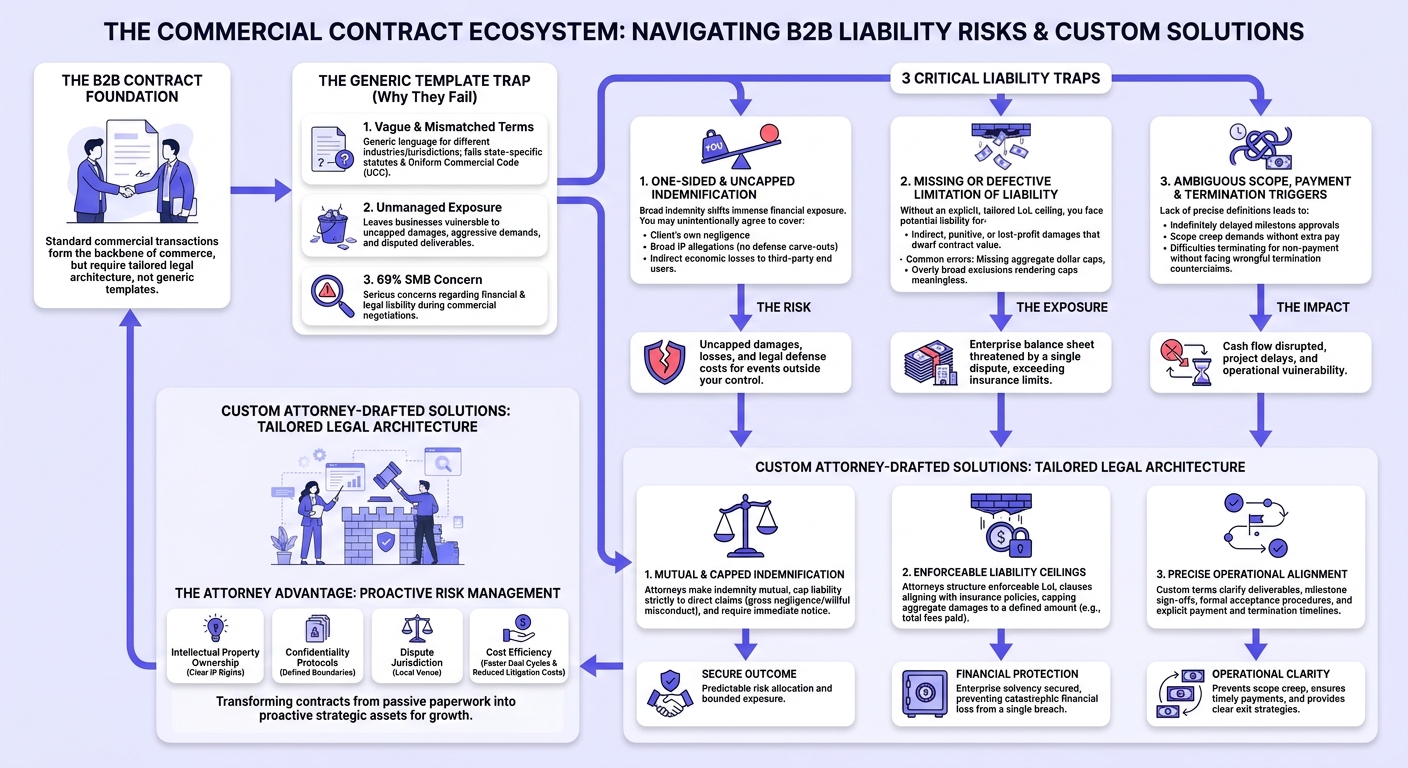
Why Commercial B2B Agreements Fail on Generic Templates
Free templates and boilerplate contracts online are designed to appear universally applicable, but commercial law does not operate on a one-size-fits-all model. Every transaction carries distinct variables: service delivery workflows, software licensing mechanics, intellectual property creation, and regulatory requirements.
When businesses rely on generic templates, they inadvertently adopt language written for entirely different industries or jurisdictions. A template drafted under general principles may violate state-specific commercial statutes or fail to account for statutory warranties under the Uniform Commercial Code.
Furthermore, templates typically feature vague definitions of non-performance and ambiguous termination rights. These gaps leave business owners vulnerable when a counterparty delays payment, disputes project deliverables, or attempts to cancel a multi-year arrangement without cause.
3 Critical Liability Traps in B2B Contracts
Commercial disputes rarely stem from basic pricing disagreements; they arise from secondary operational and liability clauses that were left unchecked. The following three structural traps represent the most common points of catastrophic risk in commercial contracting.

1. One-Sided and Uncapped Indemnification
An indemnity clause is a contractual promise where one party agrees to compensate the other for legal damages, losses, or legal defense costs arising from specific events. According to the Cornell Law School Legal Information Institute, broad indemnity obligations shift immense financial exposure from one contracting party to another.
In generic templates and vendor-drafted contracts, indemnification clauses are frequently one-sided and open-ended. You may unintentionally agree to indemnify a client for:
- Claims arising from the client's own operational negligence.
- Broad allegations of intellectual property infringement without standard defense carve-outs.
- Indirect economic losses suffered by third-party end users.
A custom-drafted agreement reins in this risk by making indemnity mutual, capping liability strictly to direct claims caused by gross negligence or willful misconduct, and requiring immediate notice of claims.
2. Missing or Defective Limitation of Liability Clauses
The limitation of liability (LoL) clause serves as a contractual ceiling on your financial exposure if a breach occurs. Without an explicit, well-tailored LoL provision, your company could be held liable for indirect, punitive, or lost-profit damages that dwarf the total contract value.
Boilerplate LoL clauses frequently suffer from two fatal drafting errors:
- Missing Aggregate Caps: Failing to limit total damages to a defined dollar amount (such as the total fees paid in the previous 12 months).
- Overly Broad Exclusions: Carving out standard operational errors from the liability cap, effectively rendering the protection meaningless during litigation.
Attorneys structure enforceable liability ceilings that align with your commercial insurance policies, ensuring that a single contract dispute does not threaten your company's solvency.
3. Ambiguous Scope, Payment, and Termination Triggers
Cash flow is the lifeblood of small and mid-sized enterprises. Many commercial templates lack precise definitions for project milestones, formal acceptance procedures, and explicit payment timelines.
Without custom terms, clients can indefinitely delay milestone approvals while demanding additional work outside the original scope. If you need to terminate an agreement due to non-payment, an ambiguous contract may leave you exposed to counterclaims for wrongful termination. For larger corporate clients, you can read our guide on hiring an attorney to review master services agreements in the USA to navigate complex enterprise procurement processes.
Key Provisions That Require Professional Attorney Customization
Beyond core liability mechanisms, several standard sections require custom legal drafting to prevent disputes:
- Intellectual Property Ownership: Clarifying whether custom work product belongs to the client or remains proprietary background IP licensed for specific use.
- Confidentiality & Trade Secrets: Defining confidential data boundaries, exclusions, and mandatory return or destruction protocols.
- Warranties and Disclaimers: Disclaiming implied merchantability or fitness warranties to prevent unexpected claims of breach.
- Governing Law & Forum Selection: Establishing your home state courts as the sole venue for resolving legal disputes.
- Attorneys' Fees Clauses: Ensuring the prevailing party recovers legal expenses in the event of formal litigation.
Template vs. Custom Attorney-Drafted Contract Decision Matrix
Understanding when to transition from basic operational forms to attorney-drafted contracts is critical for balanced risk management.
| Contract Element | Generic Downloaded Template | Custom Attorney-Drafted Contract |
|---|---|---|
| Liability Ceiling | Often missing or legally unenforceable under state law | Precisely capped to fees paid or specific insurance limits |
| Indemnification | Broad, one-sided, and exposes company assets | Strictly mutual, bounded by clear carve-outs and fault standards |
| Intellectual Property | Vague assignment language risking loss of core assets | Explicit distinction between background IP and work product |
| Dispute Resolution | Often points to unfavorable out-of-state jurisdictions | Tailored to your local venue, mandatory mediation, or arbitration |
| Deal Customization | Rigid terms that do not reflect unique delivery workflows | Built around your specific payment gates, SLAs, and milestones |
How Custom Contract Drafting Works Step-by-Step
Obtaining professionally drafted contracts through modern legal platforms is straightforward, transparent, and fast.
- Step 1: Scoping and Questionnaire: You provide the core commercial details, pricing model, deliverables, and counterparty requirements through a structured intake process.
- Step 2: Attorney Drafting: A licensed US attorney drafts a bespoke agreement tailored to your jurisdiction, operational workflows, and risk parameters within 3 business days.
- Step 3: Document Review and Refinements: You review the drafted terms and submit feedback or revision requests, which are incorporated directly into the final agreement.
- Step 4: Deployment and Negotiation: You deploy an enforceable, professional contract that can be reused across standard client relationships or adapted for future deals.
Protect Your Deals With Tailored Legal Architecture
Do not let generic templates put your business at risk of uncapped liability or drawn-out client disputes. Securing a clear, professionally structured legal agreement allows you to negotiate with enterprise counterparties from a position of confidence and strength.
AirCounsel provides fast, fixed-fee legal solutions designed for entrepreneurs and growing enterprises. Whether you need a comprehensive Custom Contract Drafter package, a deal-ready Custom Services Agreement, or an expert Review of your Contract or Legal Document, our licensed US attorneys deliver legally sound documents in 3 business days.
Frequently Asked Questions
When do I need a custom contract instead of a template for a B2B deal?
You need a custom contract whenever a transaction involves significant revenue, proprietary intellectual property, ongoing recurring obligations, or customized deliverables. If a dispute on the contract could materially impact your cash flow or balance sheet, relying on a generic template introduces unmanaged legal risk.
What liability clauses matter most in commercial agreements?
The most critical liability clauses are the limitation of liability provision (which caps aggregate monetary exposure), the indemnification clause (which governs compensation for third-party legal claims), and the warranty disclaimer (which limits implied statutory obligations).
Can limitation of liability and indemnity clauses be negotiated in the US?
Yes. Commercial B2B contracts operate under broad freedom of contract principles in the US. Both parties can negotiate liability caps, mutual indemnities, consequential damage waivers, and specific financial exclusions based on deal size and risk allocation.
What happens if a commercial contract leaves out governing law, venue, or termination terms?
If governing law and venue are omitted, a dispute can trigger expensive preliminary litigation simply to determine which state court has jurisdiction. Missing termination clauses can also make it difficult to cancel an agreement for non-performance without risking a breach of contract lawsuit.
Recommended
Need Legal Assistance?
Our expert legal team is ready to help you navigate complex legal matters with confidence.