Why US Tech Startups Need Custom Contract Drafting for Enterprise SaaS Deals

When scaling a B2B software company, closing six-figure enterprise deals is the fastest route to meaningful revenue growth. However, moving upmarket from self-serve signups to Fortune 500 accounts introduces complex legal hurdles that standard online terms cannot handle.
Industry procurement benchmarks show that up to 75% of enterprise software deals experience legal delays of 60 to 90 days, primarily caused by mismatched terms and poorly structured agreements. Relying on boilerplate templates at this stage signals operational immaturity and exposes your business to uncapped risks.
Investing in tailored custom contract drafting enables high-growth startups to establish clear boundaries, protect intellectual property, and satisfy rigorous vendor risk assessments without stalling sales momentum.
Table of Contents
- The Enterprise Procurement Reality
- Why Standard Templates Fail in Enterprise SaaS
- Key Clauses Requiring Custom Contract Drafting
- The Anatomy of an Enterprise SaaS Contract Stack
- How Custom Contract Drafting Accelerates Sales Velocity
- Common Contract Mistakes That Delay Deals
- Streamline Your Enterprise Contracting with AirCounsel
- Frequently Asked Questions
- Recommended
Quick Summary
| Takeaway | Explanation |
|---|---|
| Procurement Alignment | Enterprise buyers mandate rigorous compliance, audit, and security terms before approving vendor contracts. |
| Risk Containment | Tailored drafting prevents catastrophic exposure from uncapped liabilities, broad indemnities, and IP transfers. |
| Sales Speed | Modular, clear contracts reduce redlines and shorten sales cycles from months to days. |
| Fixed Costs | Transparent legal drafting gives startups enterprise-grade protection without open-ended hourly legal bills. |
The Enterprise Procurement Reality
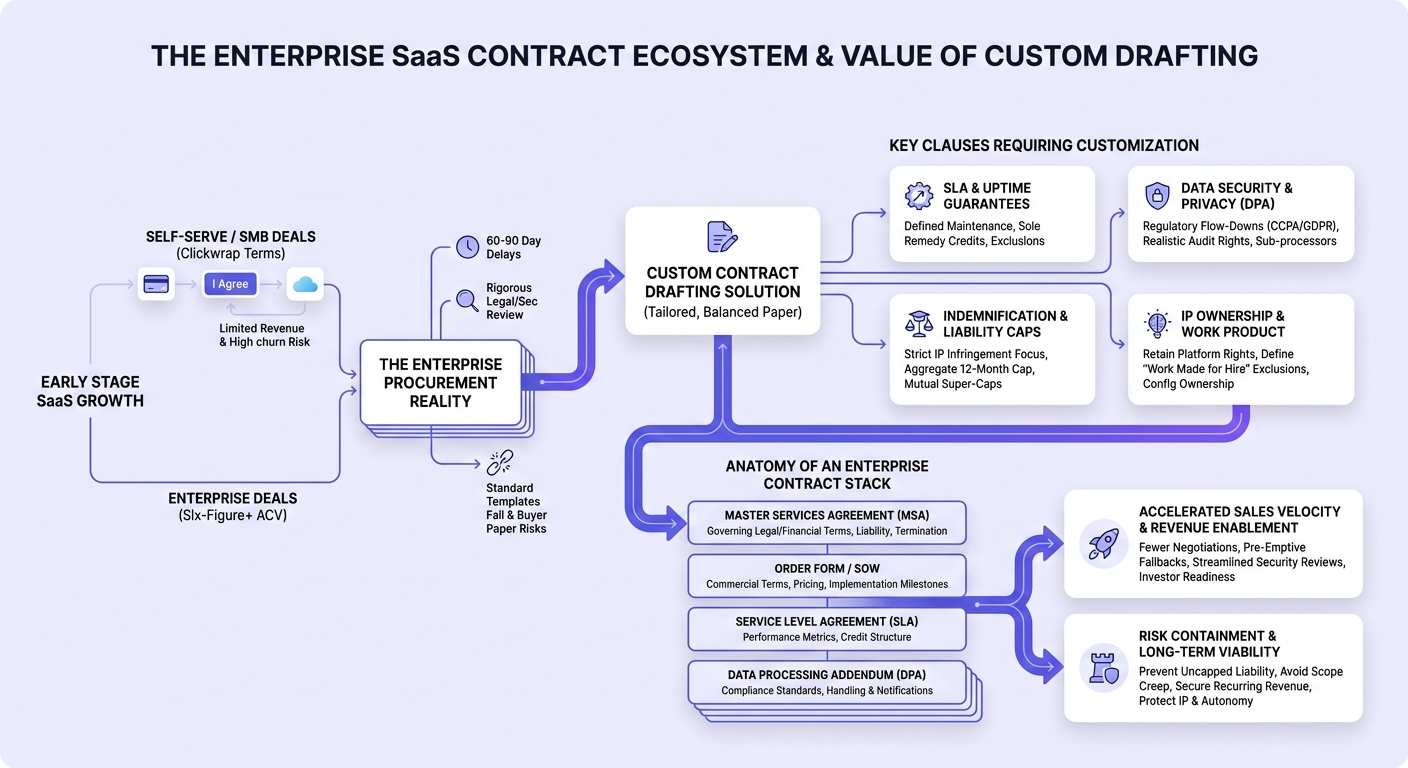
Enterprise software procurement operates very differently from self-serve SaaS. When a customer pays $50 per month on a corporate credit card, they click "I Agree" to standard online terms. When an enterprise signs an annual contract worth $100,000 or more, their legal, security, finance, and procurement departments review every word.
According to the SBA contracting guidance, structured and standardized commercial contracts are foundational for small enterprises seeking to do business with large institutions. Large corporate buyers will not accept one-sided clickwrap terms. If your legal documents do not reflect standard commercial SaaS mechanics, enterprise counsel will replace your document with their own heavily buyer-favorable paper.
When a customer forces you onto their standard vendor paper, negotiations become longer, more expensive, and inherently defensive. Professional custom contract drafting provides your sales team with balanced, professional paper that sets the agenda and keeps negotiations anchored to your terms.
Why Standard Templates Fail in Enterprise SaaS
Free internet templates and generic boilerplate agreements fail enterprise scrutiny for several predictable reasons:
- Unrealistic Operational Commitments: Downloaded templates often include standard uptime clauses or service credit calculations that your technical architecture cannot support.
- Inadequate Privacy Language: Modern software agreements must address multi-state data handling regulations, cloud infrastructure sub-processors, and strict FTC data security guidance.
- Ambiguous Fee Structures: Generic contracts fail to properly distinguish between recurring subscription fees, variable usage tiers, overage calculations, and one-time implementation fees.
- Vague Governing Law: Boilerplate documents often omit key dispute mechanisms, state-specific venue provisions, or tailored fee-shifting language.

Key Clauses Requiring Custom Contract Drafting
Every enterprise software deal hinges on four critical areas where template contracts routinely break down during legal review.
Service Level Agreements and Uptime Guarantees
A Service Level Agreement (SLA) defines expected system availability, maintenance windows, and the financial remedies available if downtime occurs.
Templates frequently promise 99.99% availability without defining scheduled maintenance exclusions, emergency maintenance protocols, or force majeure events. A custom-drafted SLA ensures that service credits represent the customer's sole and exclusive monetary remedy for downtime, preventing direct damage claims or breach-of-contract lawsuits due to temporary infrastructure outages.
Data Security, Privacy, and Regulatory Flow-Downs
Enterprise customers handle sensitive corporate and consumer data. As a result, software vendors must provide comprehensive Data Processing Addenda (DPA) and clear security commitments.
Custom contract drafting aligns your data terms with your actual cloud hosting stack (such as AWS, Google Cloud, or Azure). It establishes realistic incident notification windows, defines security standards, and restricts customer audit rights to SOC 2 report delivery rather than unrestricted on-site physical audits.
Indemnification and Mutual Liability Caps
Indemnification dictates who pays legal costs and damages if a third party sues. Enterprise buyers routinely request broad indemnification covering system failures, breaches of contract, or regulatory fines.
Proper SaaS drafting strictly limits vendor indemnification to third-party claims alleging direct intellectual property infringement by your software. It also creates a strict aggregate liability cap—typically pegged to 12 months of fees paid under the agreement—with separate, clearly defined super-caps for specific data breach incidents if negotiated.
Intellectual Property Ownership and Work Product
Startups frequently provide onboarding, API integration, or custom configuration during enterprise implementations.
Without careful drafting, customers may argue that custom implementation work constitutes "work made for hire," inadvertently transferring ownership of your underlying code, scripts, or APIs to the client. A customized SAAS Application Terms of Service or enterprise master agreement clarifies that all underlying technology, derivative works, and configuration logic remain your exclusive property.
The Anatomy of an Enterprise SaaS Contract Stack
A mature enterprise contract structure uses modular components to allow flexibility during sales conversations without altering core legal protections.
| Contract Component | Purpose | Key Focus Areas |
|---|---|---|
| Master Services Agreement (MSA) | Establishes the governing legal and financial terms between the parties. | Liability caps, IP rights, confidentiality, warranties, termination for breach. |
| Order Form / Statement of Work (SOW) | Details commercial terms, pricing tiers, seats, and custom delivery milestones. | Payment terms, billing schedules, implementation deliverables, renewal terms. |
| Service Level Agreement (SLA) | Sets operational performance metrics and credit structures for downtime. | Uptime target, excluded downtime categories, credit percentages, sole remedy clauses. |
| Data Processing Addendum (DPA) | Governs compliance with state privacy statutes and data handling standards. | Sub-processor lists, breach notifications, data return/deletion, audit mechanisms. |
How Custom Contract Drafting Accelerates Sales Velocity
Startups often view legal drafting as a bureaucratic expense, but high-quality legal paper is an active revenue enablement tool.
- Fewer Negotiation Rounds: When your initial draft offers fair, commercially standard terms, enterprise attorneys have fewer objections to raise.
- Pre-Emptive Fallback Terms: Working with specialized counsel helps you develop pre-approved fallback positions for common customer redlines, allowing your sales team to respond immediately.
- Streamlined Security Reviews: Incorporating standard compliance frameworks directly into your contract stack satisfies vendor management questionnaires before they reach internal review queues.
- Investor and Acquisition Readiness: Clean, standardized customer agreements dramatically accelerate legal due diligence during venture capital financing rounds or corporate acquisitions.
If your team is currently negotiating non-standard customer terms, pairing custom drafting with professional Negotiation Support ensures you protect company valuation while closing deals quickly.
Common Contract Mistakes That Delay Deals
When founders attempt to manage enterprise sales contracts without specialized legal counsel, they often make several high-risk concessions:
- Agreeing to Uncapped Liability: Conceding to unlimited liability for general breaches of contract puts your company's entire balance sheet at risk.
- Accepting Ambiguous Scope of Work: Failing to clearly define what is included in standard onboarding versus paid professional services results in scope creep and uncompensated engineering hours.
- Allowing Termination for Convenience: Permitting large enterprise buyers to terminate multi-year contracts without cause eliminates predictable recurring revenue and complicates financial forecasting.
- Ignoring Sub-Processor Obligations: Promising not to change infrastructure vendors without prior customer approval restricts your technical operations and engineering autonomy.
Engaging an attorney for a comprehensive Review of your Contract or Legal Document before presenting it to prospective enterprise clients prevents these costly mistakes.
Streamline Your Enterprise Contracting with AirCounsel
Closing enterprise software deals requires contract infrastructure that protects your intellectual property while giving buyers confidence to move forward. AirCounsel delivers transparent, fixed-price legal solutions tailored specifically to high-growth US tech companies and service providers.
Our experienced corporate attorneys draft negotiation-ready enterprise contract stacks in 3 business days, complete with revisions and strategic guidance. Explore our dedicated Custom Contract Drafter and Custom Services Agreement packages to get custom, attorney-backed protection designed for scale.
This article provides general information and is not legal advice.
Frequently Asked Questions
Why are enterprise SaaS agreements harder to use than standard startup templates?
Enterprise agreements involve cross-functional scrutiny from legal, procurement, and information security teams. Unlike standard online terms, enterprise contracts must account for regulatory compliance, strict liability caps, data privacy obligations, audit rights, and service level credits.
What terms usually need to be customized for enterprise customers in the US?
The most heavily negotiated terms include limitation of liability caps, third-party IP indemnification, data breach notification timeframes, intellectual property ownership over custom integrations, and specific SLA uptime exclusions.
When should a startup have a lawyer draft instead of using a template?
A startup should engage an attorney when transitioning from self-serve credit card billing to annual invoice-based enterprise deals, typically when annual contract values exceed $15,000 to $25,000, or when selling to heavily regulated industries like healthcare, finance, or government.
How can custom contract drafting help a startup close enterprise deals faster?
Custom-drafted contracts use balanced, commercially standard language that enterprise procurement teams recognize and trust. This reduces redlines, minimizes protracted email exchanges between legal teams, and keeps deals moving smoothly toward signature.
Recommended
- Custom Contract Drafter - Get custom, attorney-drafted commercial contracts with fixed pricing and fast turnaround.
- SAAS Application Terms of Service - Secure your software application with tailored terms covering IP, billing, and liability.
- Negotiation Support - Flexible, on-demand legal counsel to help you navigate enterprise contract redlines and deal strategy.
Need Legal Assistance?
Our expert legal team is ready to help you navigate complex legal matters with confidence.