The USA Tech Company Checklist for Engaging Contract Drafting Services on Software Development Agreements in 2026

Building custom software is one of the most significant capital investments a growing company can make. Whether you are hiring an external development agency to build a minimum viable product (MVP), engaging freelance engineers for specialized features, or modernizing enterprise infrastructure, selecting professional contract drafting services ensures your intellectual property, delivery timelines, and budget remain fully protected under US law.
According to data published by the U.S. Small Business Administration, small businesses make up 99.9% of US businesses, yet many early-stage operators still rely on informal statements of work or generic templates that leave critical legal ambiguities exposed. A misstep in how code ownership or acceptance criteria are defined can stall future venture capital rounds, complicate mergers, or lead to costly breach of contract litigation.
Engaging dedicated legal counsel to draft bespoke development contracts allows founders to define precise deliverable milestones, establish enforceable acceptance testing, and lock down proprietary assets before writing a single line of production code.
Table of Contents
- Quick Summary
- Why Modern Tech Startups Need Dedicated Contract Drafting Services
- Key Clauses Every Software Development Agreement Must Contain
- Agile vs. Waterfall: Adapting Contract Terms to Your Workflow
- Critical US Legal and Regulatory Traps to Avoid
- How to Evaluate Contract Drafting Services for Your Project
- Secure Your Software IP and Streamline Development Deals
- Frequently Asked Questions
- Recommended
Quick Summary
| Takeaway | Explanation |
|---|---|
| IP Ownership | Under US copyright law, contractor code does not automatically belong to your company without explicit written assignment language. |
| Acceptance Criteria | Concrete testing periods prevent endless disputes over whether deliverables meet your commercial standards. |
| Change Management | Formal change order processes prevent scope creep and surprise budget overruns during technical builds. |
| Methodology Alignment | Contracts must reflect whether your development team uses fixed-scope Waterfall delivery or iterative Agile sprints. |
| Fixed-Fee Drafting | Modern legal drafting platforms offer transparent, fixed pricing with guaranteed delivery turnaround. |
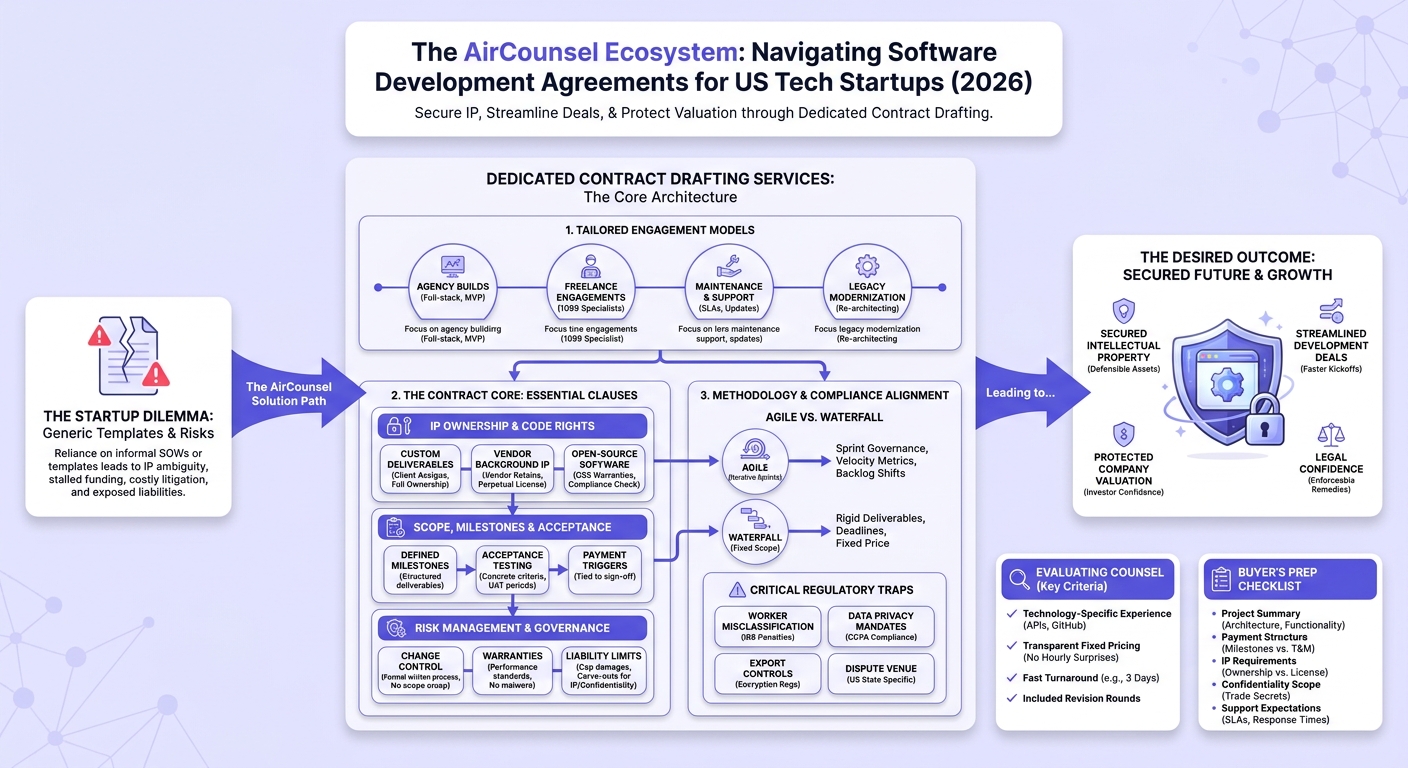
Why Modern Tech Startups Need Dedicated Contract Drafting Services
Generic online templates frequently fail to account for the nuanced realities of modern software engineering. Boilerplate agreements rarely distinguish between bespoke code created specifically for your product and open-source libraries or pre-existing vendor frameworks. When legal language is ambiguous, the default rules under state and federal law often favor the creator of the work over the hiring party.
Utilizing dedicated contract drafting services provides tailored legal protection aligned with your company's commercial goals. An experienced US attorney crafts terms that define technical deliverables, outline warranties regarding malicious code or performance standards, and insulate your business from third-party copyright or patent infringement claims.
Core Use Cases: From Agencies to Freelance Developers
Software development agreements cover several distinct business engagements:
- Custom Application Builds: Full-stack design and deployment of mobile, web, or desktop applications managed by specialized software development agencies.
- Independent Contractor Engagements: Adding specialized engineers or designers to augment your internal engineering team on a 1099 basis. To explore contractor compliance further, we cover independent contractor agreements in detail here.
- Ongoing Maintenance and Support: Service level agreements (SLAs) establishing response times, bug fixes, system updates, and server uptime guarantees post-launch.
- Legacy System Modernization: Re-architecting existing proprietary software, requiring strict data security protocols and non-disclosure safeguards.
Key Clauses Every Software Development Agreement Must Contain
A well-structured development contract balances technical precision with enforceable legal remedies. Leaving key operational mechanisms undefined invites disputes when timelines slip or technical hurdles arise.
+-------------------------------------------------------------------+
|               CORE SOFTWARE CONTRACT ARCHITECTURE                 |
+---------------------------------+---------------------------------+
| Technical Governance            | Legal & Commercial Risk         |
| - Statement of Work (SOW)       | - IP Assignment & Retained IP   |
| - Milestone & Acceptance Testing| - Indemnity & Liability Caps    |
| - Change Control Procedures     | - Confidentiality & Data Rights |
+---------------------------------+---------------------------------+
Intellectual Property Ownership and Pre-Existing Code
Under the U.S. Copyright Office rules, independent contractors retain copyright in their creations unless there is an express, signed agreement assigning those rights as a work made for hire or transferring ownership outright.
A comprehensive contract drafting strategy handles three distinct IP categories:
- Custom Deliverables: Full assignment of all source code, object code, documentation, and graphical assets to the hiring client upon payment.
- Vendor Background IP: Identification of pre-existing frameworks, utilities, and developer tools that the vendor retains, paired with an irrevocable, perpetual, worldwide license granted to you to use and modify the software.
- Open-Source Software (OSS): Explicit warranties that any third-party open-source components comply with commercial use guidelines and do not introduce "copyleft" obligations (like GPL) that force you to disclose your proprietary source code.
For standalone IP transfers between co-founders or departing contractors, securing a Custom IP Assignment Agreement ensures complete legal ownership.
Scope Definition, Milestones, and Acceptance Testing
Vague statements of work are the leading cause of software project failure. Your agreement should establish concrete milestones linked directly to structured acceptance testing.
| Phase Milestone | Deliverable Requirement | Acceptance Mechanism | Payment Trigger |
|---|---|---|---|
| Phase 1: Architecture | System design document & wireframes | 5-day review period by client | 20% release upon sign-off |
| Phase 2: Core Build | Staging environment with core API integration | Automated test suite execution & bug review | 30% release upon test passage |
| Phase 3: Beta Release | Feature-complete build on test server | 10-day user acceptance testing (UAT) | 30% release upon bug clearance |
| Phase 4: Production | Source code repository transfer & deployment | Final verification against specifications | 20% final settlement |
Change Control, Warranties, and Liability Limits
Technical requirements inevitably shift as software evolves. A robust change control mechanism requires all modifications to scope, delivery dates, and fees to be documented in a written Change Order signed by both parties before work begins.
Warranties should guarantee that the delivered software functions substantially according to specifications for a defined warranty period (commonly 30 to 90 days post-launch) and contains no viruses, backdoors, or malicious scripts. Additionally, mutual limitations of liability should cap total financial damages at the total fees paid under the contract, while carving out gross negligence, confidentiality breaches, and IP indemnification from the cap.
Agile vs. Waterfall: Adapting Contract Terms to Your Workflow
Contracts must match your team's actual development methodology. Applying a rigid Waterfall agreement to an iterative Agile sprint model creates contractual friction.
- Waterfall Contracts: Ideal for fixed-scope, fixed-price projects where complete architectural blueprints exist before engineering starts. Deliverables, deadlines, and acceptance criteria are rigid.
- Agile Contracts: Geared toward iterative development. The contract establishes sprint governance, velocity metrics, team allocation, and hourly or sprint-based billing rates, while allowing product backlogs to shift continuously through structured product owner sign-offs.
If your platform is intended for cloud distribution upon completion, preparing your public terms alongside your backend agreements via SAAS Application Terms of Service guarantees uniform operational protection across your entire ecosystem.

Critical US Legal and Regulatory Traps to Avoid
When engaging developers across different states or countries, tech businesses face distinct regulatory compliance hurdles:
- Worker Misclassification: Treating developers as 1099 contractors while controlling their daily schedules, equipment, and work methods can trigger severe penalties from the IRS and state labor boards.
- Data Privacy Mandates: If developers handle live consumer data during development or testing, ensure terms comply with regulations such as the California Consumer Privacy Act (CCPA). Pair your master agreement with a Custom Application, Software or Website Privacy & Cookies Policy to protect end-user data flows.
- Export Control Regulations: Developing encryption-heavy or defense-adjacent software requires compliance with federal export control laws when working with non-US developers.
- Dispute Resolution Venue: Contracts should stipulate a specific US state governing law and venue (as well as mandatory mediation or arbitration rules) to avoid traveling to a distant jurisdiction to enforce your rights.
If your business operations also extend to leasing specialized hardware servers or physical engineering labs, read our guide on commercial equipment lease agreements for related operational best practices.
How to Evaluate Contract Drafting Services for Your Project
Selecting the right legal partner directly impacts the enforceability and speed of your software agreements. Look for contract drafting providers that deliver:
- Technology-Specific Experience: Lawyers who understand GitHub workflows, API integrations, open-source licensing, and continuous deployment environments.
- Transparent Fixed Pricing: Upfront flat rates that eliminate the unpredictable costs of traditional hourly billing.
- Fast Turnaround Times: Delivery within 3 business days so project kickoffs are not delayed by protracted legal redlining.
- Included Revision Rounds: Opportunities to refine clauses based on feedback from your engineering leadership or counterparties.
Buyer's Preparation Checklist Before Engaging Counsel
Before initiating contract drafting services, compile the following project details to accelerate the legal drafting process:
- Project Summary: High-level overview of the software, platform architecture, and end-user functionality.
- Payment Structure: Fixed-price milestones, time-and-materials, or recurring retainer arrangements.
- IP Requirements: Clarification on whether you require sole ownership of all code or will accept vendor-retained utilities under license.
- Confidentiality Scope: Identification of proprietary data, customer lists, or trade secrets shared during the project.
- Support Expectations: Required post-launch bug fixing, SLA commitments, and response times.
Secure Your Software IP and Streamline Development Deals
Custom software agreements form the legal backbone of your tech company's valuation. Leaving code ownership, acceptance milestones, and liability terms open to interpretation exposes your business to catastrophic disputes, stalled development, and compromised intellectual property.
AirCounsel provides fast, fixed-fee legal drafting tailored specifically to your technology stack and commercial model. Get your Website Design/Software Development and/or Maintenance Agreement or work with a licensed US attorney through our Custom Contract Drafter to protect your assets and launch your next project with complete legal confidence.
Frequently Asked Questions
What should a software development agreement include for a US startup?
A software development agreement for a US startup should clearly outline the project scope and deliverables, structured milestone schedules, acceptance testing criteria, comprehensive intellectual property assignment, open-source software warranties, confidentiality safeguards, limitations of liability, and clear termination protocols.
When is a custom draft better than a template for software development contracts?
A custom draft is essential whenever you are building proprietary code, paying significant development fees, integrating complex APIs, using iterative Agile methodologies, or hiring external agencies. Templates routinely fail to address pre-existing vendor IP, open-source licensing risks, and detailed warranty protections.
Who should own the code and IP in a software development deal?
In most commercial transactions, the hiring client should own all custom source code, documentation, and graphical assets upon payment. The developer or agency may retain their pre-existing background tools and frameworks, provided they grant the client an irrevocable, perpetual, royalty-free license to use, maintain, and modify the software.
How do fixed-fee contract drafting services typically work for founders and small businesses?
Fixed-fee contract drafting services allow businesses to submit their project requirements through a structured intake questionnaire. A licensed attorney then drafts a tailored, legally enforceable agreement within a guaranteed timeframe (such as 3 business days) for a transparent flat fee, including a round of revisions to address specific project needs.
Recommended
- Website Design/Software Development and/or Maintenance Agreement – Custom-drafted contracts defining scope, deliverables, IP ownership, SLAs, and development warranties.
- Custom IP Assignment Agreement – Enforceable intellectual property transfer agreements crafted by licensed US attorneys.
- Custom Contract Drafter – Tailored commercial agreements, statements of work, and terms prepared for modern businesses.
Need Legal Assistance?
Our expert legal team is ready to help you navigate complex legal matters with confidence.